

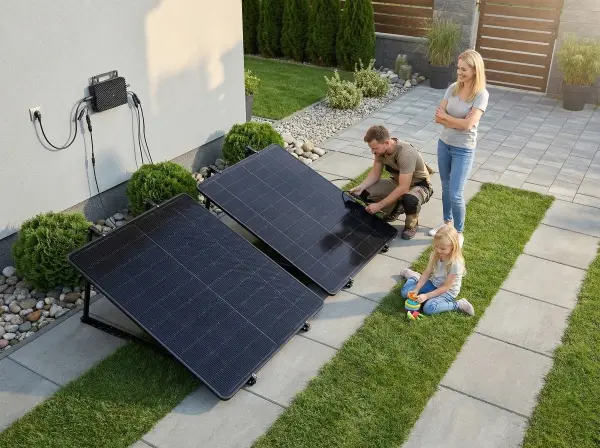
UL 1741 explained: UL 1741 is the mandatory US safety certification for all grid-tied solar micro-inverters. It is published by Underwriters Laboratories and covers anti-islanding protection, voltage/frequency trip limits, DC injection limits, and waveform quality. Without a UL 1741 listing, a solar inverter has not been independently verified to safely interact with the US grid. UL 1741-SA is the enhanced version required in California and Hawaii. Verify any inverter listing number at iq.ul.com.
What Is UL 1741?
UL 1741 explained simply: it is the US safety standard published by Underwriters Laboratories covering inverters, converters, controllers, and interconnection system equipment for use with distributed energy resources. For residential plug-in solar, it certifies that a micro-inverter safely connects to, operates on, and disconnects from the utility grid.
In practical terms: if you buy a solar micro-inverter for use in the USA without a UL 1741 listing, you are installing equipment that has not been independently verified to safely interact with the grid. Most utilities will not accept the system, homeowner's insurance may not cover related incidents, and the system may create safety hazards for utility workers during outages.
Not just a label: UL 1741 is not self-certified. Underwriters Laboratories independently tests the actual inverter hardware against the standard's requirements. A valid UL 1741 listing has a specific file number searchable at iq.ul.com.
6 Things UL 1741 Verifies in Every Inverter
| Test | What It Verifies | Why It Matters |
|---|---|---|
| Test 1: Anti-Islanding | Inverter detects loss of grid power within IEEE 1547 specified time and ceases energizing the local circuit. | Protects utility workers repairing outages from unexpected voltage. Most critical safety test. |
| Test 2: Voltage Trip Limits | Inverter disconnects automatically if grid voltage exceeds or falls below specified thresholds. | Prevents damage from voltage fluctuations and protects connected equipment. |
| Test 3: Frequency Trip Limits | Inverter disconnects if grid frequency deviates from 60Hz by more than specified amounts. | Frequency deviation indicates grid instability. Inverter must stop contributing power until stable frequency resumes. |
| Test 4: DC Injection Limits | Inverter must not inject more than 0.5% of rated AC output as DC current into the grid. | DC injection can saturate distribution transformers and cause serious grid damage. |
| Test 5: Waveform Quality | Total Harmonic Distortion of the AC output must stay below 5% over the full output power range. | High THD creates dirty power, overheating in motors, interference in electronics, and metering errors. |
| Test 6: Reconnection After Outage | After grid restoration, inverter must wait a specified delay before reconnecting and resuming generation. | Ensures grid stability during reconnection and prevents voltage spikes. |
UL 1741 vs UL 1741-SA: What's the Difference?
| Feature | UL 1741 Base | UL 1741-SA Enhanced |
|---|---|---|
| Anti-islanding protection | Yes | Yes |
| Voltage and frequency trip limits | Yes | Yes |
| DC injection limits | Yes | Yes |
| Waveform quality | Yes | Yes |
| Reconnection delay after outage | Yes | Yes |
| Volt-var optimization | Not required | Yes |
| Volt-watt control | Not required | Yes |
| Frequency-watt control | Not required | Yes |
| Utility remote disconnect/reconnect | Not required | Yes |
| Where Required | All US states for grid-tied systems | California and Hawaii |
For most residential plug-in solar buyers: Standard UL 1741 listing is sufficient in all states except California and Hawaii. If purchasing for California or Hawaii, confirm whether your specific utility requires UL 1741-SA before buying.
How UL 1741 Fits into the US Standards Framework
- IEEE 1547: The foundational technical standard for interconnection of distributed energy resources. UL 1741 is the testing methodology that verifies compliance with IEEE 1547.
- FERC Order 2222: Federal Energy Regulatory Commission order opening capacity markets to aggregated distributed resources.
- NEC Article 690/705: National Electrical Code sections covering solar PV and interconnected power sources.
- State PUC Rules: State Public Utilities Commissions set interconnection rules that require UL 1741 or UL 1741-SA.
- Utility Interconnection Agreements: Utility tariffs and interconnection agreements commonly reference UL 1741 as a prerequisite for system acceptance.
How to Verify UL 1741 Certification
- Request the UL file number from the inverter manufacturer or product documentation.
- Search the UL Product iQ database at iq.ul.com.
- Verify the specific model is covered. Confirm the exact model you are purchasing is listed, not just the product family.
- Check listing status. Only active listings are currently certified.
Frequently Asked Questions
UL 1741 is the safety standard from Underwriters Laboratories covering inverters and interconnection equipment for distributed energy resources. For residential plug-in solar, it certifies that a micro-inverter safely connects to, operates on, and disconnects from the utility grid. All grid-tied solar micro-inverters in the USA must be UL 1741 listed.
UL 1741 covers core safety requirements: anti-islanding, voltage/frequency trip limits, DC injection limits, waveform quality, and reconnection delays. UL 1741-SA adds advanced grid support functions including volt-var optimization, volt-watt control, and utility remote disconnect.
Search the UL Product iQ database at iq.ul.com using the UL file number. Confirm the specific inverter model is listed and verify that the listing status is active.
In Germany and much of Europe, the equivalent inverter certification is VDE-AR-N 4105. It covers anti-islanding, grid synchronization, power quality, and voltage trip limits for the 230V/50Hz European grid. CE marking covers general product safety requirements.
Related guides: Safety Guide · Schuko vs NEMA Guide · USA State Guide · Is It Legal?