




Why Plug-In Solar Works for Apartments
Traditional rooftop solar was built for homeowners with large budgets and roof access. Plug-in solar was designed for everyone else — especially apartment dwellers who rent, move often, and have a balcony instead of a roof. Key reasons it works:- No roof access needed: Panels mount on balcony railings, window sills, or exterior walls. A sunny balcony can be enough to start generating electricity, but output depends on orientation, shading, mounting angle, and local weather.
- Low-commitment mounting: Rail clamps, hook-over brackets, and weighted floor stands can avoid permanent changes to walls, railings, and floors when correctly installed and approved.
- Move-friendly hardware: When you move, panels and removable hardware can usually travel with you. Unclamp the panels, disconnect the inverter, coil the cables, and reinstall at the next apartment.
- Immediate bill reduction: Where local rules allow this type of connection, a plug-in system may offset part of the home load during sunny hours. The actual result depends on the system design and real-time consumption.
- Renter rules are improving in some markets: Several European markets are making small balcony solar easier to discuss, but the exact requirements still depend on the country, lease, building manager, utility, and product configuration. Always verify your lease, building rules, HOA rules where applicable, and local utility requirements before installation.
- Lower upfront cost than rooftop solar: A small balcony system can have a much lower upfront cost than a full rooftop installation. Payback depends on sun exposure, electricity price, self-consumption, system cost, and local rules.
Mounting Options: Where Can You Put Solar Panels in an Apartment?
Four main mounting locations work for most apartments. The balcony railing is most common, but not the only option.| Location | Drill Required? | Best For | Key Limitations |
|---|---|---|---|
| Balcony railing (rail clamps) | No | Most popular; adjustable tilt 20–70°; works with round, flat, square profiles | Railing must be structurally sound; limited to balcony width |
| Balcony floor stand (ballasted) | No | Larger balconies; position independently of railing for best sun angle | Takes up floor space; may need sandbag ballast in windy areas |
| Window sill / window bracket | No | Apartments without a balcony; small panels (100–200W) | Limited panel size; check local regulations about external protrusions |
| Exterior wall mount | Yes | Owner-occupiers or tenants with explicit landlord consent; most secure option | Drilling required; landlord consent needed; leaves marks if removed |
Balcony Orientation: How Much Does Direction Matter?
Balcony orientation has the single biggest impact on annual output. Even non-ideal orientations still generate useful electricity — but the financial case is strongest for south and east-west installations.| Direction | Output vs South | Notes |
|---|---|---|
| South | Usually strongest | Often the best direction for annual output, provided the balcony is not heavily shaded. |
| Southeast / Southwest | Strong | Useful for morning or afternoon generation and often practical for apartment self-consumption. |
| East / West | Moderate to strong | Can work well when electricity use happens in the morning or afternoon. East-west layouts may improve self-consumption in some homes. |
| North | Usually weak | Needs careful review because output may be much lower, especially with shade or poor mounting angle. |
Do You Need Landlord Permission?
In many regions, no-drill plug-in solar is treated as removable equipment — but rules vary significantly by country, municipality, and lease. Always verify locally before buying or installing.| Region | General Situation | Recommended Action |
|---|---|---|
| Germany | Balcony solar rules have become more supportive, but installation details, registration, meter rules, landlord notification, and product requirements still need to be checked against current guidance. | Notify landlord or building manager in writing before installation. Confirm acceptable mounting method and current registration steps. |
| Austria & Netherlands | Small plug-in or balcony solar systems may be used in some cases, but requirements vary by local rules, utility process, and housing arrangement. | Written notification to the landlord or building manager is strongly recommended. Attach mounting plan and product documentation. |
| France, Belgium, Switzerland | No country-level renter protection law for plug-in solar. Lease terms govern. | Review lease for balcony modification clauses. No-drill solutions reduce dispute risk. Written notification recommended. |
| USA | Rules vary widely by state, utility, building type, and HOA. Some products may be treated as portable equipment, while grid-connected equipment can trigger electrical and utility requirements. | Review lease, HOA rules, local electrical requirements, and utility requirements before purchase. |
| Universal Best Practice | Even where the law protects you, landlord conflicts cause delays and deposit disputes. | Notify landlord in writing before installation. Include a photo of the mounting solution and the system certification. Keep a copy. |
Setting Up Solar on Your Balcony: 6 Steps
A no-drill balcony solar setup can be relatively quick, but installation time depends on the mounting kit, balcony structure, product instructions, and local electrical requirements.- Measure your balcony space. Measure the railing length and floor area available. Check the panel dimensions, weight, mounting points, cable route, and railing condition against the product manual and local building requirements.
- Assess sun exposure and orientation. Stand on your balcony at midday and identify the compass direction using a phone compass app. Note any shading from the building above, neighboring structures, or trees. A system with suitable MPPT design and shade-aware layout may reduce mismatch losses, but it cannot remove all shading loss.
- Choose the right configuration. Select a certified panel and plug-in solar configuration suited to your space and local regulations. Buyers should confirm the certifications and electrical requirements that apply to the target market and specific product model. Choose panel type based on your mounting surface: flexible panels for curved or weight-sensitive railings; lightweight rigid panels for standard installations.
- Mount the panels. Attach rail clamps to the panel frame and position on the railing. Set the mounting angle according to the product manual, local wind exposure, balcony geometry, and safety requirements. Ensure all clamps are securely tightened and the panel cannot shift. Pull and push the mounted panel firmly to confirm it is stable before release.
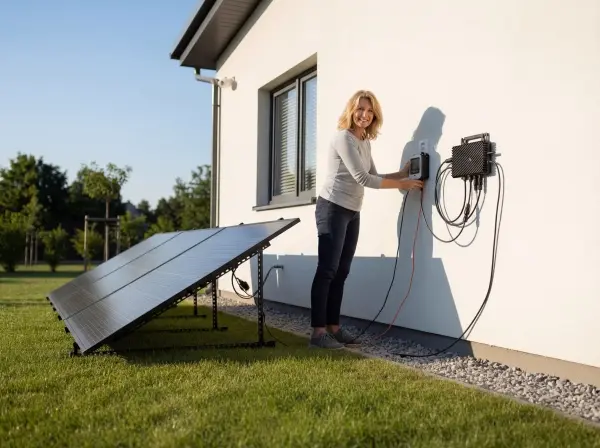
- Connect the micro-inverter. Plug the panel DC output cables (MC4 connectors) into the micro-inverter DC input. Follow the product manual for connector polarity, cable routing, strain relief, weather protection, and safe connection practice.
- Plug in and verify generation. Where local rules allow plug-in connection, connect the system according to the product manual and required socket or circuit standard. On a sunny day, the inverter should begin generating after normal startup checks. Check generation via the inverter’s companion app or LED status indicator. In Germany, users should check current registration requirements such as MaStR before installation.
Savings Planning: How Much Can Apartment Solar Save?
Apartment solar savings are usually lower than full rooftop systems, but the upfront cost and installation scope are also different. The financial case depends on sun exposure, system size, electricity rate, self-consumption, installation limits, and whether local rules allow grid interaction.| Factor | Why It Matters | Buyer Check |
|---|---|---|
| Sun exposure | Balcony direction and shading define usable output | Check direct-sun hours and nearby obstructions |
| System size | Small systems offset only part of apartment demand | Match panel wattage with available space and use case |
| Self-consumption | Solar is most useful when energy is used during generation or stored | Shift small loads to sunny hours where practical |
| Electricity rate | Higher retail rates improve the economic case | Use current local tariff data, not generic savings claims |
| Local rules | Connection method and export treatment affect value | Confirm utility, building, lease, and product requirements |
Maximize Self-Consumption
Self-consumption means using solar electricity yourself instead of relying only on export or credits. Practical habits include running small appliances during sunny hours, charging devices at midday, reviewing east-west balcony layouts, and using monitoring tools where supported by the system.Sungold Panel Options for Apartment Plug-In Solar
Sungold manufactures lightweight and flexible solar panels that can be reviewed for apartment, balcony, portable, and plug-in solar kit projects. Final product selection should be based on target market rules, inverter compatibility, certification scope, mounting method, and electrical requirements.| Panel Direction | Best-Fit Apartment Use | Buyer Check |
|---|---|---|
| Flexible solar panels | Visible balcony, curved or weight-sensitive mounting | Review panel size, cable route, mounting, heat, and appearance |
| Lightweight solar panels | Balcony kits, renter-friendly packages, portable structures | Confirm weight, frame, wind exposure, bracket fit, and shipping format |
| Custom panel support | OEM/ODM apartment solar kits and distributor packages | Confirm size, voltage, connector, cable exit, packaging, and target market documents |
Frequently Asked Questions
Yes. Plug-in solar systems are specifically designed for apartments without roof access. Panels may be mounted on balcony railings, window areas, stands, or other suitable locations where the structure, building rules, and product instructions allow.
Rules vary by country, city, lease, building rules, utility, and local electrical code. In markets where balcony solar has become easier to install, renters should still follow the notification or approval process required by their lease and building manager. Always review your specific lease and inform your landlord in writing before installation.
East and west-facing balconies can still be useful, especially when household consumption happens in the morning or evening. North-facing balconies usually need more careful review because output may be much lower.
Yes — portability is one of the key advantages of plug-in solar for renters. No-drill mounting systems are designed to avoid permanent marks on the balcony railing or wall. After safe disconnection, detach the panels, remove the clamps, and pack everything for reinstallation at the next apartment. Always verify that the new apartment allows the same mounting configuration and local electrical requirements are met.
Savings vary with electricity rates, sun exposure, system size, self-consumption, shading, and local connection rules. Buyers should calculate using current local tariff data and realistic balcony output estimates.
Partial shading reduces output, but it does not always make the project unworkable. Buyers should check direct-sun hours, railing shadows, nearby buildings, and whether the selected system has suitable string or MPPT design.