



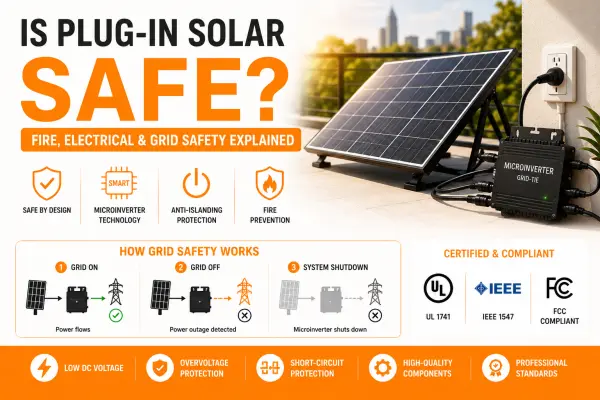
Many homeowners and renters wonder, is plug-in solar safe for apartments and balconies? Yes — certified plug-in solar is safe when paired with a UL 1741 listed (USA) or VDE-AR-N 4105 certified (EU) micro-inverter. This technology introduces no meaningful fire risk, no electrical hazard to buildings, and no danger to utility grid workers. To ensure maximum balcony solar safety, always select a certified micro-inverter and avoid damaged outlets or uncertified DIY extension cables.
Real Safety Risks: Low, Medium, and Preventable
When analyzing whether is plug-in solar safe, it helps to break down the technical risks into specific electrical components. Below is an overview of common concerns and their real-world mitigation strategies.
| Risk | Level | Why | Mitigation |
|---|---|---|---|
| Circuit overload | Low | An 800W system draws ~3.5A (EU 230V) or ~6.7A (US 120V). Standard circuits are rated 16A (EU) or 15–20A (US) — system uses only 22–45% of capacity at maximum output. | No action needed for standard outlets in good condition. Use a dedicated circuit for permanent installations. |
| Fire from panels | Low | IEC 61730-certified panels include bypass diodes (prevent hotspots), fire-rated encapsulant, and safety-rated junction boxes. No moving parts, no combustion risk. | Use IEC 61730 certified panels. Ensure panels are not partially shaded or damaged before installation. |
| Faulty outlet connection | Moderate (Preventable) | Connecting to a damaged, worn, or loose outlet presents a risk — not unique to solar. Any high-draw appliance has the same risk. Overheating from a loose neutral connection can cause arcing. | Inspect the outlet with a socket tester before connection. Use a GFCI/RCD protected outlet for outdoor installations. Never use cracked or discolored outlets. |
| Incorrect cable or extension cord | Moderate (Preventable) | Using a non-rated extension cord, a damaged plug cable, or a DIY-modified connection introduces real fire and shock risk. Extension cord wiring is not rated for continuous solar output. | Use only the supplied inverter output cable. If extra length is needed, use a proper solar-rated or outdoor-rated heavy-gauge extension cable. |
| Uncertified micro-inverter | High | An uncertified inverter may lack anti-islanding protection, produce distorted AC waveforms, or inject DC into the circuit — causing equipment damage, metering errors, or utility worker hazards. | Only purchase systems with UL 1741 listed (USA) or VDE-AR-N 4105 certified (EU) micro-inverters. Verify the listing number at the certification body's database. |
Anti-Islanding: The Most Important Safety Feature
Anti-islanding is the most critical safety mechanism in any grid-tied solar system. It answers the question: what happens if the grid goes down while the solar system is generating?
Without anti-islanding, the inverter could continue feeding electricity into a grid circuit that utility workers believe is de-energized — creating a lethal electrocution hazard. Every certified inverter must detect grid loss within milliseconds and immediately cease output.
- UL 1741 (USA): Anti-islanding must be demonstrated to meet IEEE 1547 requirements
- VDE-AR-N 4105 (Germany/EU): Anti-islanding tested to EN 62116 standard
- Time to disconnect: Typically within 100–200 milliseconds of grid loss detection
- Reconnection: System waits a specified delay (typically 5 minutes in USA) before resuming after grid restoration
This is why plug-in solar provides no backup power during outages — the safety mechanism correctly prevents it. A battery with an off-grid inverter is required for backup capability.
Safety Certifications Explained
| Certification | Covers | Required In | Where to Verify |
|---|---|---|---|
| UL 1741 | Anti-islanding, voltage/frequency trip limits, DC injection, waveform quality, reconnection delay | All 50 US states for grid-tied systems | iq.ul.com (search by file number) |
| UL 1741-SA | Everything in UL 1741 + advanced grid support (volt-var, volt-watt, frequency-watt, remote disconnect) | California (CPUC Rule 21), Hawaii (HECO Rule 14H) | iq.ul.com |
| VDE-AR-N 4105 | Grid synchronization, anti-islanding, power quality, voltage trip limits for the German 230V/50Hz grid | Germany (recommended for all EU) | VDE certification database |
| CE marking | General product safety, EMC, Low Voltage Directive compliance | Required for all products sold in EU | Manufacturer declaration of conformity |
| IEC 61730 | Solar panel electrical and mechanical safety (bypass diodes, junction box rating, fire class) | EU and USA for residential residential panels | TÜV or equivalent test report |
| TÜV Tested | Independent third-party testing for IEC 61215 (performance) and IEC 61730 (safety) | EU markets; export documentation | TÜV Rheinland or TÜV SÜD test reports |
What Makes an Uncertified System Dangerous
Uncertified plug-in solar inverters pose three specific risks that certified systems are engineered to prevent:
- No anti-islanding: The inverter may continue generating during a grid outage, endangering utility workers and creating voltage on circuits the user believes are de-energized.
- Poor waveform quality (high THD): High Total Harmonic Distortion "dirty power" causes overheating in motors, interference in electronics, and metering errors. UL 1741 requires THD below 5%.
- DC injection: Injecting DC into an AC grid circuit can saturate distribution transformers and cause serious grid damage. UL 1741 limits DC injection to less than 0.5% of rated output.
Frequently Asked Questions
Yes — when using a certified micro-inverter. A UL 1741 listed (USA) or VDE-AR-N 4105 certified (EU) system presents no meaningful fire risk, no electrical hazard to the building, and no danger to utility workers. Every verified incident involving plug-in solar and electrical problems traces back to uncertified equipment, incorrect wiring, or damaged outlets — not the technology itself.
Anti-islanding shuts off a solar inverter when the utility grid loses power. Without it, the inverter could energize a circuit that utility workers believe is de-energized — creating an electrocution hazard. Every UL 1741 and VDE-AR-N 4105 certified inverter must detect grid loss within milliseconds and immediately cease output. This is mandatory by law, not optional.
Only if the extension cord is specifically rated for continuous outdoor solar output use. Standard household extension cords are not rated for continuous high current — they can overheat under sustained load. If extra cable length is needed, use a proper outdoor-rated heavy-gauge cable or consult the inverter manufacturer's specifications.
Yes — from a technical safety standpoint, a certified plug-in system on a rental apartment balcony presents no greater risk than any other standard electrical appliance. From a legal standpoint, Germany's 2024 Solarpaket I explicitly permits tenant installation of no-drill systems. In other countries, check your lease and notify your landlord in writing before installation.
Related guides: UL 1741 Explained · How Plug-In Solar Works · Is It Legal? · Germany Guide