
 EN
EN
 Deutsch
 Italiano
 Español
 Français
 日本語
日本語
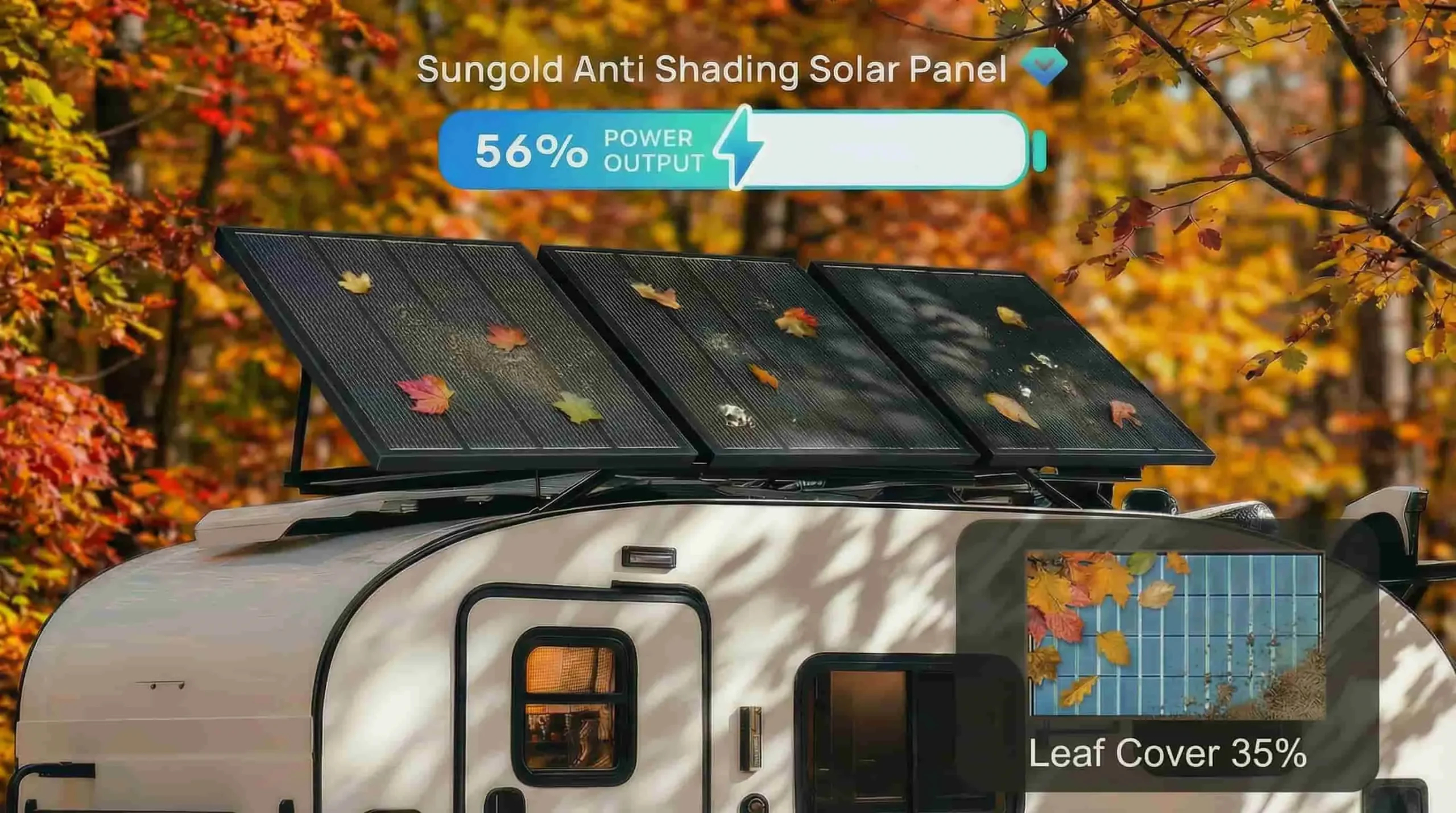
Solar Panel Technical Guide
How Anti-Shading Technology Works in Partial Shade
Partial shade is one of the fastest ways to reduce solar panel output. A narrow shadow from a railing, RV roof vent, boat mast, chimney, tree branch, or nearby wall can create electrical mismatch inside a module and make system output less predictable. This guide explains how standard panels behave under partial shade, how bypass diodes, half-cell architecture, multi-busbar layouts, series/parallel wiring, MPPT controllers, optimizers, and anti-shading solar panels fit together, and how B2B buyers should evaluate shade-tolerant solar modules.
Quick Answer: Solar panels lose performance in partial shade because shaded cells produce less current than unshaded cells, creating mismatch loss and possible reverse-bias stress. Sungold describes its anti-shading solar panel technology as a module-level and cell-level current-routing approach that helps route current around shaded cell areas when resistance rises. It can help reduce mismatch loss, support more stable output, and lower hotspot formation risk, but actual performance depends on the model, shade pattern, wiring, controller, and installation conditions.
1. What Happens to a Standard Solar Panel Under Partial Shade?
A solar module is not one single power-generating surface. It is a connected electrical network of cells. When all cells receive similar sunlight, the module can operate near its expected power curve. When one area is shaded, the shaded cells generate less current while the unshaded cells continue producing. This creates current mismatch.
In many modules, groups of cells are connected in series. In a series path, the same current must pass through each cell group. A shaded cell group can limit the current of the larger circuit path, which is why a small shadow may produce a larger-than-expected output drop.
The Series Connection Problem
Series wiring increases voltage, but it also makes the string more sensitive to the weakest current-producing section. This can happen inside one module and across multiple modules connected in series. If one module or cell group is shaded, the current of the connected path can be constrained unless bypass behavior or module-level electronics reduce the impact.
The Hot Spot Effect
A shaded cell can be forced into reverse-bias operation when current from illuminated cells pushes through it. In that condition, the shaded area may dissipate energy as heat instead of generating power. This is commonly discussed as hotspot risk. Bypass diodes and shade-management designs are used to reduce this risk, but they do not make a module immune to all shade patterns.
2. Bypass Diode Definition: What It Does and Why It Matters
Definition: A bypass diode is a protective diode connected across a group of solar cells. When that cell group becomes shaded or electrically limited, the diode can provide an alternate current path around the affected group. This helps reduce power loss from mismatch and helps prevent shaded cells from being stressed by excessive reverse bias.
Bypass diodes are important, but their protection is zone-based. If one diode protects a large cell group, activating that diode may preserve current flow while removing a larger part of the module from active power generation. More refined architectures aim to localize the shaded zone more effectively.
Multi-Zone Bypass Diodes
Multi-zone bypass diode design divides the module into smaller protected electrical zones. When a local shadow affects one zone, the current path can bypass that affected zone while other zones continue contributing power. This is why zone layout matters as much as the diode itself. For product claims, the exact number of zones and protected cell groups should be confirmed from the model datasheet or engineering record.
| Design Item | What It Does | Shade-Performance Impact |
|---|---|---|
| Bypass diode | Routes current around a shaded or limited cell group. | Reduces reverse-bias stress and limits the effect of one shaded zone. |
| Bypass zone | The cell group protected by one diode. | Smaller zones can reduce how much active area is sacrificed during shading. |
| Junction box layout | Houses diode and connection architecture. | Affects protection design, serviceability, and module reliability strategy. |
3. Half-Cell Architecture and Partial Shade
Half-cell modules divide standard cells into smaller cell sections and redesign internal current paths. This can reduce resistive losses because each half-cell path carries less current. It can also help localize the effect of some shade patterns, especially when combined with suitable bypass-zone design.
Half-cell design does not automatically solve every shading problem. Its value depends on how the module is electrically divided, where the shade falls, and whether the affected area aligns with a protected zone. For technical content, it is safer to describe half-cell architecture as a design that can improve shade tolerance and reduce current-related loss, not as a guarantee of fixed output retention.
4. Multi-Busbar and Current Collection Under Shade
Busbars collect current from the cell surface. A multi-busbar layout uses more current-collection paths than older three-busbar or five-busbar layouts. This can shorten the distance current travels across the cell, reduce resistive loss, and improve current collection when small areas are affected by shade or micro-cracks.
Multi-busbar design should be treated as one part of a shade-tolerant module architecture. It works together with cell layout, bypass protection, encapsulation, soldering quality, and system design.
5. How Sungold Anti-Shading Technology Works
Sungold describes its Anti-Shading Solar Panel Technology as a module-level and cell-level current-routing approach for partial-shading management. The technology is described as integrating smart current routing elements inside the module to help reroute current around shaded cell areas when resistance rises.
The practical goal is to help reduce mismatch loss, lower hotspot formation risk, and support more stable output when part of the module is shaded. This is a product-positioning and mechanism-level statement, not a universal performance guarantee.
Claim boundary: Do not state that Sungold anti-shading technology creates zero shade loss, eliminates all hotspot risk, guarantees output under all shade patterns, or applies to every Sungold model. Product-level claims should be checked against confirmed model mapping, datasheets, and test evidence.
6. Performance Data: What Should Be Verified Before Publishing Numbers?
Performance data is useful, but it must be tied to a defined test. Partial-shade performance depends on shade coverage, shade angle, cell group affected, irradiance, module temperature, baseline module, wiring method, and MPPT operating point. A percentage without those conditions can mislead buyers.
| Data Item | Why It Is Needed | Safe Publishing Rule |
|---|---|---|
| Exact model tested | Shade behavior can vary by model and internal layout. | Do not generalize one model's result to all product families. |
| Shade pattern | A line shadow, corner shadow, full-row shadow, and random tree shadow behave differently. | State the shade position, size, and angle if available. |
| Baseline comparison | Performance improvement only has meaning against a defined baseline. | Identify the conventional module or control sample. |
| Measured output | Voltage, current, power, temperature, and operating point may all change. | Use measured values only within the tested configuration. |
| Evidence source | Datasheet, lab report, internal test, or third-party test affects claim strength. | Separate confirmed evidence from marketing-level mechanism explanations. |
For the current Sungold content draft, the safest approach is to explain the mechanism and selection criteria, then invite buyers to confirm the specific model and testing scope with the Sungold team. If product-level partial-shade test data becomes available, this section can be upgraded with measured output-retention data and test conditions.
7. Series vs Parallel Wiring in Partial Shade
Wiring design changes how shade affects the whole array. Series wiring increases voltage, which is useful for many MPPT systems and longer cable runs. However, a shaded or weak module in a series string can influence current through the string. Parallel wiring keeps voltage closer to one module and increases current, which can help isolate the effect of one shaded module but requires correct cable, fuse, connector, and controller sizing.
| Wiring Choice | Benefit | Partial-Shade Concern | B2B Design Check |
|---|---|---|---|
| Series | Higher voltage, lower current, often suitable for MPPT and longer cable runs. | One shaded module may reduce string current depending on bypass and MPPT behavior. | Check Voc, Vmp, cold-weather voltage, controller max PV input, and shade exposure. |
| Parallel | Better module-level isolation in many shade scenarios. | Higher current can increase cable loss and component sizing requirements. | Check Imp, Isc, fuse rating, wire gauge, connector rating, and controller current limit. |
| Segmented series-parallel | Balances voltage target with shade isolation. | Needs careful layout and connector planning. | Group panels by similar irradiance and shade exposure. |
8. MPPT, Optimizers, and Microinverters: How They Compare With Anti-Shading Panels
Anti-shading solar panels are not the same as MPPT controllers, DC optimizers, or microinverters. These technologies work at different levels of the system.
| Solution | Where It Works | What It Helps With | What It Does Not Replace |
|---|---|---|---|
| Anti-shading panel | Inside the module | Local current routing and partial-shade behavior. | Controller selection, wiring design, or installation review. |
| MPPT controller | Array-to-battery or array-to-inverter power conversion | Tracks the operating point that produces better power under changing conditions. | Cell-level shade management inside the module. |
| DC optimizer | Module-level electronics | Improves module-level mismatch management and monitoring in suitable systems. | Good panel placement and shade-aware layout. |
| Microinverter | Module-level DC-to-AC conversion | Reduces string-level mismatch and supports module-level operation. | Module-level thermal and mechanical design. |
9. Best Use Cases for Anti-Shading Solar Panels
RV and Van Roofs
Vents, roof racks, antennas, air conditioners, and parking direction can create moving shade. Anti-shading panels can help reduce output fluctuation where full-sun placement is hard to guarantee.
Marine Solar
Masts, rails, ropes, booms, and cabin edges can cast narrow shadows. Shade-aware module design should be reviewed together with corrosion resistance, waterproofing, and mounting method.
Balcony Solar
Railings and building edges may create repeated line shadows. Buyers should check local rules, mounting angle, inverter/controller compatibility, and model-level technology scope.
Off-Grid and Remote Sites
Trees, poles, shelters, and terrain can reduce charging reliability. Anti-shading panel selection should be paired with battery sizing, controller input range, and maintenance planning.
10. Installation Tips for Partial Shade Environments
- Map shade at different times of day, especially the main sun window rather than only noon.
- Place panels so recurring shadows affect the smallest possible active area.
- Avoid grouping panels with very different shade exposure in the same series string when possible.
- Confirm MPPT input voltage and current range before choosing series, parallel, or series-parallel wiring.
- Use suitable cable gauge, connectors, fuses, and combiner design for higher-current parallel layouts.
- Keep ventilation and heat dissipation in mind, especially on RV, marine, and low-clearance surfaces.
- For procurement, ask suppliers for model-level shade-management scope, datasheets, and available test conditions.
11. Common Myths About Solar Panels and Shade
| Myth | Reality |
|---|---|
| A small shadow only causes a small output loss. | Not always. A small shadow can affect a key cell group or series path and cause larger mismatch loss. |
| Bypass diodes solve all shading problems. | Bypass diodes reduce stress and preserve current flow, but they may bypass an entire zone and reduce output. |
| Anti-shading panels are shade-proof. | No panel is shade-proof. Anti-shading panels are designed to help manage partial shade, not eliminate all loss. |
| Optimizers and anti-shading panels are the same thing. | They are different. Anti-shading is module design; optimizers are power electronics used at module level. |
| Wattage alone decides field performance. | Wattage is only one input. Shade pattern, wiring, controller range, temperature, mounting, and module design also matter. |
12. FAQ: Solar Panels Partial Shade Performance
How do anti-shading solar panels perform in partial shade?
Anti-shading solar panels are designed to improve partial-shade behavior by helping current move around shaded cell areas instead of allowing one shaded area to reduce the whole module's output. Sungold describes its technology as a module-level and cell-level current-routing approach. Actual performance depends on the product model, shade pattern, wiring, MPPT/controller behavior, and installation conditions.
What is the bypass diode in a solar panel?
A bypass diode is a protective component connected across a cell group. When that group is shaded or electrically limited, the diode can provide an alternate current path around it. This helps reduce mismatch loss and reverse-bias stress, but it does not eliminate every shade-related output loss.
Do half-cell solar panels perform better in partial shade?
Half-cell architecture can improve shade tolerance in many designs because it reduces current in each cell path and can localize some shade effects. However, performance still depends on the module layout, bypass zones, shade location, and system wiring.
Are anti-shading solar panels better than optimizers?
They solve different problems. Anti-shading panels improve shade behavior inside the module. Optimizers are module-level electronics that manage mismatch and monitoring in suitable systems. In some projects, one solution may be enough; in complex shade conditions, buyers should evaluate both module design and system electronics.
Can anti-shading technology prevent hot spots?
Anti-shading technology can help lower hotspot formation risk by improving current routing around shaded areas, but it should not be described as eliminating all hotspot risk. Hotspot behavior depends on shade pattern, module design, operating temperature, bypass protection, and installation conditions.
What should B2B buyers ask before choosing anti-shading panels?
Buyers should ask for the exact model scope, datasheet, electrical parameters, confirmed technology mapping, available shade test conditions, recommended wiring method, mounting requirements, and compatibility with the target controller or inverter.
Review Anti-Shading Options for Your Project
If your project faces recurring partial shade from roof equipment, railings, trees, masts, walls, or nearby structures, review the module design before selecting panels by wattage alone. Sungold Solar can help B2B buyers evaluate application conditions, target voltage, controller range, cable routing, model scope, and shade-management requirements.
View DetailsReference Notes
This article uses Sungold's internal claim boundaries for anti-shading technology and avoids unsupported output-retention percentages. External technical references used for concept grounding include NREL research on partial shade and reverse-bias stress, IEC 61853 PV module performance testing context, and IEA PVPS / TÜV Rheinland materials discussing bypass diodes and field risk in PV systems.