
 EN
EN
 Deutsch
 Italiano
 Español
 Français
 日本語
日本語
Quick Answer
A liftgate solar charger helps maintain the battery that powers a truck or trailer liftgate. It normally does not power the liftgate motor directly. Instead, solar panels charge the battery during parking, daylight operation, and short delivery routes so the battery is less likely to fall below a usable state of charge.
What Is a Liftgate Solar Charger?
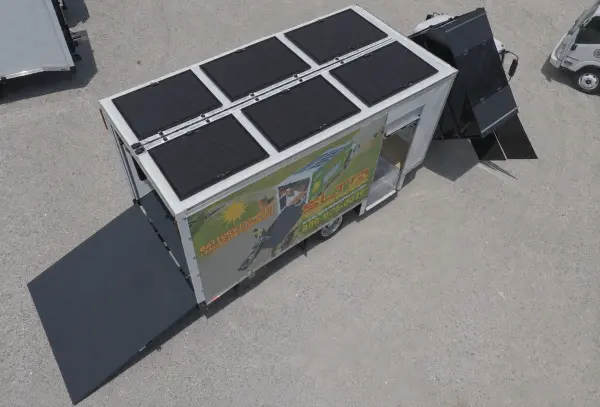
A liftgate solar charger is a solar charging setup designed to support the battery system behind a hydraulic liftgate. The system usually includes one or more roof-mounted solar panels, a solar charge controller, cabling, mounting hardware, and the existing liftgate battery bank.
For delivery fleets, the problem is practical: the liftgate needs short bursts of high current, while the vehicle’s alternator may not have enough drive time to recharge the battery between frequent stops. Solar charging adds a steady daytime charging source that can help keep the battery closer to a healthy operating range.
That is why liftgate solar charging is most relevant for box trucks, delivery trucks, refrigerated delivery vehicles, urban distribution fleets, and trailers that spend long periods parked away from shore power.
Why Liftgate Batteries Fail in Delivery Fleets
Liftgate batteries often fail because the battery is asked to do heavy work without enough time to recover. A liftgate motor can draw high current during loading and unloading, but many delivery routes involve short driving intervals, repeated stops, overnight parking, and accessory loads such as lights, telematics, locks, or cameras.
Common causes include:
- Frequent lift cycles during urban delivery routes
- Short drive time between delivery stops
- Aging AGM or deep-cycle batteries
- Poor cable condition or long cable runs
- Cold weather reducing usable battery capacity
- Long parking periods with parasitic loads
- Battery systems that are not matched to the route profile
Solar does not remove the need for proper battery sizing and maintenance. It adds a continuous charging source that can reduce the frequency and depth of battery discharge when the vehicle is exposed to daylight.
What Solar Charging Can and Cannot Do for a Liftgate
Solar charging is best understood as battery support, not direct liftgate propulsion. The liftgate motor still needs a battery capable of supplying high-current demand. The solar panel replenishes energy over time.
| Fleet Problem | How Solar Helps | What Buyers Still Need to Check |
|---|---|---|
| Battery drains during short delivery routes | Adds daytime charging between stops | Daily lift cycles, route length, battery capacity |
| Liftgate battery loses charge while parked | Charges when the vehicle is stationary in daylight | Parking location, shading, seasonal sunlight |
| Roadside service calls from dead batteries | Helps keep battery state of charge higher | Wiring, controller setup, battery health |
| Auxiliary loads draw power from the same battery | Offsets part of small continuous loads | Load profile, standby current, fuse protection |
| Mixed 12V and 24V fleet systems | Can be designed around system voltage | Vehicle voltage, controller compatibility |
Solar cannot guarantee that a liftgate battery will never fail. It also cannot compensate for a damaged battery, incorrect wiring, an undersized battery bank, or a charging controller that is not matched to the system.
Common Liftgate Solar Charger Power Ranges
The right panel size depends on liftgate use, available roof area, battery capacity, vehicle voltage, route pattern, and sunlight. In many commercial liftgate discussions, buyers commonly evaluate systems around 100W to 400W for liftgate battery support.
| Planning Range | Typical Fit | Notes |
|---|---|---|
| 100W | Light-duty liftgate support, lower daily lift cycles, smaller box trucks | Useful where roof space is limited or the goal is battery maintenance |
| 200W | Medium-duty delivery fleets, repeated stops, higher accessory loads | Often a practical starting point for B2B fleet evaluation |
| 300W-400W | High-use liftgate routes, larger battery banks, more demanding duty cycles | Requires more roof space and careful controller selection |
These ranges should be treated as planning references, not universal specifications. Fleet buyers should confirm actual energy demand before selecting a panel size.
12V vs 24V Liftgate Solar Charging Systems
Voltage matters because the solar panel, charge controller, wiring, and battery bank must work as one system. Many North American liftgate applications use 12V battery systems, while some commercial vehicles and European platforms may require 24V design considerations.
| Item | 12V Liftgate Solar Charging | 24V Liftgate Solar Charging |
|---|---|---|
| Common use | North American delivery trucks and many box trucks | European commercial vehicles and some heavier platforms |
| Panel design | Often uses 12V nominal panel planning | May require higher-voltage panel or series configuration |
| Controller | PWM or MPPT depending on system design | MPPT is commonly preferred for voltage matching |
| Buyer check | Battery type, route profile, controller amperage | Vehicle voltage, controller input range, cable protection |
| Risk if wrong | Poor charging or controller mismatch | Undercharging, overvoltage risk, compatibility issue |
Before ordering a liftgate solar charging system, confirm the actual battery voltage at the liftgate battery bank rather than assuming from the vehicle model.
Flexible vs Rigid Panels for Box Truck and Trailer Roofs
Both flexible and rigid solar panels can be used in commercial vehicle solar projects, but the installation environment is different from a fixed rooftop system. Commercial vehicles face vibration, wind, washing, roof curvature, loading constraints, and maintenance access requirements.
| Panel Type | Strengths | Buyer Considerations |
|---|---|---|
| Flexible or semi-flexible panel | Low profile, lighter weight, easier fit on curved or limited roof areas | Requires careful bonding, cable routing, heat management, and surface preparation |
| Rigid framed panel | Strong structure, familiar mounting approach, good airflow if mounted above roof | Adds height and weight; mounting hardware must handle vibration and wind |
| Custom-size panel | Fits specific roof space, liftgate battery location, or OEM integration need | Requires engineering confirmation, drawings, MOQ, and lead time review |
For fleets and liftgate manufacturers, the best choice is not only about panel wattage. It is also about installation time, serviceability, wiring distance to the battery, roof layout, and whether the panel can be repeated across many vehicles.
What Fleet Buyers Should Check Before Choosing a System
Fleet teams should evaluate a liftgate solar charger as part of the vehicle’s electrical system, not as a standalone accessory.
Use this checklist before requesting a quote:
- Battery voltage: 12V or 24V.
- Battery type: AGM, flooded lead-acid, gel, or lithium.
- Battery capacity: amp-hour rating and battery age.
- Lift cycles: average liftgate operations per day.
- Route pattern: short urban routes, long-haul, overnight parking, or weekend storage.
- Available roof area: panel dimensions, obstructions, and shading.
- Cable route: distance from panel to controller and battery.
- Controller type: PWM or MPPT, voltage and current rating.
- Mounting method: adhesive, bracket, rail, or OEM integrated design.
- Compliance needs: fleet, market, or customer-specific certification requirements.
The key specification question is duty cycle. A fleet using liftgates 10 times per day and a fleet using liftgates 80 times per day should not be specified the same way.
Where Sungold Solar Fits for OEM and Aftermarket Projects
Sungold Solar supports B2B solar panel projects where vehicle roof space, weight, mounting method, and product repeatability matter. For liftgate solar charging projects, the better starting point is not a generic panel catalog, but a project-specific panel configuration.
For commercial vehicle roof applications, buyers can start by reviewing Sungold’s flexible and lightweight panel families, including the PA219 flexible solar panel series and the PA621 lightweight solar panel series. Final selection should still be confirmed against roof size, voltage platform, mounting method, and project-specific certification requirements.
Sungold can support discussions around:
- Flexible and lightweight solar panel options for commercial vehicle roofs
- Custom panel dimensions for box truck, trailer, or upfitter layouts
- OEM and ODM panel development for liftgate manufacturers and fleet suppliers
- 12V and 24V project planning support at the panel level
- Application-specific wording and documentation for B2B evaluation
Final system performance depends on the complete electrical design, including the battery, charge controller, wiring, installation method, and vehicle duty cycle. Any claim about exact charging output, certification coverage, warranty terms, MOQ, delivery time, or fleet ROI should be confirmed before publication or quotation.
FAQ
What is a liftgate solar charger?
A liftgate solar charger is a solar panel and charging setup used to help maintain the battery that powers a truck or trailer liftgate. It adds charging support during daylight operation and parking, reducing the risk that the liftgate battery becomes too depleted for normal use.
Can a solar panel fully power a liftgate?
Usually no. A liftgate motor draws high current and is normally powered by the battery bank. The solar panel charges or maintains that battery over time. The battery still needs enough capacity and condition to operate the liftgate safely.
What size solar panel is needed for a liftgate battery?
Many fleets evaluate liftgate solar charging in the 100W to 400W planning range, but the correct size depends on lift cycles, battery capacity, voltage, route pattern, parking time, sunlight, roof space, and controller design.
Is 12V or 24V better for liftgate solar charging?
Neither is automatically better. The solar charging system should match the vehicle and liftgate battery voltage. Many North American applications use 12V systems, while some commercial vehicles and European platforms may require 24V planning.
Are flexible solar panels suitable for box truck roofs?
Flexible or semi-flexible solar panels can be suitable when low weight, low profile, and roof fit matter. Buyers should still confirm mounting surface, adhesive method, cable routing, roof temperature, vibration, and long-term service conditions.
Who should consider liftgate solar charging?
Delivery fleets, box truck operators, liftgate manufacturers, truck upfitters, aftermarket parts distributors, and fleet maintenance teams should consider it when dead liftgate batteries, short routes, or frequent service calls create operating costs.
What information should I provide for an OEM liftgate solar panel quote?
Provide battery voltage, panel size limits, expected wattage range, roof layout, cable exit position, connector requirements, controller preference, target market, certification needs, estimated order volume, and installation method.
Request a Project-Specific Liftgate Solar Panel Configuration
If your fleet, upfitter program, or liftgate product line needs a solar charging panel, Sungold Solar can review the roof space, voltage platform, target wattage, mounting method, and OEM requirements before recommending a panel configuration.
Send your project requirements to discuss a liftgate solar panel option for 12V or 24V commercial vehicle battery support.
Source Notes
- Internal market research report: Commercial Vehicle & Truck Off-Grid Solar Market Intelligence Report.
- Internal competitor research report: Merlin Solar Competitive Intelligence Report.
- Public reference: WALTCO Solar Charger page by Hiab.
- Public reference: NACFE solar confidence report coverage for trucking solar use cases.
- Public reference: Heavy Duty Trucking article on solar power for liftgates.
- Public reference: PowerFilm Solar liftgate integration and commercial trucking references.