




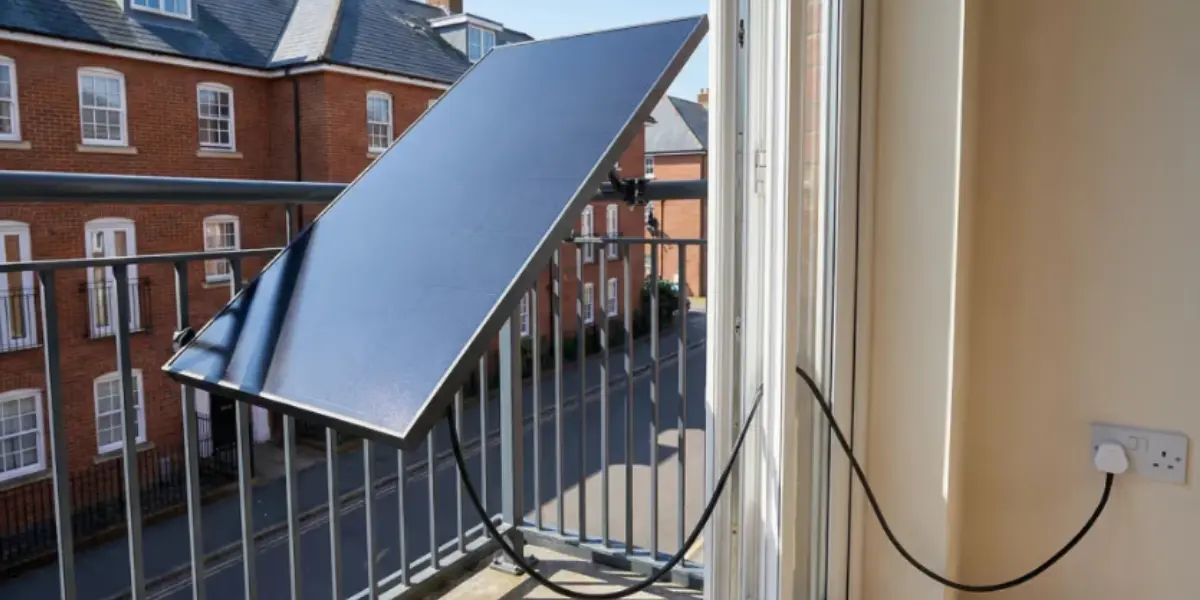
The UK plug-in balcony solar market is moving from early interest toward a more serious retail and product-development stage. For retailers, system brands and OEM buyers, the opportunity is not only selling panels. It is building a UK-ready balcony solar package that fits local safety expectations, building conditions, user instructions and after-sales support.
The UK plug-in balcony solar market is attracting attention for good reasons. Energy bills remain a pressure point, traditional rooftop solar is not available to every household, and major retailers are watching smaller solar products that can serve flats, rented homes and homes without suitable roof access.
But for B2B buyers, this category should not be treated as a simple consumer gadget. The UK has its own electrical safety expectations, plug format, housing stock, leasehold restrictions, balcony structures and weather conditions. A product that works well in mainland Europe still needs to be reviewed for UK homes, UK documentation, UK installation behaviour and UK after-sales risk.
Why Plug-in Balcony Solar Is Getting Attention in the UK
There are three market signals behind the current interest.
First, electricity remains expensive for many households. Ofgem states that the price cap from 1 July to 30 September 2026 is £1,862 per year for a typical household paying by Direct Debit, with an average electricity unit rate of 26.11p/kWh. That keeps small-scale self-consumption relevant for households looking to reduce grid electricity use.
Second, traditional rooftop solar is not available to everyone. Many people live in flats, rented homes, leasehold properties, townhouses, shared buildings or homes where roof access is limited. These users may not be able to install a full rooftop PV system, even if they are interested in solar.
Third, the retail channel is starting to pay attention. The Guardian reported in June 2026 that UK retailers including Currys, B&Q, Amazon, Asda, Screwfix and Wickes were involved in discussions around plug-in balcony solar sales guidance. This does not mean every plug-in product is automatically approved, but it does show that the category is moving closer to mainstream retail consideration.
For Sungold’s target customers, this creates a window: not simply to sell panels, but to help retailers and system brands build UK-ready balcony solar product packages.
Why the UK Is Not Just Another Germany-style Balcony Solar Market
Germany helped make balcony solar familiar in Europe, but the UK should not be treated as a direct copy.
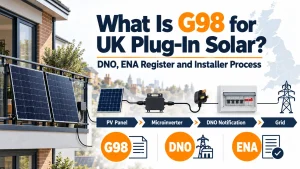
UK homes commonly use BS 1363 three-pin plugs, and many homes use ring final circuits. Older consumer units, RCD compatibility, local wiring conditions and DNO notification expectations can all affect how a small grid-interactive solar product should be explained and sold.
This matters because balcony solar is not only a module problem. It is a system packaging problem.
| UK market question | Why it matters |
|---|---|
| What is the system’s intended AC output class? | Helps retailers avoid overselling the system scope. |
| What plug, cable and inverter configuration is used? | Affects consumer safety and product instructions. |
| Is the inverter suitable for UK grid connection expectations? | Reduces compliance and after-sales risk. |
| What does the user need to check before installation? | Prevents misuse in unsuitable homes. |
| What documentation is included in the box? | Retail buyers need clear warning labels, manuals and support materials. |
The strongest UK balcony solar products will not be the ones with the most aggressive headline wattage. They will be the ones that reduce confusion for the user and reduce risk for the retailer.
The 800W Class: What It Means for Product Design
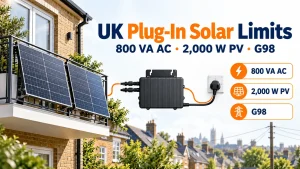
The 800W class is likely to become an important reference point for small plug-in balcony solar discussions in the UK. Product teams should still verify the latest UK guidance before making legal or compliance claims, but the market conversation is clearly forming around compact, low-power, consumer-accessible systems.
For product design, this means the panel wattage is only one part of the decision.
| Design item | What to check |
|---|---|
| AC output | What maximum output will the microinverter deliver? |
| DC configuration | How many panels, what voltage range, and what wiring layout? |
| Module format | Rigid, lightweight rigid, flexible, coloured or all-black? |
| Cable routing | Can users route cables safely without damaging the building? |
| Packaging | Are the limits and installation boundaries clear before purchase? |
| Documentation | Does the manual explain when professional review is needed? |
For UK retail, clarity may become as important as performance. If the product is easy to misunderstand, returns and complaints may increase.
Weight, Wind and Mounting: The Real Balcony Challenge
In the UK, balcony solar is not only about electricity. It is also about buildings.
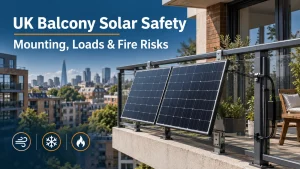
Many target users live in flats, leasehold properties, rented homes or townhouses where drilling, external wall changes and visible facade changes may be restricted. For high-rise balconies, retailers also need to think carefully about wind load, falling-object risk and fixing methods.
This is where lightweight and flexible module design becomes commercially important.
Traditional framed glass modules may be too heavy or too visually intrusive for many balcony situations. Lightweight or flexible panels can reduce handling difficulty, improve installation flexibility and make product packages easier to adapt for balconies, garden fences, sheds or small outbuildings.
| Mounting question | Why it matters |
|---|---|
| Is the panel weight suitable for balcony handling? | Reduces installation difficulty and logistics risk. |
| Can the panel be fixed without permanent building damage? | Important for renters and leasehold users. |
| Are fixing points designed into the module or frame? | Improves repeatability for retail kits. |
| Has wind exposure been considered? | Critical for elevated balconies and coastal areas. |
| Is the installation method easy to explain? | Reduces user error and support burden. |
Cloudy Weather: What UK Buyers Should Really Expect
UK buyers often ask whether solar panels work in cloudy weather. The answer is yes, but with limits.
Energy Saving Trust explains that solar panels can work on cloudy days, but stronger sunshine generates more electricity. For balcony solar, this distinction matters. The message should not be “cloudy weather does not matter.” It should be “module efficiency, orientation, shading, inverter behaviour and available daylight all matter.”
For system brands, low-light performance is a useful design angle, especially in a UK climate. Higher-efficiency cell technologies such as TOPCon may help create stronger product positioning, but they should not be described as a guarantee of high output in poor weather.
That means checking panel orientation, partial shading, usable mounting angle and electrical matching before promising the user a result.
Shading: The Problem Many Balcony Solar Kits Underestimate
Shading is often more severe on balconies than on rooftops.
A balcony panel may be affected by railings, neighbouring buildings, trees, wall edges, window recesses, laundry racks or nearby outdoor equipment. Even small shadows can reduce output, especially when the panel layout and electrical design are not matched to the application.
Energy Saving Trust notes that nearby buildings, trees or chimneys can negatively affect solar system performance, and that optimisers can help reduce the impact of shading in some systems. For balcony solar, the same principle becomes even more important because the installation area is smaller and more obstructed.
| Shading factor | Product implication |
|---|---|
| Railing shadow | Consider panel orientation, cell layout and mounting height. |
| Side-wall shadow | Avoid assuming full panel exposure throughout the day. |
| Building-to-building shading | Provide realistic user guidance. |
| Partial obstruction | Review bypass design and module segmentation. |
| Multi-panel layout | Match panel wiring with microinverter MPPT inputs. |
This is where anti-shading module design, bypass layout and customized electrical configuration can become valuable for UK balcony solar products.
Aesthetic Fit: Why All-black and Coloured Modules Matter
UK adoption will not be driven by electricity savings alone. Appearance matters.
Many flats, townhouses and managed buildings have rules around external appearance. Leasehold users may face limits from landlords, freeholders or management companies. Even when a product is technically suitable, a visible and bulky panel may face resistance.
That creates an opportunity for better-looking balcony solar modules.
All-black panels, coloured panels, thinner structures and low-visual-impact designs can help make balcony solar feel less like a temporary add-on and more like part of the building envelope. For retailers, this can reduce hesitation from customers who care about appearance or property restrictions.
| Appearance factor | Why it matters |
|---|---|
| All-black design | Better fit for modern flats and premium products. |
| Coloured module options | Better match with balcony rails or facade tones. |
| Thin profile | Reduces visual bulk. |
| Cable routing | Prevents untidy installations. |
| Private-label appearance | Helps retailers create differentiated product lines. |
Should Battery Storage Be Included in the First UK Product Wave?
Battery storage is attractive, but it should be handled carefully in the first UK plug-in balcony solar wave.
Energy Saving Trust explains that energy storage can help users store electricity for later use and make better use of renewable generation. That logic is strong: many UK households are away during the day, while evening electricity use is often more important.
But storage also adds complexity. It may increase product cost, certification requirements, shipping constraints, fire-safety considerations, app support, after-sales questions and warranty responsibility. For a retailer entering the category, a simple PV-only product may be easier to launch than a full solar-storage system.
| Product path | Suitable for | Main risk |
|---|---|---|
| PV-only balcony solar | Entry-level retail, renters, flats | Savings depend on daytime self-use. |
| PV + storage-ready design | System brands planning future upgrades | Requires clear compatibility rules. |
| Full PV + battery kit | Energy-focused brands and premium users | Higher cost and support complexity. |
For Sungold’s positioning, this article should not claim that Sungold provides a complete UK-certified plug-in storage system. The safer and stronger angle is module-side customization for balcony solar product packages.
Procurement Checklist for UK Retailers and System Brands
Before building a UK balcony solar product line, retailers and system brands should review the product as a complete package.
| Checklist item | What to confirm |
|---|---|
| Target system class | 400W, 600W, 800W or another product tier. |
| Product scope | PV-only, PV + microinverter, or PV + storage-ready. |
| UK electrical expectations | Plug format, inverter compliance, DNO/G98 guidance and user warnings. |
| Module format | Rigid, lightweight rigid, flexible, coloured or all-black. |
| Mounting method | Balcony rail, wall, shed roof, garden fence or temporary structure. |
| Wind and mechanical safety | Fixing points, anti-fall measures and load assumptions. |
| Shading tolerance | Bypass layout, module segmentation and MPPT matching. |
| Weather resistance | Rain, humidity, wind exposure and coastal environment. |
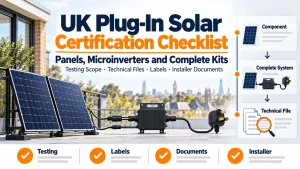
| Documentation | User manual, safety labels, installation limits and support flow. |
| Retail packaging | SKU structure, private label, accessories and clear buyer guidance. |
| After-sales | Replacement parts, cable compatibility and support responsibilities. |
The most successful products will likely combine clear documentation with practical physical design: lighter panels, easier mounting, cleaner cable routing and better tolerance for real balcony conditions.
How Sungold Can Support UK-ready Balcony Solar Product Development
For retailers, system brands and OEM buyers preparing for the UK balcony solar market, the next step is not only choosing a panel wattage. It is defining a product package that fits UK homes, UK safety expectations, retail instructions and real installation conditions.
Sungold can support this process through balcony solar module-side customization, including:
- lightweight module structures
- flexible solar panel formats
- coloured and all-black appearance options
- anti-shading module design
- customized dimensions
- cable routing and junction box placement
- OEM/ODM product development
- sample review for B2B projects
For the solar module itself, Sungold can help B2B customers build products that are easier to adapt to UK balconies, flats, townhouses, garden structures and small distributed solar applications.
FAQ
The UK market is moving toward clearer guidance for plug-in balcony solar, but retailers and buyers should check the latest official requirements before making legal claims. Product safety, plug format, inverter compliance and grid connection rules still matter.
Yes. Solar panels can generate electricity on cloudy days, but output is lower than in strong sunlight. For the UK market, product design should consider low-light conditions, panel efficiency, orientation and shading.
Retailers should review the full product package, not only the panel wattage. Key checks include system power class, inverter compliance, plug and cable safety, mounting method, weather resistance, shading tolerance, user documentation, packaging and after-sales support.
Sungold can support module-side customization for UK balcony solar products, including lightweight panels, flexible modules, coloured or all-black designs, anti-shading layouts, customized dimensions and OEM/ODM development. Final UK compliance review should still be handled by the retailer, system brand or local compliance partner.
Final Thoughts
The UK plug-in balcony solar market is opening, but it should not be treated as a simple low-cost consumer gadget category.
The real opportunity is in UK-ready product design: lightweight modules, clear installation boundaries, safer packaging, better shading tolerance, cleaner aesthetics and stronger documentation.
For retailers and system brands, the next competitive advantage will not come only from being first to list a balcony solar kit. It will come from offering a product that fits how UK homes are actually built, how UK users actually install products, and how UK channels manage risk after sale.