 EN
EN
 Deutsch
 Italiano
 Español
 Français
 日本語
日本語
Quick Answer
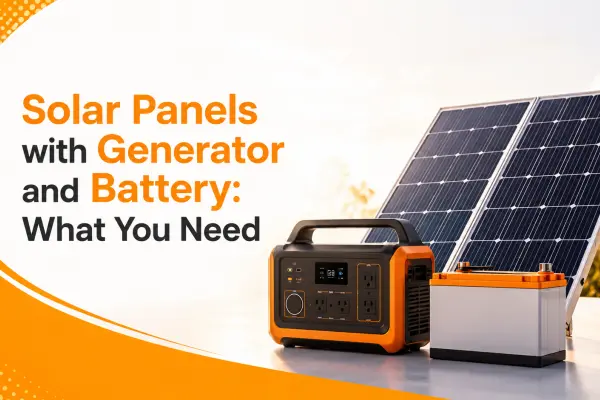
A solar panel, generator, and battery system is not one single product. It is a hybrid power setup where solar panels generate electricity, batteries store usable energy, and a fuel generator provides backup when solar production or battery capacity is not enough.
For B2B buyers, the key question is not “which solar generator should I buy?” The better question is: what loads need to run, for how long, under what site conditions, and which part of the system should solar panels support?
In most off-grid, mobile, backup, or remote power projects, solar panels can reduce generator runtime and keep batteries charged during daylight hours. But the final system must still be designed around battery voltage, inverter capacity, charge controller limits, generator charging compatibility, installation surface, local electrical codes, and safety requirements.
What Does “Solar Panels with Generator and Battery” Actually Mean?
The phrase can mean different things in the market. Some buyers use it to describe a portable consumer “solar generator.” Others mean a larger backup or off-grid system that combines photovoltaic panels, a battery bank, an inverter/charger, and a fuel generator.
For commercial or project-based applications, the second meaning is usually more relevant.
| Component | Main Role | What Buyers Should Confirm |
|---|---|---|
| Solar panels | Generate DC electricity from sunlight | Power range, voltage, roof or mounting fit, weight, weather exposure |
| Charge controller / MPPT | Regulate solar input into the battery | Input voltage, charging current, battery chemistry compatibility |
| Battery bank | Store energy for later use | Voltage, usable capacity, discharge limits, temperature range |
| Inverter or inverter/charger | Convert DC battery power to AC loads and manage charging | Continuous output, surge rating, AC voltage, generator input compatibility |
| Generator | Backup source during low sunlight, high load, or long runtime demand | Fuel type, rated output, duty cycle, safe transfer method |
| Safety and monitoring equipment | Protect people, wiring, and equipment | Disconnects, fuses, grounding, meters, local code compliance |
The U.S. Department of Energy notes that off-grid or stand-alone renewable systems commonly require batteries, charge controllers, power conditioning equipment, safety equipment, and meters or instrumentation in addition to PV panels. It also describes hybrid systems as renewable technologies combined with another source, including fossil fuel generators.
How the Three Power Sources Work Together
In a well-designed hybrid system, solar panels, batteries, and generators should not compete with each other. They should cover different parts of the load profile.
Solar panels are best for daily energy production. They are useful when the project has predictable sunlight exposure, enough mounting space, and loads that can be partially supported during the day.
Batteries are best for short-term storage and load smoothing. They cover nighttime use, cloudy periods, peak load events, and times when the generator is off.
A generator is best for backup and high-demand periods. It can help when battery state of charge drops too low, solar production is weak, or the project needs to support heavy intermittent loads.
The most stable system logic is: solar panels reduce daily fuel dependence, batteries stabilize power availability, and the generator protects the system when solar and battery capacity are not enough.
When You Need a Generator in a Solar Battery System
A generator is worth considering when the project cannot tolerate extended downtime.
| Scenario | Why Generator Backup May Be Needed |
|---|---|
| Remote off-grid sites | Solar production may not cover every season or weather condition |
| Mobile commercial equipment | Roof space may limit panel capacity |
| RV, marine, or service vehicle platforms | Loads and parking conditions can vary by route and use case |
| Telecom, monitoring, or security equipment | Continuous operation may be more important than fuel reduction |
| Temporary work sites | Load profile changes from project to project |
| Backup power systems | Outage length is uncertain and may exceed battery autonomy |
The generator should not be treated as a sign that solar has failed. In many projects, it is part of the reliability design. The mistake is assuming that solar panels alone can cover all loads without doing a load analysis.
When You May Not Need a Generator
A generator may be unnecessary if the system has low loads, enough battery autonomy, predictable sunlight, and enough solar mounting area.
Examples include small monitoring equipment, low-power DC loads, seasonal equipment with modest runtime, and applications where temporary downtime is acceptable.
Before removing the generator from the design, confirm:
- Daily energy consumption
- Peak startup load
- Nighttime load
- Required backup hours or days
- Local solar resource
- Seasonal shading
- Battery usable capacity
- Maintenance access
- Safety and certification requirements
The DOE recommends starting renewable system planning with electricity load analysis, including wattage, daily use hours, load timing, and seasonal variation. That principle applies strongly to commercial and off-grid projects.
How to Estimate System Size Before Buying
A simple planning method is to start with the load, not the product.
First, list the equipment that must run. Then record the wattage and expected hours of use. A basic energy estimate is:
Daily energy demand = load wattage x daily operating hours
This does not replace engineering design, but it helps buyers avoid under-sizing the solar and battery side of the system.
| Load Type | What to Check |
|---|---|
| Continuous loads | Communication devices, sensors, lighting, refrigeration, control systems |
| Intermittent loads | Pumps, motors, tools, lift mechanisms, HVAC, compressors |
| Surge loads | Motor startup, inverter surge demand, compressor startup |
| Critical loads | Equipment that must run during outages or poor weather |
| Optional loads | Loads that can be delayed until solar production is available |
After the load profile is clear, buyers can evaluate solar panel capacity, battery voltage and usable capacity, charge controller input limits, inverter continuous and surge rating, generator charging route, installation space, mounting structure, and required safety equipment.
This is where many projects go wrong. Buyers often start with panel wattage, but the real sizing problem starts with load demand, battery architecture, and system losses.
Solar Panels vs Battery vs Generator: Role Comparison
| Question | Solar Panels | Battery | Generator |
|---|---|---|---|
| Does it create energy? | Yes, when sunlight is available | No, it stores energy | Yes, when fuel is available |
| Does it run at night? | No | Yes, if charged | Yes |
| Does it reduce fuel use? | Yes, when sized and installed correctly | Indirectly | No |
| Does it provide backup during bad weather? | Limited | Limited by capacity | Yes, if fuel and maintenance are available |
| Is it silent during operation? | Yes | Yes | No |
| Can it solve the whole system alone? | No | No | No |
For project buyers, this table matters because each component solves a different problem. A battery is not an energy source. A generator is not a solar charging system. Solar panels are not a replacement for proper inverter, controller, and safety design.
Common Mistakes to Avoid
Choosing Panel Wattage Before Confirming Loads
A 200W, 400W, or 800W solar array may be reasonable in one project and inadequate in another. The right panel capacity depends on daily load, sunlight, installation angle, shading, battery voltage, and charging current limits.
Treating the Generator as a Direct Battery Replacement
A generator can recharge batteries or power loads through the right equipment, but it is not a substitute for correctly sized storage. If the battery bank is too small, the system may cycle too often or fail to support loads when the generator is off.
Ignoring Charge Controller Limits
Solar panels must match the controller’s voltage and current range. Incompatible panel strings can cause poor charging performance or equipment damage.
Ignoring Inverter Surge Demand
Some loads require much higher startup power than running power. Motors, pumps, compressors, and refrigeration systems should be checked carefully.
Assuming All Systems Can Be Grid-Connected
Grid-connected systems need additional equipment and must comply with utility requirements. Stand-alone systems have a different design logic. DOE guidance separates grid-connected and stand-alone renewable systems and notes that both require balance-of-system equipment for safe operation.
Overlooking Generator Safety
Fuel generators create carbon monoxide risk. CDC guidance states that portable generators should be used outside, more than 20 feet away from windows, doors, and vents, and never inside a home or garage.
For B2B and project use, this means generator placement, ventilation, transfer equipment, maintenance access, and operator instructions should be part of the design review.
What B2B Buyers Should Confirm Before RFQ
Before asking for a solar panel quote, buyers should prepare a short system brief. This saves time and reduces the risk of a panel recommendation that does not fit the actual project.
| RFQ Item | Why It Matters |
|---|---|
| Application type | Off-grid cabin, RV, marine, truck, trailer, monitoring system, backup site |
| Load list | Determines daily energy demand and peak power |
| Required runtime | Defines battery and backup needs |
| Battery voltage | Affects controller, inverter, and panel matching |
| Battery chemistry | Charging profile must match the battery system |
| Existing generator | Determines backup charging and integration logic |
| Available mounting area | Determines solar panel size and layout |
| Weight limits | Important for vehicles, boats, low-load roofs, and mobile equipment |
| Weather exposure | Heat, UV, salt mist, vibration, hail, foot traffic, or flexing risk |
| Certification needs | Model-level documentation may be required for project approval |
This is also where E-E-A-T matters. A serious supplier should not only ask “how many watts do you need?” They should ask where the panel will be installed, what system it connects to, what environmental stress it will face, and what documentation the project requires.
Where Sungold Solar Panels Fit in This Type of System
Sungold’s role in a solar panel, generator, and battery setup should be understood clearly: Sungold supports the solar panel side of the system, especially where flexible, lightweight, portable, or customized PV modules are needed.
For projects where the battery, inverter, generator, and electrical architecture are already defined, Sungold can help review the solar module side, including panel wattage range, flexible or lightweight structure, roof or surface fit, weight-sensitive installation, mobile or off-grid application needs, custom dimensions for OEM/ODM projects, and product documentation requirements.
For applications that require flexible installation on RVs, yachts, caravans, low-load rooftops, or off-grid surfaces, buyers can review the Sungold PA219 flexible solar panel series.
For projects where reduced module weight and mobile installation are key concerns, the Sungold PA621 lightweight solar panel series may be a better product page to review.
Procurement recommendation: do not choose flexible, lightweight, rigid, or portable solar panels only by product label. Review the installation surface, expected lifetime, system voltage, battery charging design, environmental exposure, and documentation needs first. Then select the solar panel structure that fits the system.
Practical System Design Path
For a B2B project, the decision path should look like this:
- Define the application and critical loads.
- Estimate daily energy demand and peak load.
- Confirm battery voltage, chemistry, and usable capacity.
- Confirm inverter or inverter/charger requirements.
- Decide whether generator backup is required.
- Check local electrical code, safety, and certification needs.
- Review available solar mounting area and weight limits.
- Select suitable solar panel type and power range.
- Confirm controller input limits and wiring plan with the system integrator.
- Request a project-specific solar panel proposal.
This process prevents the common mistake of buying panels first and solving system compatibility later.
FAQ
Can solar panels charge a battery and work with a generator?
Yes, but they need the right system architecture. Solar panels usually charge batteries through a charge controller. A generator may support loads or recharge batteries through an inverter/charger or other approved equipment. The exact connection depends on the battery system, controller, inverter, and safety design.
Do I still need a generator if I have solar panels and batteries?
Sometimes, yes. If the project has high loads, limited roof space, long cloudy periods, or strict uptime requirements, generator backup may still be needed. Solar can reduce generator runtime, but it should not be assumed to replace the generator without load and site analysis.
What size solar panel do I need for a generator and battery system?
There is no universal answer. Start with daily load demand, battery voltage, battery capacity, sunlight availability, and available mounting area. Panel wattage should be selected after the system requirements are clear.
Can Sungold provide the complete generator and battery system?
This article focuses on the solar panel side of the system. Sungold can support flexible, lightweight, portable, and customized solar panel selection for suitable applications. Battery, inverter, generator, and electrical integration details should be confirmed with the system integrator or qualified electrical professional.
Are flexible solar panels suitable for generator and battery systems?
They can be suitable when the project needs lightweight installation, curved surfaces, mobile platforms, or custom dimensions. The final choice depends on mounting conditions, electrical requirements, environmental exposure, and certification needs.
Final Thoughts
A solar panel, generator, and battery setup should be treated as a system, not as a single product purchase. Solar panels generate energy, batteries store it, and generators provide backup when solar and battery capacity are not enough.
For B2B buyers, the best next step is not to pick a panel wattage immediately. It is to define the load profile, confirm the battery and inverter architecture, review generator backup needs, and then select the solar panel structure that fits the installation surface and project requirements.
If your project needs flexible, lightweight, portable, or customized solar panels for an off-grid, mobile, backup, or hybrid power application, Sungold can review the solar module side and help match the panel format to your system design.
Request a Project-Specific Solar Panel Review
Source Notes
- DOE Energy Saver: renewable system planning, load analysis, local codes, grid-connected vs stand-alone systems. energy.gov
- DOE Energy Saver: balance-of-system equipment, batteries, charge controllers, inverters, safety equipment, UL 1741 and NFPA 70 references. energy.gov
- DOE Energy Saver: off-grid/stand-alone systems and hybrid system logic. energy.gov
- CDC: portable generator carbon monoxide safety guidance. cdc.gov
- Sungold PA219 flexible solar panel product page. sungoldsolar.com
- Sungold PA621 lightweight solar panel product page. sungoldsolar.com