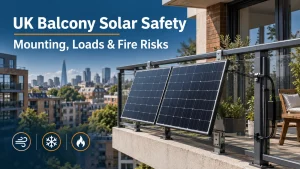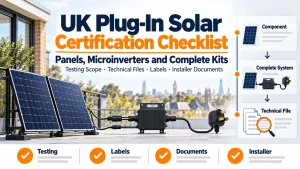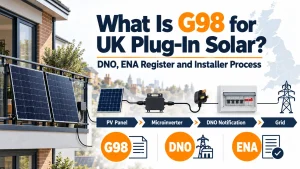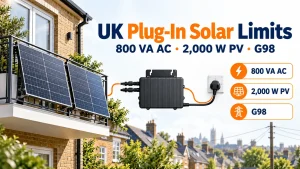





Yes, solar panels can still generate electricity on cloudy days in the UK. They do not need a clear blue sky to work. Solar panels use light, and cloudy weather still provides diffuse daylight. But output is lower than it would be under strong direct sunlight. For balcony solar buyers, the real question is whether the balcony, flat or small home receives enough usable daylight, with limited shading, to make a small solar system worthwhile.
That answer depends on panel position, shading, available space, panel efficiency, daytime electricity use and whether battery storage is included.
Why This Question Matters for UK Balcony Solar Buyers
Many UK buyers do not doubt the idea of solar energy. They doubt whether it makes sense in their own weather.
That concern is reasonable. The UK does not have the same solar conditions as Spain, Australia or the Middle East. A buyer in Manchester, Birmingham or London may look out at a grey morning and wonder whether a balcony solar panel will do anything useful. For flats and small homes, the doubt is even stronger because there is usually less installation space than on a full roof.
So the real concern is not only weather. It is value.
- Will the panel still produce power on cloudy days?
- Will winter output be too low?
- Is balcony solar too small to matter?
- Is shading from railings or nearby buildings a bigger problem?
- Do I need a battery?
- Should I choose a high-efficiency panel?
- Is this a real energy product or just a trend?
A good answer has to be honest. Solar panels can work in UK cloudy conditions, but a balcony solar system must be designed around its limits.
How Solar Panels Generate Power on Cloudy Days
Solar panels generate electricity when light reaches the solar cells. Direct sunlight gives stronger output, but diffuse daylight can still be converted into electricity.
That is why panels can still work on cloudy days.
The important difference is intensity. Thick cloud reduces the amount of light reaching the panel. Short winter days also reduce the available generation window. A low sun angle can further reduce output if the panel is poorly positioned.
For UK balcony solar, this means cloudy-day performance depends on several things working together:
- how much open sky the balcony receives;
- whether the panel faces a useful direction;
- whether the panel is blocked by walls, railings or nearby buildings;
- how efficient the panel is;
- whether the system can use or store the power generated during the day.
Cloudy Weather vs Shading: Which Is Worse?
This is where many buyers misunderstand the problem. Cloudy weather and shading are not the same.
Cloudy Weather Reduces Light More Evenly
On a cloudy day, the entire panel usually receives less light. The panel can still generate electricity, but the output drops because the light is weaker. This is a normal performance condition.
A high-efficiency panel can help make better use of limited space, but it cannot turn a dark winter afternoon into a strong summer noon. It improves the panel side of the equation. It does not change the weather.
Partial Shading Can Be More Disruptive
Partial shading is different. A balcony railing, side wall, tree, neighboring building, clothes rack or roof edge may shade only part of the panel. That sounds minor, but it can be more disruptive than general cloudy weather because solar cells are connected electrically inside the module.
If one section is shaded, the effect can spread through part of the circuit depending on the module layout, bypass design and system architecture.
This is why balcony solar buyers should not only ask whether panels work on cloudy days. They should also ask:
For projects where railings, nearby walls or neighboring buildings create regular shade, buyers should review module layout and anti-shading design. Sungold’s anti-shading solar panels can be considered where partial shading is a known project risk.
What Limits Balcony Solar Performance in the UK?
A balcony solar system is a small energy system. Its performance is shaped by the site.
The UK weather matters, but it is not the only factor. In many real projects, the balcony itself is the bigger limitation.
| Factor | Why It Matters |
|---|---|
| Balcony direction | South-facing positions usually receive more usable light than north-facing positions |
| Open sky access | A balcony with a wide open view performs better than one blocked by nearby structures |
| Partial shading | Railings, walls, trees and adjacent buildings can reduce output |
| Panel angle | Poor angle can reduce the light reaching the panel |
| Available area | Small balconies limit total panel capacity |
| Season | Winter days are shorter, so the generation window is smaller |
| Daytime electricity use | Self-consumption affects the practical value of the system |
| Battery pairing | Storage may help when daytime generation and evening usage do not match |
A buyer with a sunny south-facing balcony and daytime usage has a very different case from a buyer with a shaded north-facing balcony and most electricity use at night. Both may be searching the same keyword. They should not receive the same answer.
Do High-Efficiency Panels Help in Cloudy UK Conditions?
High-efficiency panels can help, but they should be understood correctly.
For balcony solar, space is limited. If a buyer can only install one or two panels, power density matters. A higher-efficiency panel can generate more power from the same available area than a lower-efficiency panel, assuming the rest of the conditions are comparable.
That is why TOPCon and high-efficiency solar panels are relevant for balcony solar, small homes, RV systems, marine systems and compact off-grid applications.
But high efficiency is not a promise of high output in every condition. A high-efficiency panel still needs light. It still loses output under heavy cloud. It still suffers if it is shaded, badly angled or installed in a poor location.
For B2B buyers and retailers, this matters in product communication. If the sales message suggests that high-efficiency panels solve cloudy weather, customer expectations will be wrong. If the message explains that high-efficiency panels improve limited-area generation, the claim is safer and more useful.
Do Balcony Solar Buyers Need a Battery?
A battery is not always required. It depends on how the household uses electricity.
A balcony solar panel generates power during the day. If the user is at home and can use that power directly, a simple system may already provide value. If the user is usually away during the day and uses more electricity in the evening, storage becomes more interesting.
This is especially relevant in the UK, where many flats and small homes have limited installation space and users are sensitive to electricity costs.
| User Situation | Battery Value |
|---|---|
| User is at home during the day | Battery may not be essential |
| User is away during the day | Battery can help shift daytime generation to evening use |
| Evening electricity use is high | Storage may improve self-consumption |
| Balcony system is very small | Battery size should be reviewed carefully |
| Retail product package | Storage can improve product value, but adds cost, instructions and support needs |
The key is sizing. A battery should match the realistic output of the balcony system. Oversizing storage for a very small panel setup may increase cost without improving the user experience.
For B2B product development, the practical route is to design the panel, inverter, storage and user instructions together. Sungold’s balcony solar solution can be reviewed where buyers need a balcony solar and micro-storage product direction.
What Panel Design Works Better for UK Flats and Small Balconies?
For balcony solar, product design is not only about power.
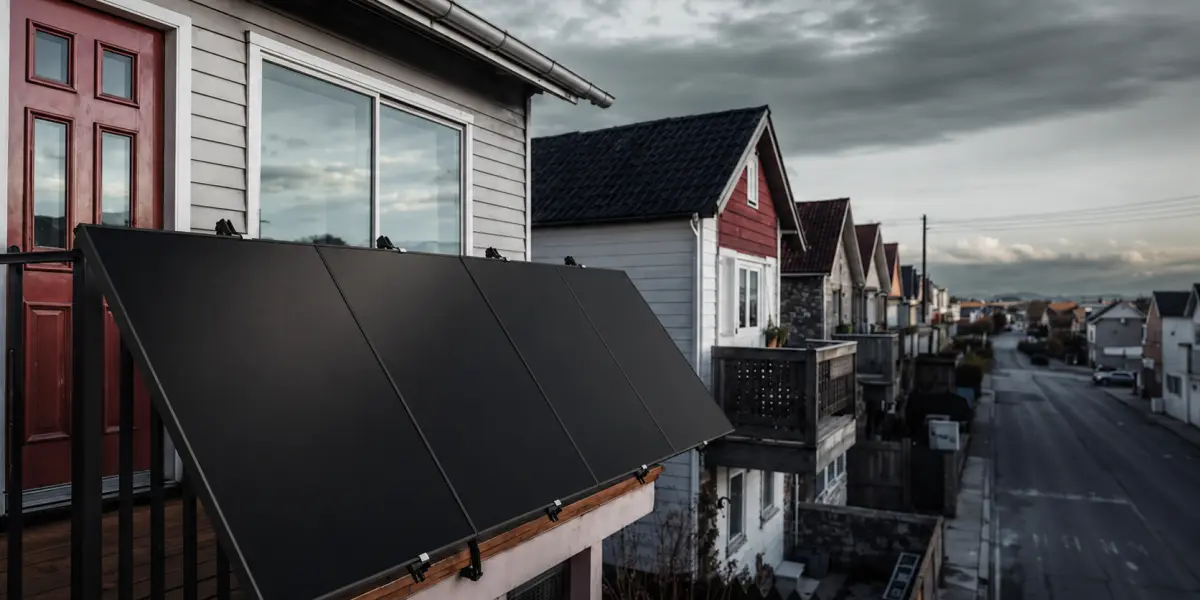
The panel is visible. It may sit on a railing, wall, facade or small outdoor area. Users care about appearance, weight and ease of installation. Retailers care about packaging, instructions and return risk. System brands care about whether the product feels serious enough for a new category.
A good UK balcony solar product should consider:
- panel weight;
- visual appearance;
- mounting method;
- cable routing;
- shading risk;
- weather exposure;
- battery or storage compatibility;
- simple user education.
All-black designs can be useful because they look cleaner on visible balconies. Lightweight or flexible formats may also help where the mounting surface is non-standard or where load is a concern.
Sungold’s PA219 flexible solar panel can support all-black design directions and non-standard panel formats, but the exact fit should still be reviewed against the installation surface, mounting method and safety requirements.
B2B Buyer Checklist Before Choosing a UK Balcony Solar Product
For retailers, distributors and system brands, the risk is not only whether the product works. The risk is whether the buyer understands when it works well and when it does not.
A clear product package should answer these points before launch.
| Check Item | Why It Matters |
|---|---|
| Target user | Flats, renters, small homes and retailers have different needs |
| Balcony direction | Direction affects expected output |
| Open sky exposure | A narrow or blocked balcony may limit useful generation |
| Shading condition | Determines whether anti-shading design should be reviewed |
| Panel efficiency | Important when installation area is limited |
| Panel weight | Affects mounting, logistics and user confidence |
| Appearance | Important for visible balcony products |
| Battery option | Helps match daytime generation with evening usage |
| User instructions | Reduces unrealistic expectations and support pressure |
| Safety documentation | Important for plug-in product education and market trust |
| Product positioning | Avoids overpromising whole-home power from a small system |
For UK balcony solar, the best product is not the one that promises the most. It is the one that explains the use case clearly and performs within that promise.
How Sungold Supports UK Balcony Solar Product Development
For B2B buyers, the next step is not only to select a solar panel. The better approach is to define the product scenario first.
A UK-ready balcony solar product should be reviewed around cloudy and low-light conditions, partial shading risk, small available installation area, panel efficiency, visual appearance, panel weight, battery or micro-storage options, user instructions and the target retail channel.
Sungold can support this type of product review through several module and solution directions:
- Anti-shading solar panels for projects with repeated partial shading risk;
- TOPCon and high-efficiency solar panels where limited area makes power density important;
- Balcony solar and micro-storage solutions for system-oriented product development;
- PA219 flexible solar panels where all-black appearance, flexible format or non-standard mounting needs to be considered.
For the UK market, the product message should be realistic: balcony solar can help users use available daylight, but the final value depends on site conditions, usage pattern and system design.
FAQ
Yes. Solar panels can still generate electricity on cloudy days because they use daylight, not only direct sunlight. However, output is lower than it would be under strong direct sun.
Not always. Cloudy weather usually reduces light across the whole panel. Partial shading from railings, walls or nearby buildings can be more disruptive because it may affect part of the module circuit. For balcony solar, shading should be checked carefully.
High-efficiency panels can help when space is limited because they can provide more output from the same area. But they do not remove the impact of low irradiance, poor orientation or shading. Efficiency should be reviewed together with the installation conditions.
It depends on when electricity is used. If the user can consume power during the day, a battery may not be essential. If the user is away during the day and uses more electricity in the evening, a small storage option may improve self-consumption.
Final Thoughts
Solar panels do work on cloudy days in the UK. That is the simple answer.
The more useful answer is that cloudy weather is only one part of balcony solar performance. For flats, renters and small homes, orientation, shading, available panel area, efficiency, daytime usage and battery pairing often matter just as much.
For B2B buyers, this creates a clear product requirement. A UK balcony solar package should not be sold as a whole-home power solution. It should be designed and explained as a compact energy product for suitable balconies, realistic self-consumption and clear user expectations.
That is how the category becomes useful, credible and easier to sell.
Energy Saving Trust: Solar panels advice
Ofgem: Energy price cap unit rates and standing charges