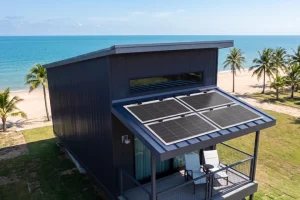





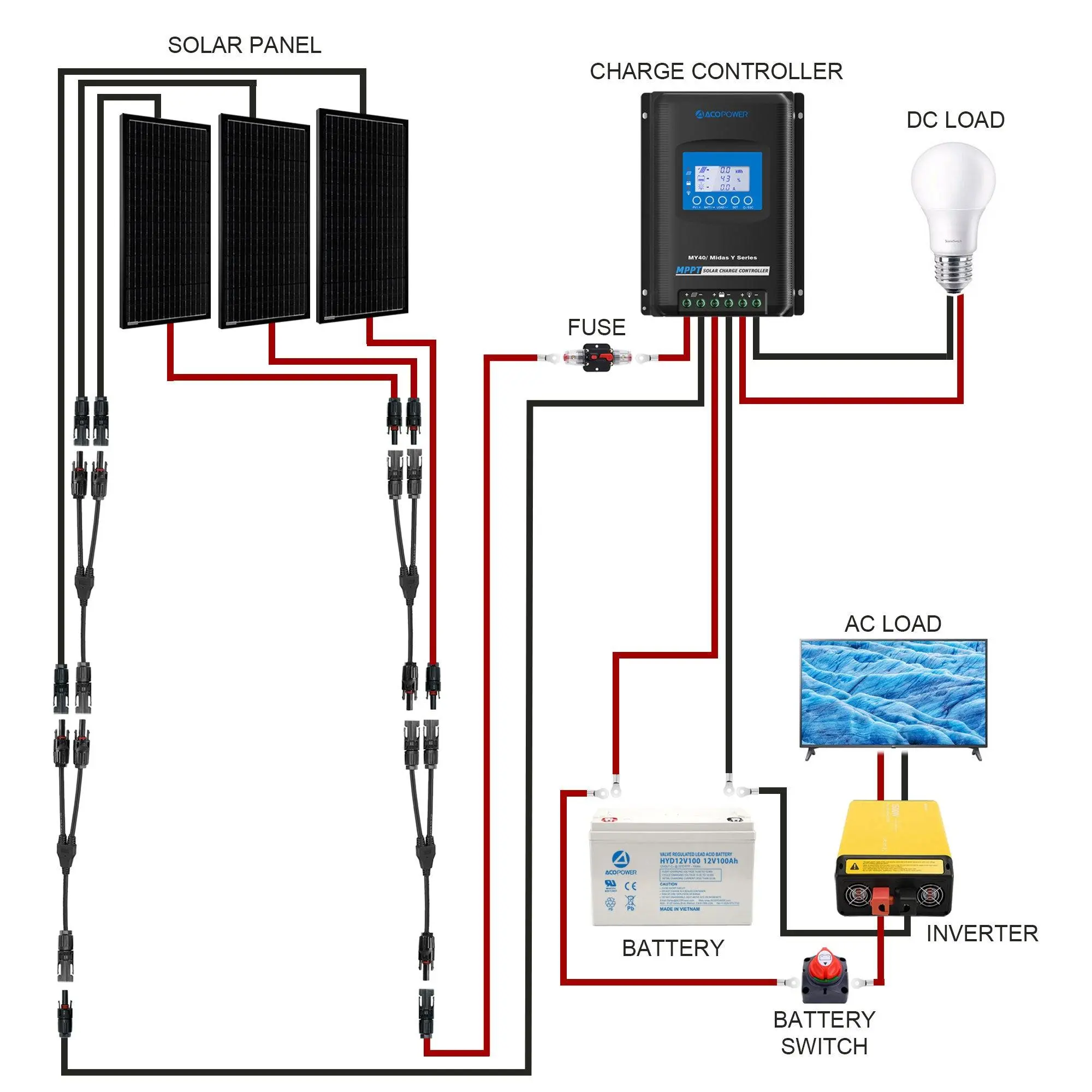
Determining how many solar panels and batteries for off-grid living requires calculating daily power consumption, factoring in local solar irradiance, accounting for system losses, and sizing components for your specific application. For B2B buyers and system integrators, the calculation also includes component compatibility, procurement logistics, and cost optimization. Calculate daily consumption in kWh, divide by peak sun hours (multiplied by system efficiency factor), and size batteries for 2-5 days of autonomy with appropriate depth of discharge. This guide provides the precise calculation methodology used by professional system integrators.
Why Solar Panel and Battery Quantities Differ for Off-Grid Systems
Off-grid solar systems require fundamentally different component quantities than grid-tied systems:
- Energy storage requirement: Every kWh consumed must be stored locally, requiring substantial battery banks
- Generation capacity: Solar array must generate enough energy for daily use plus battery charging losses
- Autonomy factor: Systems must operate independently without grid backup during low-production periods
- Component interdependency: Panel and battery quantities must be precisely matched for optimal performance
- Maintenance considerations: Components must be sized for long-term reliability without external support
- Seasonal variation: Winter production may be 30-70% lower than summer, requiring over-sizing
These constraints mean that off-grid component quantities cannot simply be calculated as "grid-tied system + batteries." The entire system must be designed as a unified whole with precise component matching.
STEP 1 Calculate Your Power Requirements
Daily Energy Consumption Analysis
The foundation of component quantity calculation is accurate power consumption data:
Load Categories for Quantity Planning
| Category | Purpose | Quantity Impact | Examples |
|---|---|---|---|
| Critical loads | Must operate continuously | Drives battery bank sizing | Refrigeration, communications, medical equipment |
| Essential loads | Needed for basic operation | Affects daily consumption | Lighting, water pumping, heating |
| Convenience loads | Enhance comfort but not essential | Influences panel quantity | Entertainment, power tools, washing machines |
| Peak loads | High power draw for short periods | Affects inverter and panel sizing | Air conditioning, well pumps, power tools |
Typical Daily Consumption by Application
| Application | Daily Consumption (Wh) | Monthly Consumption (kWh) |
|---|---|---|
| Remote cabin (basic) | 2,000–4,000 | 60–120 |
| Off-grid home (moderate) | 4,000–8,000 | 120–240 |
| Full-time off-grid living | 8,000–15,000 | 240–450 |
| Commercial facility | 15,000–50,000+ | 450–1,500+ |
Consumption Calculation Method
For each electrical load:
- Identify device wattage (check nameplate or manufacturer specs)
- Estimate daily usage hours
- Multiply to get daily Wh consumption
- Sum all loads to get total daily consumption
Example calculation:
- LED lighting: 100W × 6h = 600Wh
- Refrigerator: 150W × 12h = 1,800Wh
- Water pump: 800W × 0.5h = 400Wh
- Electronics: 200W × 8h = 1,600Wh
- Total daily consumption: 4,400Wh (4.4kWh)
STEP 2 Determine Solar Panel Quantity
Basic Panel Quantity Formula
System Sizing Factor Considerations
Real-world conditions significantly impact panel requirements. Based on NREL and NASA POWER data, combined real-world efficiency is commonly modeled around 45–70%, depending on site conditions:
| Loss Factor | Percentage | Reason |
|---|---|---|
| Temperature derating | -15% to -25% | Panel efficiency drops at high cell temperatures |
| Inverter efficiency | -5% to -10% | DC to AC conversion losses |
| Charge controller efficiency | -2% to -5% | MPPT/PWM losses |
| Wiring losses | -2% to -5% | Resistance losses in DC and AC circuits |
| Soiling/aging | -5% to -10% | Dust, dirt, and gradual degradation |
| Shading | -5% to -25% | Partial or full shading effects |
| Combined real-world efficiency | 45% to 70% | System sizing factor: 1.43 to 2.22 |
Location-Based Peak Sun Hours
| Location | Summer (PSH) | Winter (PSH) | Annual Avg |
|---|---|---|---|
| Southwest US | 6.5–7.5 | 4.5–5.5 | 5.5–6.5 |
| Southeast US | 5.0–6.0 | 3.5–4.5 | 4.5–5.0 |
| Northeast US | 4.0–5.0 | 2.0–3.0 | 3.0–4.0 |
| Northwest US | 3.5–4.5 | 1.5–2.5 | 2.5–3.5 |
| Mediterranean | 5.0–6.0 | 3.0–4.0 | 4.0–5.0 |
| Northern Europe | 3.0–4.0 | 0.5–1.5 | 2.0–3.0 |
Data source: NREL PVWatts, NASA POWER solar irradiance database
Panel Quantity Calculation Example
Scenario: Off-grid home with 6,000Wh daily consumption in Phoenix, AZ
- Apply system sizing factor: 6,000Wh × 1.5 system sizing factor = 9,000Wh required
- Divide by peak sun hours: 9,000Wh ÷ 6.0 PSH = 1,500W required
- Add seasonal buffer: 1,500W × 1.3 (30% winter buffer) = 1,950W
- Round up to nearest practical size: 2,000W (2kW)
If using 400W panels: 2,000W ÷ 400W = 5 panels
If using 300W panels: 2,000W ÷ 300W = 7 panels
Panel Selection Based on Quantity Needs
| Panel Size | Advantages | Disadvantages | Best For |
|---|---|---|---|
| 250–300W | Lower cost per panel, easier to transport | More panels needed, more connections | Small systems, limited roof space |
| 350–400W | Good balance of power and manageability | Higher cost per panel | Mid-size systems |
| 450–550W | Fewer panels needed, lower BOS costs | Heavier, requires stronger mounting | Large systems, utility-scale |
STEP 3 Calculate Battery Bank Quantity
Battery Quantity Formula
Days of Autonomy Considerations
| Application | Recommended Days of Autonomy | Reason |
|---|---|---|
| Remote cabin | 3–5 days | Limited access for maintenance |
| Off-grid home | 2–4 days | Backup generator available |
| Critical facilities | 5–7 days | Zero tolerance for power loss |
| Seasonal homes | 2–3 days | Occupied during good weather |
Depth of Discharge (DOD) by Battery Type
| Battery Type | Recommended DOD | Cycle Life | Cost Factor |
|---|---|---|---|
| Lead-acid (AGM) | 50% | 300–800 cycles | 1.0x |
| Lead-acid (Flooded) | 50% | 500–1,000 cycles | 0.8x |
| Lithium (LiFePO4) | 80–90% | 2,000–5,000+ cycles | 2.5–3.5x |
| Gel | 50–80% | 500–1,200 cycles | 1.2–1.5x |
Data source: Battery manufacturer specifications and industry standards
Battery Quantity Calculation Example
Scenario: 6,000Wh daily consumption, 3 days autonomy, lithium batteries
- Apply DOD and efficiency: (6,000 × 3) ÷ (48 × 0.80 × 0.97) = 483 Ah at 48V
- If using 200Ah battery units: 483 ÷ 200 = 2.42 → 3 batteries
Alternative scenario: Same consumption, lead-acid batteries
- Apply DOD and efficiency: (6,000 × 3) ÷ (48 × 0.50 × 0.83) = 902 Ah at 48V
- If using 200Ah battery units: 902 ÷ 200 = 4.51 → 5 batteries
Battery Bank Configuration
For larger systems, batteries are connected in series and parallel combinations:
| Configuration | Purpose | Example | Total Capacity |
|---|---|---|---|
| Series | Increase voltage | 4 × 12V = 48V | Same Ah, higher voltage |
| Parallel | Increase capacity | 4 × 200Ah = 800Ah | Same voltage, higher Ah |
| Series-Parallel | Both | 2 series × 2 parallel | 24V @ 400Ah |
STEP 4 Component Compatibility Verification
Charge Controller Sizing
PWM controllers: Current rating should be 1.25 × battery-side output current
MPPT controllers: Current rating should be 1.25 × battery-side output current
Example: 5 × 400W panels at 48V system
- Total power: 2,000W
- Battery-side output current estimate: 2,000W ÷ 48V = 41.7A
- Required controller: 41.7A × 1.25 = 52A → 60A MPPT controller
Inverter Sizing
Continuous power: Total continuous loads × 1.25
Surge capacity: Motor loads × 2–7 (starting surge)
Example: 3,000W continuous loads + 2,000W surge
- Required inverter: 3,000W × 1.25 = 3,750W
- With surge capacity: 5,000W inverter recommended
Battery Management System (BMS) Requirements
For lithium systems, BMS must handle:
- Maximum charge/discharge current
- Cell balancing requirements
- Temperature monitoring
- Communication protocols
STEP 5 B2B Procurement Planning
Once panel and battery quantities are calculated, many integrators source through a unified off-grid program rather than ad-hoc SKUs. Sungold's off-grid solar kits combine customizable voltage, IP67-rated modules, and tiered power classes (30W–200W+) for telecom, irrigation, RV, and remote-site deployments—useful as a procurement baseline before scaling to full home or commercial banks.
Economies of Scale
Larger quantity orders typically receive better pricing, though this may vary by order volume, specification, and delivery terms:
| Quantity Tier | Typical Discount | Best For |
|---|---|---|
| 1–10 units | List price | Small projects |
| 11–50 units | 5–10% discount | Mid-size projects |
| 51–200 units | 10–15% discount | Large projects |
| 200+ units | 15–25% discount | Bulk orders |
Transportation and Logistics Optimization
- Shipping container optimization: Calculate quantities that fill containers efficiently
- Local storage: Balance inventory holding costs vs. shipping frequency
- Delivery scheduling: Coordinate panel and battery deliveries for installation timing
Inventory Management
- Safety stock: Maintain 10–15% excess for replacements
- Rotation: First-in-first-out for batteries (aging consideration)
- Forecasting: Predict future project needs to consolidate orders
Quantity-Based Specification Examples
| Project Size | Panel Quantity | Battery Quantity | Cost Optimization Strategy |
|---|---|---|---|
| Cabin (3kW) | 8–12 panels | 4–8 batteries | Standard configurations |
| Home (5kW) | 12–18 panels | 8–12 batteries | Volume discounts |
| Community (50kW) | 120–150 panels | 80–120 batteries | Custom configurations, bulk pricing |
Common Quantity Calculation Mistakes
| Mistake | Consequence | Solution |
|---|---|---|
| Ignoring system losses | Underestimated panel quantity, poor performance | Apply 35–55% system sizing factor |
| Using STC ratings without temperature correction | Overestimates winter performance | Account for temperature derating (-15% to -25%) |
| Incorrect DOD assumptions | Premature battery failure | Verify DOD recommendations for battery type |
| Mismatched component quantities | System inefficiency, component stress | Verify compatibility between all components |
| Seasonal variation oversight | Insufficient winter power | Size for worst-case seasonal conditions |
| Inadequate autonomy planning | Frequent low-battery events | Plan for 2–7 days depending on application |
| Neglecting future expansion | Expensive system upgrades | Plan for 20–30% expansion capacity |
| Poor economic analysis | Suboptimal quantity decisions | Balance initial cost vs. lifecycle cost |
Sungold Solar Component Quantity Support
Based on Sungold Solar's experience in solar module manufacturing and B2B off-grid project support since 2008, our engineering team typically recommends:
For energy-efficient off-grid homes, Sungold Solar's PA621 lightweight panels may be suitable where roof load is a concern. For curved mounting surfaces, PA219 flexible panels can accommodate non-standard installations. For standard ground-mounted or flat-roof systems, SGSP rigid panels provide reliable performance. For premium residential off-grid rooftops where shading and aesthetics drive panel count, BC back-contact solar modules reduce front-side shading loss and support higher effective yield on limited roof area:
| Application | Recommended Panel Quantity | Battery Quantity | System Configuration |
|---|---|---|---|
| Remote cabin | 400W panels × 6–10 units | 10kWh LiFePO4 × 2–4 units | 2.4–4kW system |
| Off-grid home | 400W panels × 10–20 units | 10kWh LiFePO4 × 4–8 units | 4–8kW system |
| Agricultural operation | 400W panels × 20–50 units | 2.4kWh AGM × 20–40 units | 8–20kW system |
| Commercial facility | 400W panels × 50–200 units | 10kWh LiFePO4 × 10–50 units | 20–80kW system |
Quantity optimization services:
- Precise component quantity calculations
- Batch ordering optimization
- Logistics and shipping coordination
- Installation scheduling
- Spare parts inventory planning
Bulk purchasing benefits:
- Volume discounts on large orders
- Consistent product specifications
- Streamlined procurement process
- Coordinated delivery scheduling
What to Specify When Ordering Components
Quantity Specification Checklist
- Daily power consumption (Wh/day) for the target application
- Required days of autonomy (battery bank sizing)
- Peak load requirements (inverter sizing)
- Geographic location and solar irradiance data
- Environmental conditions (temperature, weather patterns)
- Battery chemistry preference (Lead-acid vs Lithium)
- System voltage (12V/24V/48V)
- Panel wattage preference (300W/400W/500W)
- Projected installation timeline
- Future expansion plans
- Logistics requirements (delivery location, access constraints)
Solar Panel and Battery Quantity Calculator
For quick reference, here are the core formulas used in off-grid system sizing:
| Formula | Purpose | Variables |
|---|---|---|
| Daily energy = Device wattage × Hours of use | Load calculation | For each electrical load |
| Required panel kW = (Daily consumption × System sizing factor) ÷ Peak sun hours | Solar array sizing | 1.43–2.22 sizing factor |
| Required battery capacity (Ah) = (Daily consumption × Days of autonomy) ÷ (Battery voltage × DOD × Efficiency) | Battery bank sizing | DOD: 50% for lead-acid, 80% for lithium |
Ready to calculate precise component quantities for your off-grid system?
Send your project specifications and power requirements — our engineering team will calculate precise solar panel and battery quantities for your application.
- Off-Grid Solar Kits — Customizable off-grid solar solutions (30W–200W+ tiers)
- BC Back-Contact Solar Modules — High-efficiency all-black panels for premium off-grid rooftops
- How to Design Complete Off-Grid Solar System — Complete system design guide
- Solar Panel Sizing Calculator — Interactive sizing tool