 EN
EN
 Deutsch
 Italiano
 Español
 Français
 日本語
日本語
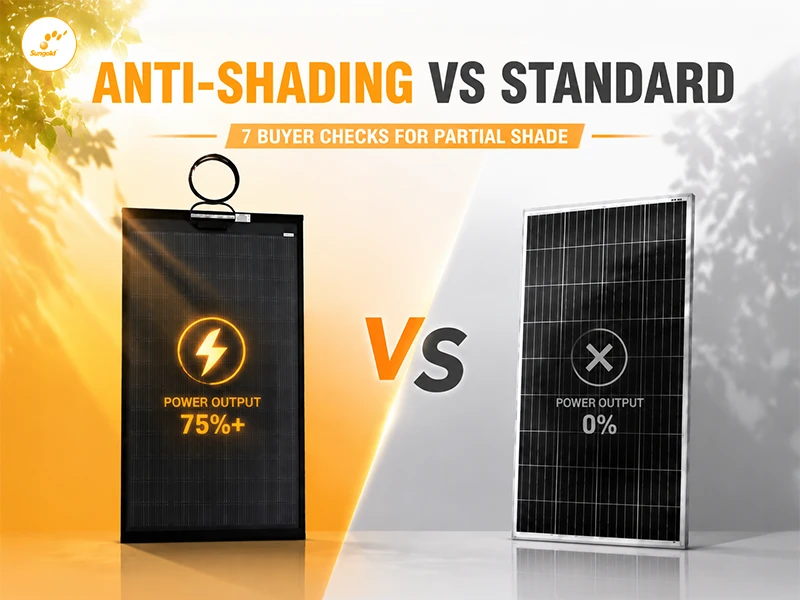
Anti-Shading vs Standard Solar Panels is a technical choice, not a simple upgrade question. Anti-shading solar panels are not shade-proof panels. They are designed to reduce power loss under certain partial-shade conditions, especially when shadows from railings, roof vents, antennas, tree branches, masts, or nearby structures move across part of the module. Standard solar panels can still be the better choice for open, low-shade installations. The right decision depends on shade pattern, module layout, system electronics, mounting environment, and project requirements.
For B2B buyers, the question is not simply whether an anti-shading panel is better than a standard solar panel. The better question is whether partial shade is a real design condition in the project.
A standard solar panel can work well on an open rooftop, ground-mounted array, or other installation with predictable sunlight. But in RV, marine, balcony, commercial vehicle, and compact off-grid projects, shadows are often harder to avoid. A roof vent, railing, mast, cable, luggage rack, wall edge, or rooftop accessory can create local shade during part of the day.
This article provides a technical decision framework based on PV module behavior under partial shading. It does not claim a fixed output improvement percentage, because actual performance depends on shade pattern, module layout, system electronics, installation angle, maintenance, and site conditions.
Why Partial Shading Matters More Than Many Buyers Expect
Solar panels are not affected by shade in the same way a flat surface is affected by shade. In a PV module, cells are electrically connected. When one area receives less light, it can limit current flow through part of the module.
This is why a small shadow can sometimes create a larger-than-expected output drop. A leaf, railing, cable, vent, mast, luggage rack, or building edge may only cover part of the panel. But if that shadow affects a critical cell string, the module may lose more power than the shaded area suggests.
That uneven irradiance is where the problem begins. It can reduce output, activate bypass paths, and in some cases increase thermal stress on the affected area. For projects where shade is recurring, this issue should be reviewed before the buyer selects a module format.
How Standard Solar Panels Handle Partial Shade
Standard solar panels are widely used because they are proven, cost-effective, and suitable for many open-sun installations. They are not low-quality panels by definition. In the right environment, they can be the most practical option.
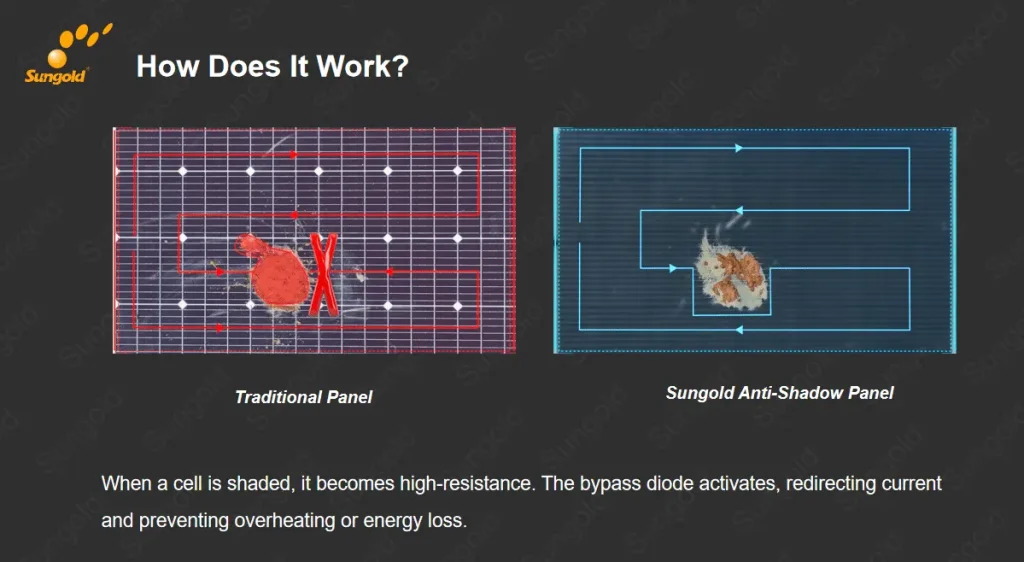
Most standard modules use bypass diodes to reduce damage risk and limit severe mismatch effects. Bypass diodes help route current around affected cell groups when part of the module is shaded or underperforming.
But bypass diodes do not make a panel immune to shade. They usually protect groups of cells, not every small shaded area. If one area is shaded, a larger cell group may be bypassed depending on the module design. This can reduce output even when the visible shadow looks small.
When standard panels are still the right choice
| Installation Condition | Standard Panel Suitability | Buyer Note |
|---|---|---|
| Open rooftop with little obstruction | Good fit | Standard panels often provide strong value when shade risk is low. |
| Ground-mounted array with planned spacing | Good fit | Layout can often be designed to reduce row-to-row shade. |
| Commercial site with predictable sun exposure | Good fit | System design and maintenance may matter more than anti-shading module design. |
| Cost-sensitive project with low shade risk | Good fit | Standard modules may be the better commercial decision. |
| RV, marine, balcony, or vehicle roof with recurring local shadows | Needs review | Anti-shading design may be more relevant when shade is hard to avoid. |
The decision should start with the installation condition, not the product name.
What Anti-Shading Solar Panels Are Designed to Improve
Anti-shading solar panels are designed to improve shade tolerance at the module level. The goal is to reduce how strongly one shaded area affects the remaining active area of the panel.
This is especially useful when the installation cannot avoid partial shading. Examples include balcony panels near railings or side walls, RV roof panels near vents and racks, marine panels affected by masts or ropes, commercial vehicle panels affected by rooftop equipment, and compact off-grid systems where panel placement is limited.
Anti-shading design may help reduce mismatch loss, improve usable output under certain partial-shade patterns, and lower the risk of localized heating. But it should be described carefully.
A better way to think about it is this: anti-shading panels are designed for projects where partial shade is a known design condition, not just an occasional inconvenience.
Anti-Shading vs Standard Solar Panels: Technical Decision Comparison
| Factor | Standard Solar Panels | Anti-Shading Solar Panels |
|---|---|---|
| Best-fit environment | Open, low-shade areas | Recurring partial-shade applications |
| Main advantage | Proven structure, cost-effective, widely available | Designed to reduce partial-shade impact in selected conditions |
| Shade response | Depends heavily on cell string and bypass diode layout | Designed to localize or reduce shaded-area impact |
| Buyer risk | Output may drop sharply under certain shade patterns | Still loses output under heavy or long-term shade |
| System design need | Normal electrical matching required | Shade pattern and system matching should be reviewed more carefully |
| Suitable applications | Rooftop, ground mount, open area systems | RV, marine, balcony, off-grid, commercial vehicle, compact installations |
| Commercial decision point | Is shade rare and avoidable? | Is shade recurring and difficult to avoid? |
The comparison is not about declaring one panel better in every case. It is about matching the module to the operating environment.
When to Choose Anti-Shading Panels vs Standard Panels
For buyers, the clearest decision is usually not based on a single specification. It comes from comparing the shade condition with the application risk.
| Choose Anti-Shading Panels When | Standard Panels May Be Enough When |
|---|---|
| Partial shade appears daily or seasonally | The site has open sunlight for most operating hours |
| Shade cannot be avoided by changing layout | Shade can be avoided by better panel placement |
| The project involves RV, marine, balcony, or vehicle-mounted panels | The project is a ground mount or open rooftop with predictable exposure |
| After-sales risk from shade-related complaints is high | Cost control is the main priority and shade risk is low |
| The buyer needs better tolerance to irregular shading patterns | The system already uses suitable optimizers or microinverters and shade is limited |
Where Anti-Shading Panels Make the Most Sense
RV and camper roofs
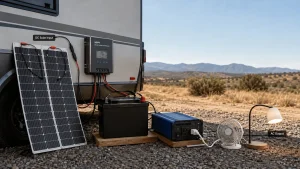
RV roofs often have vents, air conditioners, skylights, antennas, roof racks, or storage boxes. These create short, moving, or irregular shadows during the day.
In this type of project, available roof space is limited. The panel cannot always be moved to a perfect position. A shade-tolerant design may help reduce the impact of small shadows and improve usable energy during real travel conditions.
For RV applications, buyers should check roof space, panel weight, mounting method, shading from rooftop accessories, controller input range, battery voltage, and cable routing.
Marine and boat applications
Marine solar projects are rarely perfect flat-roof installations. Boats may have curved surfaces, moving sun angles, masts, rigging, antennas, guardrails, and deck equipment.
Partial shading can move across the panel as the boat changes direction or as the sun angle changes. In marine applications, buyers also need to consider surface material, salt and humidity exposure, installation curvature, foot traffic risk, cable protection, and mounting security.
Balcony solar and urban installations
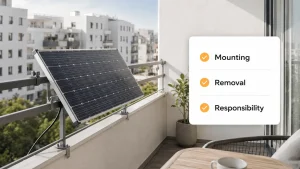
Balcony solar systems often face a different type of problem. The buyer may not control the ideal orientation. Railings, side walls, neighboring buildings, plants, or upper-floor structures may create partial shade.
For balcony systems, the question is not only about peak output. Buyers also care about weight, appearance, installation method, railing compatibility, local safety expectations, microinverter matching, and user instructions.
Commercial vehicles and liftgate systems
Commercial vehicles can also face partial shading. Roof-mounted panels may be affected by vehicle equipment, parking location, cargo structures, or roof shape.
For applications such as liftgate battery maintenance or auxiliary battery charging, the goal is often not to power the whole vehicle. It is to support battery maintenance and reduce downtime risk. The panel must still be matched with the controller, battery, wiring protection, and installation method.
When Standard Solar Panels May Still Be the Better Choice
Anti-shading panels are not always necessary. Standard solar panels may be the better choice when the installation has open sunlight, predictable layout, low obstruction risk, and a cost-sensitive target.
If shade can be avoided through better placement, system layout, or mounting adjustment, a standard panel may deliver better value. Standard panels may also be suitable when the system already uses appropriate module-level electronics, such as optimizers or microinverters, and the shade issue is handled at the system level.
Before choosing anti-shading modules, buyers should ask:
- Is the shading real, recurring, and difficult to avoid?
- What causes the shade?
- Does the shade move or stay fixed?
- Which part of the panel is shaded?
- Can the layout be changed?
- Does the system use MPPT, optimizers, or microinverters?
- What is the cost of performance loss or after-sales service if shade is ignored?
If the answer is unclear, the project needs a shading review before product selection.
Module Design Is Only One Part of the Shading Solution
Anti-shading panel design matters, but it is not the whole system. A solar project may include panels, bypass diodes, MPPT controllers, power optimizers, microinverters, batteries, BMS, fuses, cables, mounting structures, and load requirements. Each part affects the final performance.
| Solution Level | What It Helps With |
|---|---|
| Module cell layout | Reduces how a shaded area affects the rest of the panel |
| Bypass diode design | Helps limit reverse-bias and hot-spot risk |
| MPPT controller | Tracks a better operating point under changing conditions |
| Power optimizer | Helps manage module-level mismatch |
| Microinverter | Reduces string-level mismatch impact |
| Mounting layout | Avoids predictable shade before it becomes a problem |
| Maintenance | Removes dirt, leaves, snow, or other surface blockage |
This is why B2B buyers should avoid choosing panels based only on rated wattage. A higher-wattage standard panel may not perform better than a shade-tolerant panel if the installation has recurring local shadows.
7 Buyer Checks Before Choosing Anti-Shading or Standard Solar Panels
Before choosing between standard and anti-shading solar panels, buyers should confirm seven project conditions. These checks are more useful than asking for a generic “best panel” recommendation.
| Buyer Check | What to Confirm |
|---|---|
| 1. Shade source | Tree, railing, wall, mast, roof vent, antenna, cargo rack, nearby structure |
| 2. Shade pattern | Fixed, moving, daily, seasonal, narrow, wide, partial, heavy |
| 3. Application type | RV, marine, balcony, commercial vehicle, off-grid, rooftop, or compact portable system |
| 4. Mounting surface and area | Available size, curve, angle, orientation, surface material |
| 5. Module size and electrical target | Wattage, voltage, current, size, weight, surface material |
| 6. System electronics | MPPT controller, microinverter, optimizer, battery input range |
| 7. Product evidence and claim boundary | What the panel can improve, and what still needs system-level design |
For OEM/ODM buyers and system brands, this checklist should be part of the RFQ process. It helps suppliers recommend the right panel structure instead of guessing from wattage alone.
What Evidence Should Buyers Ask For?
Without controlled shade testing, claims such as “higher output under shade” should be treated as directional rather than guaranteed. Buyers should ask for evidence that matches the intended application.
| Evidence Type | Why It Matters |
|---|---|
| Datasheet | Confirms electrical specifications, size, weight, material, and operating limits. |
| Shade pattern test | Shows how the module behaves under strip shade, corner shade, or localized shading. |
| Thermal image or hot-spot review | Helps evaluate whether localized heating risk has been considered. |
| Bypass or circuit explanation | Explains how shaded areas are managed inside the module design. |
| Application examples | Shows whether the panel format fits RV, marine, balcony, vehicle roof, or off-grid projects. |
| Certification scope | Confirms which model, market, and test scope the documentation actually applies to. |
How Sungold Can Support Partial-Shade Solar Projects
For buyers dealing with recurring partial-shade conditions, the next step is not simply choosing the highest-wattage panel. The better approach is to review the shade pattern, available mounting area, voltage requirement, installation surface, and target application.
Sungold can support this review through application-specific module design, including anti-shading solar panels for projects where partial shading is a known design issue. For projects that also involve curved surfaces, weight limits, visible balcony installations, or vehicle-mounted layouts, the panel structure should be reviewed together with the mounting method and system input requirements.
The most useful RFQ is usually not a generic panel request. It should include the shade source, available panel area, installation surface, system voltage, controller or inverter input range, and expected application environment.
FAQ
Standard solar panels are best suited to open, low-shade installations. Anti-shading solar panels are designed to reduce the impact of certain partial-shade patterns, such as shadows from railings, roof vents, masts, or rooftop equipment.
They can help reduce performance loss under certain partial-shade conditions, but they are not shade-proof. Heavy, long-term, or complete shading will still reduce output.
Bypass diodes help limit reverse-bias and hot-spot risk, but they do not remove all shading loss. Their effect depends on the module design and how the shaded cells are connected.
RV roofs, marine decks, balcony systems, commercial vehicles, and compact off-grid installations are more likely to benefit because partial shading is often difficult to avoid in these environments.
They solve different problems. Anti-shading panel design works at the module level. Microinverters and optimizers work at the system electronics level. In some projects, both module design and system electronics need to be considered.
Anti-shading panels may not be necessary for open, low-shade sites where standard panels can be placed in predictable sunlight. They are also not a substitute for correct system design, safe wiring, or proper maintenance.
Final Thoughts
Anti-shading solar panels are most useful when partial shade is a real design condition, not just a possible inconvenience. Standard solar panels remain a strong choice for open and predictable installations.
For B2B buyers, the decision should be based on application conditions, not product labels. The right panel depends on shade pattern, module layout, system electronics, mounting environment, and documentation requirements.
If the project involves RV roofs, marine decks, balcony railings, commercial vehicle roofs, or compact off-grid installations, anti-shading solar panels are worth reviewing before finalizing the product design.