 EN
EN
 Deutsch
 Italiano
 Español
 Français
 日本語
日本語
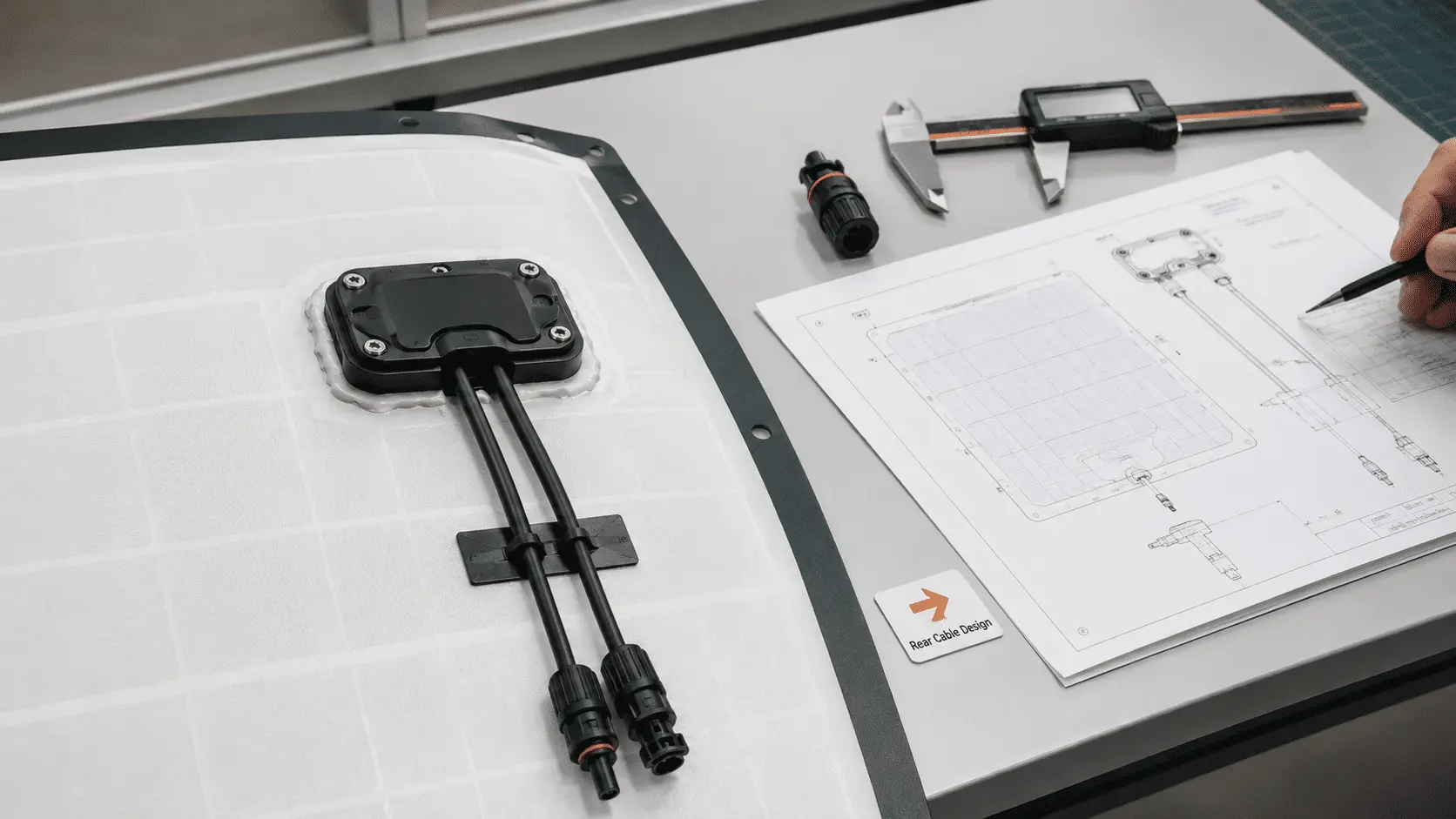
A rear cable design does not automatically mean better waterproofing. The cable exit area, connector, junction structure, edge sealing, and installation method still need to be reviewed together.
Before sampling, buyers should provide drawings, application photos, target market, installation method, and any certification or documentation requirements.
Custom rear cable solar panels are not just a different wiring style. They are a mechanical design choice for projects where the cable route, mounting surface, product appearance, and system layout all matter.
For an OEM buyer, the question is usually practical: can the cable exit from the back of the panel, stay protected after installation, avoid visible wiring, and still match the electrical and documentation requirements of the project?
The answer depends on the drawing, cable exit position, sealing structure, connector, installation surface, and target application. A rear cable design can be useful, but it should be reviewed as part of the whole product structure.
What Is a Rear Cable Solar Panel?
A rear cable solar panel is a solar panel where the cable exits from the back side of the module instead of being routed from a visible front-side junction box or a side position.
In custom solar panel projects, buyers may also describe this as a back-exit cable, hidden cable design, rear wiring, or a panel without visible front wiring. The exact structure can vary by product design, so it should always be confirmed with drawings before sampling.
This type of design is most often considered when the panel needs to fit into a product, surface, vehicle, deck, railing, or housing where visible wiring would create installation problems or affect appearance.
For OEM and system buyers, rear cable design is not only about appearance. It affects cable routing, sealing, mounting clearance, maintenance access, and long-term reliability.
Why Cable Exit Position Matters in OEM Solar Panel Projects
Many buyers start an inquiry with wattage and size. That is normal. But for custom solar panels, the cable exit position can be just as important as the electrical rating.
A panel may have the right wattage but still fail the project fit if the cable exits in the wrong direction, bends too sharply, blocks the mounting surface, or sits in a place where water collects.
This is especially common in flexible solar panel projects. The panel may be installed on a curved surface, a vehicle roof, a yacht cabin roof, a balcony railing, or a product enclosure. In these cases, cable routing is part of the mechanical design.
For buyers developing a custom module, Sungold’s custom solar panel solutions can be used as the starting point for reviewing size, voltage, cable exit, connector, and application requirements together.
Installation Space
The cable exit position affects how closely the panel can sit against the mounting surface. If the cable exits into a tight space, the installer may need extra clearance, a groove, a cable channel, or a different mounting method.
This should be reviewed before sampling. A cable route that looks fine on a drawing may be difficult to install on a real roof, deck, railing, or equipment shell.
Cable Protection
Cables may face bending, abrasion, vibration, moisture, and pulling force during use. If the exit point is poorly positioned, the cable can become a stress point.
For vehicle and marine use, cable protection is especially important because the panel may face movement, cleaning, wind, salt air, or repeated maintenance work.
Appearance and Product Integration
Rear cable routing can help keep the visible surface cleaner. This is useful for balcony products, marine panels, RV roof panels, and OEM devices where the solar panel is part of the final product design.
Clean appearance matters, but it should not override service access, sealing, and installation safety.
Rear Cable vs Side Cable vs Standard Junction Box
Different cable designs solve different problems. There is no single best option for every project.
| Cable Design | Best Used For | Main Advantage | What Buyers Should Confirm |
|---|---|---|---|
| Rear cable exit | Flush mounting, hidden wiring, OEM product integration | Cleaner visible surface and easier hidden routing | Exit position, sealing method, cable bend direction, mounting gap |
| Side cable exit | Edge-mounted panels and simple cable routing | Easier cable access and inspection | Cable protection, edge clearance, connector direction |
| Standard junction box | Conventional solar module installation | Familiar structure and easier service access | Thickness, box position, waterproof rating, mounting space |
| Customized cable position | Special-size modules, equipment housings, marine or vehicle use | Can match the product structure more closely | Drawing, tooling feasibility, cable length, connector type, production tolerance |
The right choice depends on the installation surface and system design. A yacht deck, RV roof, balcony railing, and sensor housing will not use the same cable logic.
Where Rear Cable Solar Panels Are Commonly Considered
Marine and Yacht Projects
Marine projects often have limited routing space. Buyers may want the cable to exit through the underside of a deck, cabin roof, or hardtop to keep the visible surface cleaner.
This does not mean every rear cable panel is automatically suitable for marine use. Salt mist, humidity, UV exposure, vibration, cable sealing, and installation adhesive all need to be reviewed.
For yacht or boat projects, buyers should confirm whether the panel will be installed on a cabin roof, curved surface, deck area, or hardtop. If the surface may be stepped on, the mechanical requirement must be handled separately. Do not assume a flexible panel is walkable unless the structure and test scope support that use.
RV and Vehicle Roofs
On RVs and commercial vehicles, rear cable routing can help reduce exposed wiring and make the roof layout cleaner. It may also help when several panels need to be arranged around vents, rails, antennas, or roof-mounted equipment.
But vehicle roofs also create their own risks. Cable routes may face vibration, heat, wind, cleaning tools, and maintenance access issues. The cable exit should not sit where water can pool or where the cable may be pinched during installation.
For lightweight vehicle roof projects, buyers can review Sungold’s PA621 lightweight solar panels as one possible product path, while confirming the exact cable design and installation requirements case by case.
Balcony and Railing Solar Products
Balcony solar products often need clean appearance and controlled wiring. A visible junction box or cable loop may create problems for packaging, mounting, user installation, or front-facing aesthetics.
Rear cable design may help in some balcony or railing products, especially when the cable needs to route behind the panel or through a bracket system. However, the product must still match the local plug, microinverter, mounting, safety, and user instruction requirements.
Equipment Housing and OEM Devices
Rear cable solar panels are also used in smaller OEM products such as sensor housings, GPS trackers, outdoor monitoring devices, battery maintenance systems, and compact auxiliary power products.
In these projects, the buyer may care more about cable position, panel thickness, and enclosure fit than maximum wattage. A small panel with the correct cable exit can be more useful than a larger panel that is difficult to integrate.
Waterproofing and IP Rating: What Buyers Should Verify
A common misunderstanding is that a rear cable design is always more waterproof than a standard junction box design. That is not always true.
Waterproofing depends on the full structure. Buyers should review:
- cable exit sealing;
- connector rating;
- junction or soldering area protection;
- edge sealing;
- laminate structure;
- cable strain relief;
- adhesive or mounting method;
- drainage path after installation.
If a buyer requires an IP rating, the rating should be linked to the exact component and test scope. A connector, cable gland, junction box, or full panel assembly may have different test conditions. The buyer should not assume that one rating covers the entire installed system.
For outdoor, marine, balcony, and vehicle use, the installation method matters. A good panel design can still fail if the cable exit is bent sharply, compressed under the panel, exposed to standing water, or routed through an unprotected hole.
What Buyers Should Include in an OEM RFQ Drawing
A clear RFQ drawing saves time. It also reduces sample revisions.
Before asking for a custom rear cable solar panel, buyers should prepare the following information.
| RFQ Item | Why It Matters |
|---|---|
| Panel length and width | Affects cell layout, wattage, voltage, and mounting fit. |
| Target wattage | Helps judge whether the required output fits the available area. |
| Voltage requirement | Must match the controller, battery, microinverter, or load. |
| Cable exit position | Determines routing, sealing, and installation clearance. |
| Cable length | Affects installation convenience and voltage drop. |
| Connector type | Must match the system and target market. |
| Mounting surface | Affects flexibility, adhesive choice, and mechanical stress. |
| Bend direction | Important for flexible panels installed on curved surfaces. |
| Target market | May affect certification and documentation needs. |
| Packaging requirement | Important for distributors and bulk orders. |
If the project involves a curved roof, boat surface, balcony railing, or product housing, photos are useful. A drawing shows dimensions. A photo shows the real installation problem.
For flexible project designs, Sungold’s PA219 flexible solar panels can be reviewed as a reference product path, but the final rear cable structure still needs project confirmation.
Common Mistakes Before Ordering Rear Cable Solar Panels
Only Sending Wattage
A request like “we need a 100W rear cable panel” is not enough for OEM review.
The supplier still needs to know size, voltage, cable exit position, installation surface, cable length, connector, and target application. Otherwise, the first sample may not match the final product.
Assuming Rear Cable Means Better Waterproofing
Rear cable routing can help hide wires, but it does not remove the need for sealing review.
The cable exit area is still a potential risk point. It should be reviewed together with the connector, edge sealing, installation angle, and drainage path.
Ignoring Cable Bend Radius
If the cable exits from the back of a flexible panel and is immediately bent or pressed against the mounting surface, the design may create stress over time.
The cable needs enough space to exit cleanly. This is especially important on curved surfaces or tight product housings.
Choosing Cable Length Too Early
Cable length should follow the actual installation route. If the buyer chooses it before confirming the route, the cable may be too short, too long, or difficult to protect.
For vehicle, marine, and balcony kits, cable length should be reviewed with the full system layout.
Treating Certification as Universal
Certification or test reports should be checked by model and scope. A buyer should not assume that one certificate covers every custom size, cable structure, surface material, or target market.
If certification is important for the project, it should be discussed before sampling.
How Sungold Can Support Custom Rear Cable Solar Panel Projects
For OEM buyers, rear cable design should start from the application, not from the cable position alone. Sungold can review the installation surface, available space, voltage requirement, cable route, connector, target market, and documentation needs before sample development.
Sungold can support custom solar panel projects where size, voltage, surface material, cable position, connector, packaging, and application requirements need to be reviewed together. For buyers comparing flexible, lightweight, or special-format modules, the project can start from existing product families and then move into custom engineering review.
A rear cable design is most useful when it solves a real installation problem. It should not be added only because it looks cleaner on paper.
FAQ
Yes, rear cable exit can be reviewed as a custom design option for flexible solar panels. The final feasibility depends on panel size, voltage, cell layout, laminate structure, cable position, connector type, and installation method.
Not automatically. Waterproofing depends on the full design, including the cable exit area, sealing method, connector, edge sealing, and installation surface. Buyers should verify the exact test scope before making waterproof claims.
Send a drawing, target size, wattage, voltage, cable exit position, cable length, connector type, installation surface, target market, and any certification or packaging requirements. Application photos are also helpful.
It can be suitable for some marine projects, especially where hidden cable routing or cleaner installation is needed. However, marine use should also consider salt mist, humidity, UV exposure, vibration, mounting method, and maintenance access.
Yes, they can be considered for some balcony or railing products where cable routing and appearance matter. The full kit design still needs to match the mounting structure, microinverter, plug format, user instructions, and local safety expectations.
Final Thoughts
Rear cable solar panels are not just a different wiring style. They are a mechanical design choice.
For OEM buyers, the real question is not only whether the cable can exit from the back. The real question is whether the panel, cable route, sealing structure, mounting surface, connector, and system design work together.
Before placing a bulk order, buyers should confirm the drawing, cable exit position, waterproofing requirement, installation method, and target application. That is the safest way to turn a cleaner cable design into a reliable custom solar panel project.