 EN
EN
 Deutsch
 Italiano
 Español
 Français
 日本語
日本語
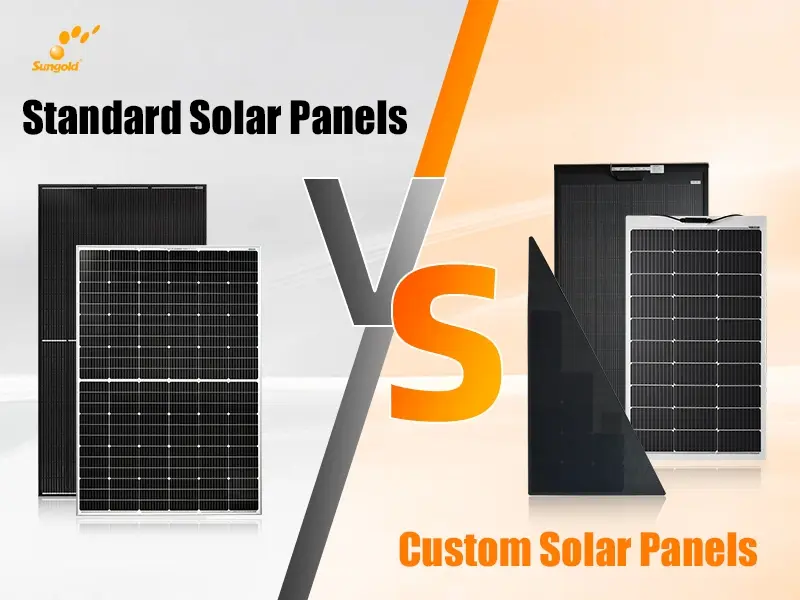
Short answer: Custom solar panels are modules built to specific dimensions, wattages, or form factors for non-standard installations — RVs, boats, irregular rooftops, and portable power stations. Standard panels are mass-produced 60- or 72-cell modules optimized for conventional rooftop and ground-mount projects. The real difference is not price per watt; it is total system cost over 25 years. In constrained or irregular spaces, custom panels frequently deliver a lower levelized cost of energy than standard alternatives.
What Are Custom Solar Panels and Who Needs Them?
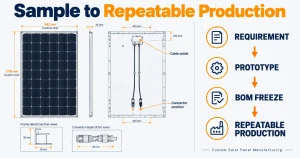
Custom solar panels are photovoltaic modules manufactured to buyer-specified dimensions, voltage outputs, or mechanical properties. They exist because the real world is not a flat, rectangular rooftop. When a project involves curved RV roofs, limited deck space on a yacht, trapezoidal building facades, or portable military field kits, off-the-shelf panels simply do not fit — physically or electrically.
Typical Customization Parameters
- Physical size — any length × width within cell-layout constraints
- Voltage & current — matched to specific charge controllers or battery banks
- Encapsulation — ETFE front sheets for lightweight flex panels; glass-glass for BIPV
- Connectors & junction boxes — positioned to suit wiring routes
- Mechanical features — grommets, adhesive backing, anti-vibration frames
Sungold Solar, for example, produces lightweight flexible panels as thin as 2 mm and as light as 2.5 kg/m², with custom sizing available from 10 W to 400 W per module. These panels have passed IEC 61215 and IEC 61730 testing and carry both TÜV and UL certifications — the same compliance benchmarks applied to any tier-one standard panel.
Reference: IEC 61215:2021 — Terrestrial photovoltaic (PV) modules — Design qualification and type approval. International Electrotechnical Commission.
What Are Standard Solar Panels and Where Do They Excel?
Standard solar panels are factory-produced modules in industry-common formats — most often 60-cell (≈1650 × 992 mm), 72-cell (≈2000 × 992 mm), or the newer 78-cell variants using M10 or G12 wafers. Their strength is volume economics: because millions of identical units roll off the same production lines, the per-watt cost is the lowest available in the market.
Best-Fit Scenarios for Standard Panels
- Large residential rooftops with uniform, unobstructed area
- Commercial flat-roof arrays and ground-mount solar farms
- Budget-first projects where installation geometry is straightforward
- Grid-tied systems using string inverters with standard voltage windows
If your roof is a clean rectangle with no vents, chimneys, or skylights breaking up the surface, standard panels will almost always be the most cost-effective choice. The challenge begins when the installation site is anything but standard.
How Do Custom and Standard Solar Panels Compare Side by Side?
Below is a specification-level comparison across the dimensions that matter most to system designers and procurement teams. The data reflects 2025–2026 market averages for mono-crystalline modules.
| Specification | Custom Solar Panels | Standard Solar Panels |
|---|---|---|
| Size flexibility | Any dimension within cell-layout limits | Fixed: ~1650×992 mm or ~2000×992 mm |
| Cell technology | Mono PERC / TOPCon / HJT / BC | Mono PERC / TOPCon / HJT / BC |
| Module efficiency | 19–22.8% | 20–23.5% |
| Weight (glass-backsheet) | Varies; flex options 2.5–4 kg/m² | ~11–13 kg/m² |
| Price per watt (module only) | $0.22–$0.38 | $0.10–$0.18 |
| Typical BOS cost share | 10–18% of system | 20–35% in non-standard installs |
| Lead time | 2–6 weeks (MOQ dependent) | In stock / 1 week |
| MOQ | 50–500 pcs (manufacturer dependent) | 1 pc (retail) / 1 pallet (wholesale) |
| Certifications available | IEC 61215, IEC 61730, TÜV, UL | IEC 61215, IEC 61730, TÜV, UL, MCS |
| Warranty | 10–25 years (varies) | 25–30 years (industry norm) |
Pricing data: BNEF Global PV Module Price Index, Q4 2025. Bloomberg New Energy Finance.
When Should You Choose Custom Solar Panels?
Custom panels earn their premium when the installation environment punishes a one-size-fits-all approach. The following scenarios consistently tip the ROI calculation in favor of customization.
Irregular or Space-Constrained Rooftops
Dormers, hip roofs, and L-shaped surfaces leave dead zones that standard panels cannot fill. A custom layout can recover 20–40% of otherwise wasted roof area, translating directly into additional annual kWh.
RV, Marine, and Overland Vehicle Applications
Weight and aerodynamics matter on a moving platform. Sungold’s PA219 series flexible panels weigh under 3 kg per module and bend to a 30° arc, fitting curved RV roofs and boat decks without roof racks or wind drag. For complete RV power setups, see Sungold RV solar kits.
Off-Grid and Remote Power Systems
Communication towers, agricultural irrigation pumps, and remote surveillance stations need panels sized to specific battery-bank voltages and enclosure dimensions. A 265 W flexible panel bolted to a canopy frame, for instance, doubles as both a power source and a weather shelter — a real deployment Sungold has delivered. Explore turnkey configurations at Sungold off-grid solar kits.
OEM / ODM Product Integration
Solar street lights, smart benches, IoT sensor housings, and portable power stations all require panels built to the product’s own form factor. In these cases, “standard” is not an option — the panel is the product.
When Are Standard Solar Panels the Smarter Investment?
Standard panels remain the default for good reason: they are cheap, fast to procure, and backed by decades of field data. Choose them when your project checks these boxes.
- Uniform roof geometry — no obstructions, no curves, no irregular edges
- Grid-tied residential or commercial — string inverter compatibility out of the box
- Tight budget, simple layout — lowest $/W wins when space is not the constraint
- Immediate availability — no time to wait 3–6 weeks for a custom run
For large-scale ground-mount farms or warehouse rooftops measured in thousands of square meters, the economies of scale in standard panels are difficult to beat. The math changes only when the site itself imposes constraints.
Why Does the "Cost Per Watt" Comparison Mislead Buyers?
Nearly every comparison article online reduces the custom-vs-standard decision to a single metric: dollars per watt. That framing is incomplete, and it consistently steers buyers toward the wrong choice in non-standard installations. Here is what the surface-level analysis misses.
The “Usable Watt” Problem
A 400 W standard panel rated at $0.14/W looks cheaper than a 200 W custom panel at $0.28/W. But place that 400 W panel on a trapezoidal RV roof where only 60% of the available area can be covered, and the installed capacity drops to roughly 240 W. Meanwhile, two custom 200 W panels shaped to the roof’s actual geometry deliver 400 W from the same footprint. Over a 25-year service life, the custom setup produces an estimated 30–35% more cumulative energy from identical roof space.
The metric that matters is not $/W at the module level. It is $/kWh actually harvested over the system lifetime — the levelized cost of energy (LCOE). When you recalculate on that basis, the custom “premium” frequently disappears.
Balance-of-System Costs: The Hidden Equalizer
Forcing standard panels into non-standard spaces creates downstream costs that rarely appear in module-price comparisons:
- Custom mounting brackets and adapters (because the panel was not designed for the surface)
- Additional wiring runs and MC4 branch connectors
- Micro-inverters or power optimizers to handle partial shading from misfit layouts
- Labor hours for improvised installation
Industry data from the National Renewable Energy Laboratory (NREL) shows that balance-of-system (BOS) hardware and labor account for 50–65% of total residential solar system cost in the U.S. In awkward installations, BOS costs can spike further. A panel that fits its mounting surface precisely — because it was designed for it — can cut BOS expenses by 40–60%, offsetting the higher module price.
Reference: Fu, R. et al., “U.S. Solar Photovoltaic System and Energy Storage Cost Benchmarks: Q1 2024,” NREL/TP-7A40-80694. National Renewable Energy Laboratory.
In a 2025 deployment for a fleet of mobile surveillance trailers, Sungold supplied custom 200 W glass-laminated panels sized to the trailer roof dimensions. The client’s original plan used standard 100 W rigid panels with aftermarket brackets. Switching to custom modules eliminated the bracket hardware entirely, reduced per-trailer installation time from 4 hours to 1.5 hours, and increased daily energy yield by 28% — while the total per-trailer cost dropped by 11%.
Why "Standard" Keeps Changing
There is an irony in calling any panel “standard.” Between 2020 and 2026, the mainstream wafer size shifted from M2 (156.75 mm) to M6, then M10, then G12, and now G12R. Module dimensions changed with each generation. Inverter compatibility windows had to be re-validated. Racking systems needed new clamp sizes. For anyone planning a phased project over multiple years, the “standard” of today may be discontinued tomorrow. Custom panels, designed around the project’s fixed parameters rather than the industry’s moving target, can actually provide greater long-term design stability.
Can Custom Solar Panels Survive Harsh Environments?
Yes — and this is where build quality matters more than panel format. A well-engineered custom panel undergoes the same IEC 61215 test sequences as any standard module: 1,000 hours of damp-heat exposure at 85 °C / 85% RH, 200 thermal cycles between −40 °C and +85 °C, mechanical load testing to 5,400 Pa, and hail impact simulation.
Sungold’s manufacturing line applies these protocols to every custom order. Key durability features across the product range include:
- IP67-rated junction boxes — sealed against dust and temporary submersion
- ETFE front sheets on flexible models — UV-stable, salt-spray resistant, self-cleaning surface
- Anti-vibration frame design on the PA621 series — engineered for vehicle-mounted applications where road vibration degrades conventional frames
- Tempered glass + POE encapsulant on rigid customs — rated for snow loads up to 5,400 Pa
Sungold panels have been deployed in Saharan desert monitoring stations, Nordic marine vessels, and Southeast Asian coastal farms — environments where temperature swings, salt fog, and humidity would destroy poorly built modules within months. The TF series, for instance, is impact-resistant and rated for foot traffic, making it a practical choice for boat decks and industrial walkways.
How Do You Choose a Reliable Custom Solar Panel Manufacturer?
Not all custom panel suppliers are equal. The gap between a prototype shop and a production-grade manufacturer shows up in consistency, certification, and after-sales support. Use this checklist before placing an order.
Certifications to Verify
| Certification | What It Covers | Why It Matters |
|---|---|---|
| IEC 61215 | Design qualification & type approval | Proves the module design survives accelerated aging |
| IEC 61730 | Safety qualification | Required for electrical safety compliance in most markets |
| TÜV Rheinland | Third-party testing & factory audit | Independent verification — not self-declared |
| UL 61730 | North American safety listing | Mandatory for U.S. and Canadian installations |
| MCS (UK) | Microgeneration Certification Scheme | Required for UK feed-in tariff eligibility |
Questions to Ask Before Ordering
- What is your MOQ for custom dimensions, and can I order samples first?
- Which cell technologies do you stock — PERC, TOPCon, HJT, back-contact?
- Do your custom modules carry the same IEC/TÜV/UL certifications as your standard line?
- What is the typical lead time from design confirmation to shipment?
- Do you provide EL (electroluminescence) test images for each production batch?
- What warranty terms apply to custom orders — product warranty and performance guarantee?
Sungold Solar has operated for 18 years with ISO-certified production facilities in Shenzhen, China, and Batam, Indonesia. The dual-factory setup allows tariff optimization for North American and European buyers while maintaining consistent quality control. Visit the Sungold custom solar panel page to start a design consultation.
Frequently Asked Questions
Are custom solar panels more expensive than standard ones?
Per-watt pricing is typically 15–30% higher for custom modules. However, in non-standard installations — curved roofs, vehicles, compact spaces — reduced mounting hardware, fewer adapters, and better space utilization often bring the total system cost below that of forcing standard panels into the same space. Compare total installed cost, not module cost alone.
What is the minimum order quantity for custom solar panels?
MOQ depends on the manufacturer and the level of customization. Some suppliers, including Sungold Solar, accept orders as low as 50–100 pieces for custom-sized modules. Larger factories may require 500 or more units. Always request evaluation samples before committing to a production run.
Can custom solar panels match the efficiency of standard panels?
Yes. Custom panels use identical cell technologies — mono PERC, TOPCon, HJT, or back-contact cells — as standard modules. Efficiency is determined by cell grade and encapsulation quality, not by panel dimensions. A properly manufactured custom panel reaches 22%+ cell efficiency, on par with mainstream products.
What Is the Bottom Line for Your Next Solar Project?
The custom-vs-standard decision is not about which panel is “better.” It is about which panel fits the project. Standard modules win on unit economics when the installation site cooperates. Custom modules win on system economics when it does not. The mistake most buyers make is optimizing for the wrong metric — module price instead of lifetime energy cost.
If your project involves irregular surfaces, weight limits, vehicle integration, or any scenario where a standard panel leaves usable space on the table, get a custom quote before defaulting to off-the-shelf. The numbers may surprise you.