 EN
EN
 Deutsch
 Italiano
 Español
 Français
 日本語
日本語
Quick Answer
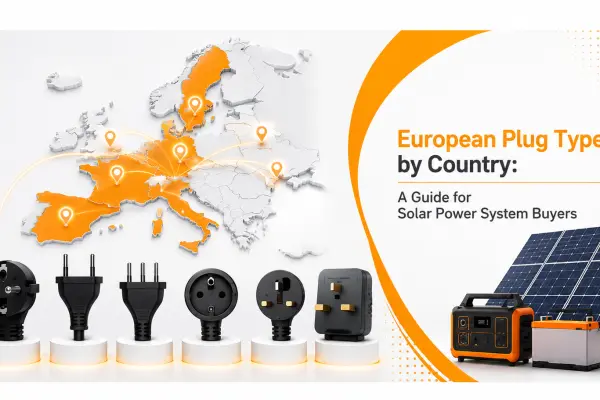
There is no single plug type used across all European countries. Type C, Type E, and Type F connections are common across much of continental Europe, while the United Kingdom and Ireland use Type G. Italy, Switzerland, and Denmark also have national plug and socket formats that buyers may need to consider.
For an OEM solar power system, however, identifying the European plug type is only one part of the specification. Buyers must also confirm the AC output voltage, frequency, grounding arrangement, outlet rating, inverter design, target-country requirements, and model-level compliance documentation.
Solar panels normally supply DC power to a charge controller, inverter, battery system, or portable power station. The European AC plug or socket is located on the downstream power-conversion equipment. It is not determined by the solar panel alone.
What Are the Main European Plug Types?
The phrase “European plug” is often used as though it describes one standard product. In practice, Europe uses several plug and socket systems.
The differences matter for more than physical fit. A plug may be ungrounded or grounded, designed for a particular current range, or governed by a national standard. For B2B buyers developing a portable power station, mobile energy system, off-grid product, or solar generator for Europe, the target market should therefore be defined before the AC outlet configuration is finalized.
Type C: The Two-Pin Europlug
Type C is commonly associated with the Europlug. It has two round pins and is widely used for low-power, double-insulated devices such as small chargers and consumer electronics.
It is important not to treat Type C as a universal solution for every European appliance or power system. The Europlug does not provide a protective earth connection, so it is not the correct reference for equipment that requires grounding. It may fit several socket families, but physical insertion does not by itself confirm the electrical suitability of the complete system.
Type E: The French-Style Grounded System
Type E is used in markets including France, Belgium, Poland, Czechia, and Slovakia. Its grounding arrangement uses an earth pin that projects from the socket.
For an OEM power product, the mechanical outlet, grounding path, enclosure design, inverter protection, labeling, and target-market documentation need to be considered together. Buyers should not assume that a Type C outlet is an equivalent substitute simply because some two-pin devices can be connected.
Type F: The Schuko System
Type F, often called Schuko, is common in Germany and in many other continental European markets. It uses two round pins and grounding contacts at the sides.
Type F is particularly relevant to searches such as “German socket,” “EU electric socket,” “European power outlet,” and “European plug for portable power station.” But specifying “Schuko” on an RFQ is still not enough. The buyer should also state the required AC voltage, frequency, output rating, protection arrangement, and destination market.
Type G: The UK and Ireland Format
Type G has three rectangular pins and is used in the United Kingdom and Ireland. It is physically different from the two-round-pin formats associated with continental Europe.
This is why a product described only as an “EU version” may not cover the UK and Ireland. If the same power station, inverter, or mobile energy product will be sold in both continental Europe and the UK, separate outlet, cable, labeling, packaging, and compliance configurations may be required.
Other National Formats
Several European markets retain additional national formats:
- Italy commonly uses Type L alongside other compatible formats.
- Switzerland uses Type J.
- Denmark uses Type K, although other compatible plug formats may also appear.
- Malta and Cyprus generally use Type G.
These variations are the main reason procurement teams should define actual sales countries instead of writing only “Europe” in the specification.
European Plug Types by Country
The following table is a planning reference for common general-use plug formats. It should not replace country-specific regulatory review, product testing, or confirmation with the system supplier.
| Target Market | Common Plug or Socket Types | Typical Nominal Supply | B2B System Planning Point |
|---|---|---|---|
| Germany | C, F | 230V / 50Hz | Confirm Schuko outlet, grounding, inverter output, and plug-specific documentation |
| Netherlands | C, F | 230V / 50Hz | Often grouped with Type F markets, but the final product version still needs market confirmation |
| Spain | C, F | 230V / 50Hz | Confirm outlet rating and complete AC output architecture |
| Portugal | C, F | 230V / 50Hz | Do not rely only on the physical two-pin appearance |
| France | C, E | 230V / 50Hz | Review Type E grounding and E/F compatibility at product level |
| Belgium | C, E | 230V / 50Hz | Confirm the grounded outlet configuration |
| Poland | C, E | 230V / 50Hz | Check whether a combined E/F product configuration is appropriate |
| United Kingdom | G | 230V / 50Hz | Usually requires a dedicated UK outlet, cable, labeling, and compliance version |
| Ireland | G | 230V / 50Hz | Do not assume a continental EU outlet is suitable |
| Italy | C, F, L | 230V / 50Hz | Define the intended outlet and connection standard for the exact product |
| Switzerland | C, J | 230V / 50Hz | A general continental version may not be sufficient |
| Denmark | C, K and other permitted configurations | 230V / 50Hz | Confirm the applicable national requirements before finalizing the outlet |
IEC 60038 provides standardized nominal voltage values for electrical supply systems and equipment design, including 230V at 50Hz. It does not mean that every European country uses the same plug, socket, grounding arrangement, or national product requirement.
Plug Type, Voltage, and Frequency Are Not the Same Specification
One of the most common mistakes in European power product sourcing is treating the plug shape as the whole electrical specification.
These items solve different compatibility questions:
| Specification | Question It Answers | Why It Matters |
|---|---|---|
| Plug or socket type | Will the physical connector fit? | Type C, E, F, G, J, K, and L are not physically identical |
| AC voltage | Is the equipment designed for the supply or output voltage? | A fitting plug does not make a 120V-only product compatible with 230V |
| Frequency | Is the equipment designed for 50Hz operation? | Some motors, timing devices, transformers, and other loads may be frequency-sensitive |
| Grounding | Is a protective earth connection required and correctly provided? | Type C does not provide protective earth |
| Continuous output | How much load can the inverter support over time? | Outlet shape alone says nothing about inverter capacity |
| Surge output | Can the system start motors, pumps, compressors, or other transient loads? | Startup power may be much higher than running power |
| Protection design | How are overload, short circuit, leakage, temperature, and other risks managed? | Protection must be assessed as part of the complete product |
| Certification scope | Which complete model and market are covered by the available documents? | A component certificate does not automatically approve the complete system |
Electrical Safety First advises users to check both the destination plug type and the voltage rating of their equipment. A travel adapter changes the physical connection; it does not automatically convert the electrical supply.
For OEM and system buyers, the same principle applies at a larger scale: a different AC receptacle cannot turn an incompatible inverter into a compliant European product.
Where the European Plug Sits in a Solar Power System
The European AC plug is not normally attached directly to a PV module. It appears after the system has converted and managed the solar-generated DC electricity.
A simplified system path is:
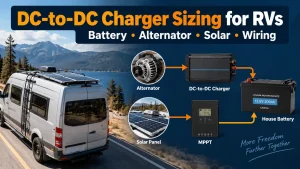
Solar panel -> charge controller or MPPT -> battery -> inverter or portable power station -> European AC outlet -> electrical load
Each part has a separate role.
| System Component | Primary Function | Plug-Related Responsibility |
|---|---|---|
| Solar panel | Generates DC electricity from sunlight | Must match the solar input voltage and current requirements of downstream equipment |
| Charge controller / MPPT | Regulates PV charging into the battery | Does not define the European AC socket |
| Battery | Stores DC energy | Must match the inverter or power station architecture |
| Inverter | Converts DC electricity to AC electricity | Defines output voltage, frequency, waveform, continuous power, surge power, and protection |
| Portable power station | Integrates battery, inverter, controls, and output ports | The regional product version normally determines the AC outlet type |
| AC plug or socket | Provides the physical connection to the load | Must match the target country and complete product design |
This distinction matters when a buyer asks for a “European plug solar panel.” The request may actually refer to one of three different products:
- A solar panel bundled with a region-specific portable power station.
- A solar module supplied with a DC connector for a European-market energy system.
- A complete solar generator or off-grid package with a European AC output.
The buyer and supplier should clarify which product layer is being discussed before confirming specifications.
How European Plug Requirements Affect Solar System Design
Portable Power Stations
A portable power station sold in Europe may require different AC outlet versions for continental Europe and the UK. The inverter output, outlet format, grounding design, charging cable, labels, manual, packaging, and market documentation should be reviewed as one product configuration.
The solar panel supplying that power station must be matched to its DC or solar input range. It does not need a Type C, Type F, or Type G AC plug unless an additional AC-powered device is part of the package.
Mobile and Vehicle-Based Systems
RV, caravan, truck, trailer, and service-vehicle systems may combine:
- Flexible or lightweight solar panels
- A charge controller
- A 12V, 24V, or higher-voltage battery architecture
- An inverter
- Region-specific AC outlets
- DC and USB charging ports
For these projects, the roof area and solar input determine the PV design, while the destination market and intended loads determine the AC output configuration.
Marine and Yacht Systems
Marine applications add environmental and installation considerations such as limited mounting area, weight, curved surfaces, moisture exposure, salt environments, cable routing, and system grounding.
A European outlet choice does not resolve these application risks. The complete module, installation method, electrical architecture, and required documentation must be reviewed for the specific vessel and market.
Remote and Off-Grid Equipment
Remote monitoring, telecom, security, agricultural, and temporary worksite systems often use DC loads without any European AC socket. Adding an inverter and AC outlet may introduce unnecessary cost and conversion losses if the equipment can operate directly from the DC system.
The first design question should therefore be whether an AC outlet is required at all, not which European type plug should be added.
Type C vs Type F for a Solar Power Product
The phrase “Type C vs Type F plug” appears simple, but the correct choice depends on the equipment.
| Decision Factor | Type C | Type F |
|---|---|---|
| Pin layout | Two round pins | Two round pins |
| Protective earth | No | Yes, through side contacts |
| Typical use | Lower-power, double-insulated devices | Grounded appliances and general-use equipment |
| Suitable as a universal European system outlet? | No | No single plug format covers every European market |
| Key procurement question | Is the connected device designed without protective earth? | Is the complete grounding and protection design correct? |
For a portable power station or inverter, buyers should not select Type C simply because it appears compact or widely recognized. The equipment class, intended loads, current rating, grounding architecture, outlet standard, and target markets must drive the decision.
Adapter vs Converter: A Critical Boundary
A plug adapter changes the physical interface. A voltage converter or transformer changes the voltage. An inverter performs a different function again: it converts DC power from a battery into AC power for connected loads.
| Device | What It Changes | What It Does Not Confirm |
|---|---|---|
| Plug adapter | Physical plug shape | Voltage, frequency, grounding, output capacity, or compliance |
| Voltage converter / transformer | Voltage level within its rated limits | Complete market compliance or solar compatibility |
| Inverter | DC power to AC power | The correct national outlet or certification unless designed accordingly |
| Charge controller | PV charging into a battery | AC output requirements |
This distinction should appear in product briefs, manuals, distributor training, and customer support materials. It reduces the risk of a buyer assuming that a low-cost adapter can replace a properly designed regional product version.
Risks and Application Boundaries
A Plug That Fits May Still Be Electrically Incompatible
Physical compatibility is not proof of voltage, frequency, current, grounding, or protection compatibility.
“EU Plug” Is Not a Complete Procurement Specification
Europe includes multiple plug systems and national requirements. RFQs should list the actual destination countries.
Type C Does Not Provide Protective Earth
It should not be treated as the default connection for equipment requiring grounding.
An Adapter Does Not Convert Voltage
Equipment designed only for another voltage may be damaged or create a safety risk when connected through a simple adapter.
A Solar Panel Does Not Define the AC Outlet
The inverter or portable power station determines the AC output. The panel must instead be matched to the solar input requirements.
One Certificate Does Not Automatically Cover Every System Version
Changing the outlet, inverter, battery, enclosure, cable, or other system components may affect the model configuration and documentation scope. Certification claims should always be verified against the exact product and target market.
Country Tables Are Planning Tools, Not Final Approval
Plug and voltage tables help buyers develop an initial market plan, but final product decisions should use current national standards, qualified testing advice, and model-specific compliance review.
B2B Procurement Checklist for European Solar Power Systems
Before requesting a quote, an OEM, distributor, or project buyer should prepare the following information:
| RFQ Item | Information to Provide |
|---|---|
| Target countries | List the actual markets rather than writing only “Europe” |
| Product type | Portable power station, mobile system, off-grid kit, solar panel bundle, or inverter system |
| AC output | Required nominal voltage, frequency, outlet type, continuous output, and surge output |
| Grounding | Required protective-earth and system grounding arrangement |
| Loads | Equipment type, running wattage, startup wattage, and operating time |
| Battery system | Voltage, chemistry, usable capacity, and charging profile |
| Solar input | Controller or power station model, MPPT range, maximum voltage, current, and input power |
| Solar module | Required wattage, dimensions, weight, flexibility, connector, and mounting method |
| Application | RV, caravan, marine, truck, trailer, remote site, balcony, backup, or other use |
| Environment | UV, temperature, vibration, moisture, salt exposure, shading, and mechanical stress |
| Documentation | Required declarations, reports, certifications, manuals, and labeling |
| OEM scope | Custom dimensions, branding, packaging, cable configuration, and forecast quantity |
This checklist also helps separate supplier responsibilities. A solar module manufacturer can review PV format and electrical matching, while the inverter, battery, outlet, and complete-system provider must confirm their own design and compliance scope.
Where Sungold Solar Panels Fit
Sungold supports the solar module side of an off-grid, mobile, backup, or portable power system. The company should not be described as determining the complete European AC outlet configuration unless that complete-system responsibility has been separately confirmed.
For projects with curved surfaces, mobile roofs, or weight-sensitive installation, buyers can review the Sungold PA219 flexible solar panel series.
For applications where reducing module weight is a central requirement, buyers can review the Sungold PA621 lightweight solar panel series.
Before selecting either direction, the project team should confirm:
- Available mounting area
- Maximum module weight
- Required solar input power
- MPPT voltage and current limits
- Installation surface
- Environmental exposure
- Cable and connector requirements
- Required product documentation
The correct product connection is therefore:
Target country and load requirements -> inverter and battery architecture -> solar input specification -> suitable Sungold module format
It should not be:
European plug type -> assume any solar panel will work
FAQ
What plug type is used in most of Europe?
Type C, Type E, and Type F are common across much of continental Europe. However, Europe does not use one universal plug. The UK and Ireland use Type G, while Italy, Switzerland, and Denmark also have national formats that may need separate consideration.
Is the EU plug Type C or Type F?
The term “EU plug” is informal and incomplete. Type C usually refers to the ungrounded two-pin Europlug, while Type F refers to the grounded Schuko system used in Germany and many other markets. The correct choice depends on the product, grounding requirements, current rating, and destination country.
Are all European countries 230V and 50Hz?
230V at 50Hz is widely used across Europe and is included in IEC standardized voltage values. However, buyers should still verify the exact target country, application, and product requirements. A common nominal voltage does not mean every country uses the same plug or socket.
Is a European plug adapter also a voltage converter?
No. A plug adapter changes the physical connection. It does not normally change voltage or frequency. Equipment that is not designed for the local supply may need a properly rated converter, transformer, or a different product version.
Can one portable power station version be sold throughout Europe?
Not automatically. Continental European markets, the UK, Ireland, Switzerland, Italy, and Denmark may require different outlet, cable, labeling, packaging, or compliance configurations. The intended countries should be reviewed before one product version is approved.
Does a solar panel need a European plug?
Usually not. Solar panels normally provide DC output to a controller, inverter, battery system, or portable power station. The European AC outlet is generally part of the inverter or power station, not the PV module.
What should an OEM buyer confirm for an EU solar power system?
Confirm the destination countries, outlet type, AC voltage and frequency, grounding, inverter output, battery architecture, solar input limits, panel format, installation environment, and model-specific documentation.
What is the difference between UK and EU power station outlets?
The UK and Ireland generally use Type G outlets, while much of continental Europe uses Type E or Type F grounded systems and accepts Type C plugs for appropriate devices. A UK power station version should not be assumed to be identical to a continental European version.
Final Thoughts
European plug types are an important part of regional product planning, but they are not the complete electrical specification.
For B2B solar power system buyers, the correct process is to define the target countries and loads first, then confirm voltage, frequency, grounding, inverter output, outlet format, battery architecture, solar input, and compliance scope.
Sungold can support the solar module portion of that process through flexible, lightweight, and customized panel options. The AC outlet and complete system architecture should be confirmed with the responsible inverter, battery, or power-system provider.