 EN
EN
 Deutsch
 Italiano
 Español
 Français
 日本語
日本語
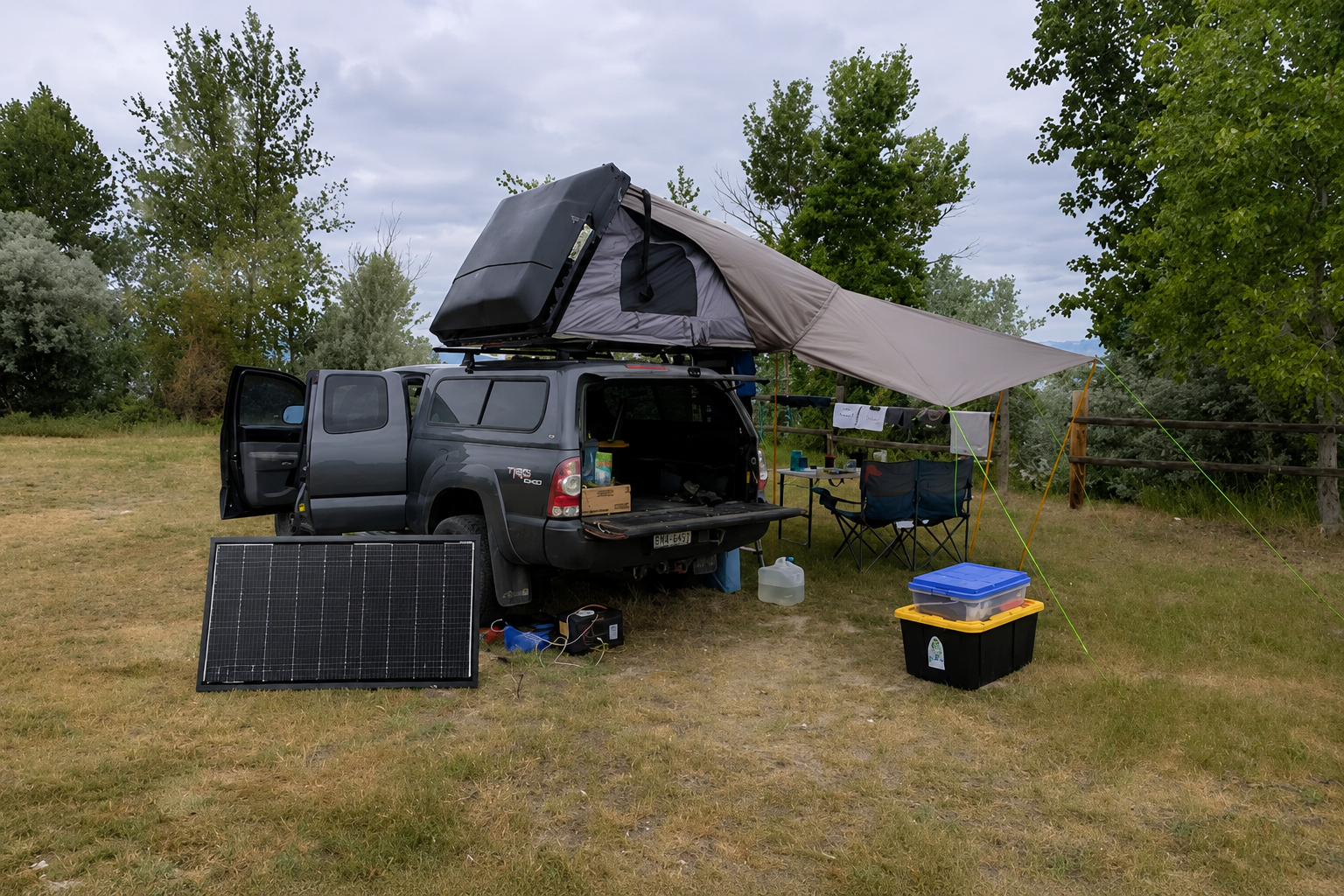
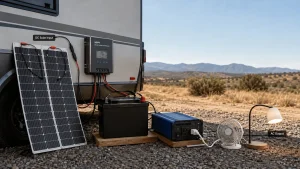
RV parks and resorts in Florida usually refer to RV campgrounds, long-stay RV communities, coastal RV resorts, nature-focused campgrounds, and full-hookup resort-style parks. Many provide electric hookups, water, dump stations, Wi-Fi, laundry, pools, and access to beaches, lakes, trails, or nearby attractions. For long-stay RV travelers, these site conditions also affect solar power planning. Solar panels are not meant to replace every campground connection. They can support battery maintenance, daytime loads, backup power, and more flexible camping when full hookups are unavailable, crowded, shaded, or limited by site conditions.
The key question is not only which RV park should I choose? It is also how the RV power system will work across different campsites, shade conditions, hookups, and travel environments.
For RV buyers, dealers, and system brands, this matters because a Florida RV resort, wooded campground, coastal site, or partial-hookup campsite can create very different solar panel requirements.
RV Park vs RV Resort vs Campground: What’s the Difference?
People often use these terms together, but they do not always mean the same thing. For solar planning, the difference matters because the site type affects how the RV is parked, whether hookups are available, and how much shade or weather exposure the solar system faces.
| Term | What It Usually Means | Solar Relevance |
|---|---|---|
| RV Park | A place designed for RV parking, often with hookups and basic amenities | Solar needs depend on hookup availability, parking layout, and shade |
| RV Resort | A more amenity-focused RV destination with pools, events, clubhouses, and long-stay comfort | Long-stay users may have more battery, device, and comfort loads |
| Campground | A broader outdoor stay option, often more nature-focused and sometimes less developed | More shade, partial hookups, and off-grid use cases may appear |
What People Usually Mean by “RV Parks and Resorts in Florida”
When people search for RV parks and resorts in Florida, they are usually comparing places to stay. They may be looking for full-hookup RV sites, beach or lake access, resort-style pools, family-friendly activities, pet-friendly sites, long-stay availability, Wi-Fi, laundry, or access to nature trails, fishing, boating, and nearby attractions.
Search results often mention resort-style destinations, coastal RV parks, Florida Keys campgrounds, Central Florida RV resorts, and wooded nature-focused sites. This article does not rank individual parks, prices, or ratings because those details change often.
Florida RV Park Region Snapshot
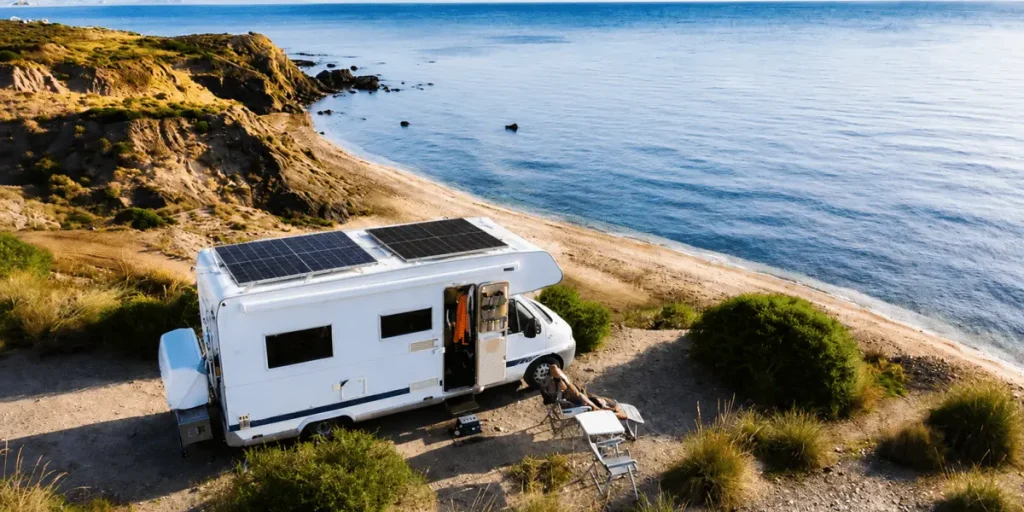
Florida is not one single RV market. Different regions create different camping and power-planning conditions.
| Florida RV Region | Typical RV Experience | Solar Planning Note |
|---|---|---|
| Florida Keys | Coastal stays, ocean access, compact spaces, seasonal demand | Salt air, humidity, wind, and limited roof space matter |
| Central Florida | Resort-style parks, long-stay communities, family attractions | Battery maintenance and daily comfort loads become more important |
| Gulf Coast | Beach access, warm-weather stays, seasonal travel | Corrosion resistance and mounting durability should be reviewed |
| North Florida | Nature-focused campgrounds, wooded sites, quieter stops | Tree shade may reduce solar output |
| State parks and lake areas | Outdoor recreation, partial hookups, natural shade | Portable or anti-shading options may be useful |
| Beyond Florida | Georgia, Tennessee, Texas, lake and mountain resort markets | Similar solar planning questions apply outside Florida |
Florida is a useful example because it combines sunshine, coastal travel, long-stay RV use, wooded campsites, and resort-style parking. But the same solar questions apply to RV resorts and campgrounds beyond Florida as well.
Common Types of RV Parks and Resorts in Florida
The value of solar changes by site type. A full-hookup RV resort creates a different power need from a wooded campground or a partial-hookup site.
| RV Park / Resort Type | Typical Situation | Solar Power Question |
|---|---|---|
| Resort-style RV parks | Pools, events, full hookups, family activities | If hookups are available, does the RV still need solar for battery support? |
| Coastal and Keys RV sites | Beach access, salt air, humidity, wind exposure | How should panel material, mounting, and corrosion resistance be reviewed? |
| Nature-focused campgrounds | Trees, lakes, state parks, shaded sites | How much will tree shade affect RV solar output? |
| Golf or long-stay communities | Central Florida, winter stays, seasonal use | How should batteries and small daily loads be maintained? |
| Partial-hookup or overflow sites | Limited electrical access or temporary parking | Can solar reduce dependence on a generator? |
| Beyond Florida resorts | Lake, mountain, and warm-weather RV destinations | Are RV solar packages useful outside high-sun Florida? |
The key point is simple: solar planning should follow the way the RV will actually be used.
Resort Amenities vs RV Solar Power Needs
Many RV resorts promote full hookups, pools, planned activities, beach access, clubhouses, Wi-Fi, laundry, and gated communities. These amenities improve the stay, but they do not remove every power-planning question.
| Amenity / Site Condition | Why It Matters for RV Solar |
|---|---|
| Full hookup | Solar becomes a support layer for battery maintenance and backup, not the main power source |
| Partial hookup | Solar can support daytime charging and smaller loads |
| Wooded site | Shade pattern becomes a key design issue |
| Coastal site | Humidity, salt air, and wind exposure affect panel and mounting choices |
| Long-stay site | Battery health and daily device loads become more important |
| Primitive or overflow area | Portable or roof-mounted solar can become more valuable |
| Resort-style parking | Nearby RVs, buildings, trees, or awnings may create partial shade |
This is why a solar discussion belongs inside an RV parks and resorts topic. The campsite type affects the energy system.
Which RV Park Conditions Make Solar More Useful?
Solar panels are not equally valuable in every RV park. They become more useful when the site or travel pattern creates a real power-planning need.
| RV Park Condition | Why Solar May Help |
|---|---|
| Partial hookup or no hookup | Solar can help maintain batteries during the day |
| Long-stay camping | Daily small loads and battery cycling become more important |
| Wooded or shaded sites | Panel type, placement, and anti-shading design need review |
| Coastal or humid sites | Material durability and mounting method matter more |
| Generator restrictions | Solar can reduce generator use for smaller loads |
| Remote work from RV | Routers, laptops, lights, and device charging need steady support |
| Frequent campsite changes | Portable or flexible panel options may improve adaptability |
Solar is most useful when it solves a specific use case: battery support, backup power, small-load charging, reduced generator use, or flexibility beyond full-hookup sites.
Why Long-Stay RV Travelers Still Consider Solar Power
Weekend campers often think about solar differently from long-stay RV travelers. A weekend user may depend on campground hookups, drive time, or a generator. A long-stay traveler often has more continuous loads and more repeated battery cycles.
| Weekend RV Camper | Long-Stay RV Traveler |
|---|---|
| Short stay | Several weeks or months |
| More dependent on campground facilities | More interested in independent power support |
| Simple device charging | More daily loads such as refrigerator, lights, fans, router, laptops, and small appliances |
| Less likely to invest in solar | More likely to review solar and battery planning |
| Less concerned about battery maintenance | More concerned about battery health and backup use |
Solar can support long-stay RV use by helping maintain house batteries during the day, reducing small-load dependence on hookups, providing backup support during limited access, reducing generator runtime for small loads, supporting remote work equipment, and improving flexibility beyond full-hookup resort sites.
Florida-Specific Solar Conditions: Sun, Shade, Humidity and Coastal Air
Florida is often considered a solar-friendly RV market because of strong sunshine and year-round travel demand. But strong sun does not mean any panel will work well in every RV site.
Florida RV solar planning should also consider high temperatures, humidity, coastal salt air, heavy rain, wind exposure, shaded campsites, trees and palm shadows, RV roof vents, air conditioners, racks, and antennas.
Shade is especially important. In real RV parks, a site may be sunny in the morning and shaded in the afternoon. A tree, neighboring RV, awning, or roof accessory can create a moving shadow across the panel.
This is why RV solar buyers should not only ask how many watts a panel has. They should also ask where the panel will be mounted, what kind of shade may appear, and how the controller or battery system will respond.
Electric Hookups vs Solar Power
Campground electricity and RV solar power solve different problems.
| Power Source | What It Helps With | Limits |
|---|---|---|
| 30A / 50A hookup | Large loads, air conditioning, long parking stays | Depends on site availability and campground rules |
| RV house battery | Night use and short basic loads | Limited capacity and needs recharging |
| Solar panels | Daytime charging, battery maintenance, backup support | Affected by weather, shade, and roof space |
| Generator | Fast charging and larger loads | Noise, fuel, maintenance, and campground restrictions |
| Portable power station | Flexible device charging and small-load backup | Limited capacity and input power |
The practical conclusion is simple: solar power is a support layer, not a universal replacement for campground electricity.
For long-stay RV users, solar is often most valuable when it supports daily battery use, reduces small-load dependence, and improves flexibility between full-hookup and partial-hookup sites.
Which Solar Panel Type Fits RV Park and Resort Use?
There is no single best solar panel type for every RV. The right format depends on roof space, weight limits, shade pattern, travel environment, mounting method, and system architecture.
| Panel Type | Best Fit | Buyer Check |
|---|---|---|
| Rigid solar panels | Fixed roof installations with enough space | Roof structure, mounting hardware, wind exposure |
| Flexible solar panels | Curved or lightweight RV roofs | Surface material, heat dissipation, adhesive or mechanical fixing |
| Lightweight solar panels | Weight-sensitive RV roofs | Roof load, wind load, vibration, installation method |
| Portable solar panels | Temporary campsite use or adjustable placement | Storage, cable length, weather resistance, theft risk |
| Anti-shading solar panels | Trees, roof accessories, or partial shade | Shade source, controller matching, expected use pattern |
For Florida RV parks and resorts, flexible, lightweight, portable, and anti-shading designs can all make sense in different situations. The panel should be selected by use case, not by one marketing term.
What RV Buyers Should Check Before Choosing Solar
Before choosing a solar panel or RV solar kit, buyers should confirm the following points.
| Check | Why It Matters |
|---|---|
| Daily power use | Determines whether the system is for battery support, device charging, or larger loads |
| Battery voltage | 12V and 24V systems should not be confused |
| Roof space | Controls panel size, number of panels, and layout |
| Shade pattern | Determines whether anti-shading design or portable placement matters |
| Mounting method | Affects rigid, flexible, lightweight, or portable panel choice |
| Controller input | Panel voltage and current must match the charge controller |
| Travel environment | Heat, humidity, salt air, vibration, and wind affect product selection |
The biggest mistake is to choose solar only by wattage. A higher-wattage panel may still underperform if it is installed in the wrong place, matched with the wrong controller, or placed under recurring shade.
For RV Dealers and System Brands: Product Package Readiness
For RV dealers, distributors, and system brands, the product opportunity is not only selling a panel. It is building a matched RV solar package.
| Package Element | Why It Matters |
|---|---|
| Panel format | Different RV roofs need different structures |
| Controller compatibility | Reduces incorrect system matching |
| Cable and connector plan | Reduces installation errors |
| Mounting method | Protects roof structure and long-term reliability |
| User instructions | Helps customers understand realistic output and safe use |
| Shade guidance | Reduces complaints caused by unrealistic expectations |
| Warranty and claim boundary | Avoids overpromising performance, certification, or lifespan |
A good RV solar package should clearly say what it can support and what it cannot support. For example, a compact solar kit may help maintain batteries and support small loads. It should not be marketed as a guaranteed air-conditioning solution unless the full system has been calculated with enough panel capacity, battery storage, inverter capacity, and load control.
How Sungold Can Support RV Solar Projects
For RV buyers, dealers, and system brands, Sungold can help review the application before recommending a panel type.
The right choice may involve flexible panels for curved roofs, lightweight panels for weight-sensitive vehicles, portable panels for temporary campsite use, or anti-shading modules for recurring partial-shade conditions.
For RV-focused projects, the main product path is RV Solar Power Solutions for Motorhomes & Camper Vans.
Instead of starting with a generic panel request, buyers should provide RV roof size, battery voltage, expected daily loads, controller or inverter input range, mounting surface, shade sources, travel environment, target market, packaging, and documentation needs.
FAQ
An RV park usually provides RV sites and basic or mid-range amenities. An RV resort often adds more comfort features such as pools, clubhouses, events, long-stay communities, and resort-style services. For solar planning, resorts may have more full hookups, while campgrounds may have more shade or partial-hookup conditions.
Many Florida RV parks and resorts provide electric hookups, but availability, amperage, and site type vary. Some locations may offer full hookups, while others may have partial hookups, primitive camping, or overflow areas. RV travelers should confirm the site details before planning their power system.
Yes, in some cases. Solar panels can support battery maintenance, backup power, and smaller daytime loads. They are not a replacement for every campground connection, especially for high-power loads such as air conditioning.
They can be useful because long-stay RV users often have more continuous battery and device loads. Actual value depends on roof space, shade, battery size, weather, and daily power use.
There is no single best type. Flexible panels fit curved roofs, lightweight panels help reduce roof load, portable panels offer placement flexibility, and anti-shading panels may help where partial shade is common.
Usually not by solar panels alone unless the system is specifically designed with enough panel capacity, battery storage, inverter capacity, and load control. This should be calculated, not assumed.
They should confirm battery voltage, panel size, controller input, cable length, connector type, mounting method, installation guide, shade guidance, and claim boundaries.
Final Thoughts
RV parks and resorts provide comfort, but long-stay RV travelers still need reliable power planning.
In Florida, the combination of sunshine, long-stay travel, coastal conditions, wooded campsites, and resort-style parking creates real solar design questions. Electric hookups may cover large loads, but solar panels can still support battery maintenance, backup power, and flexible use beyond full-hookup sites.
For B2B buyers, the right RV solar package should be selected by roof space, shade condition, battery architecture, controller compatibility, mounting method, and travel environment.
The goal is not to sell the highest-wattage panel. The goal is to build a power solution that fits how RV travelers actually use their vehicles.