 EN
EN
 Deutsch
 Italiano
 Español
 Français
 日本語
日本語
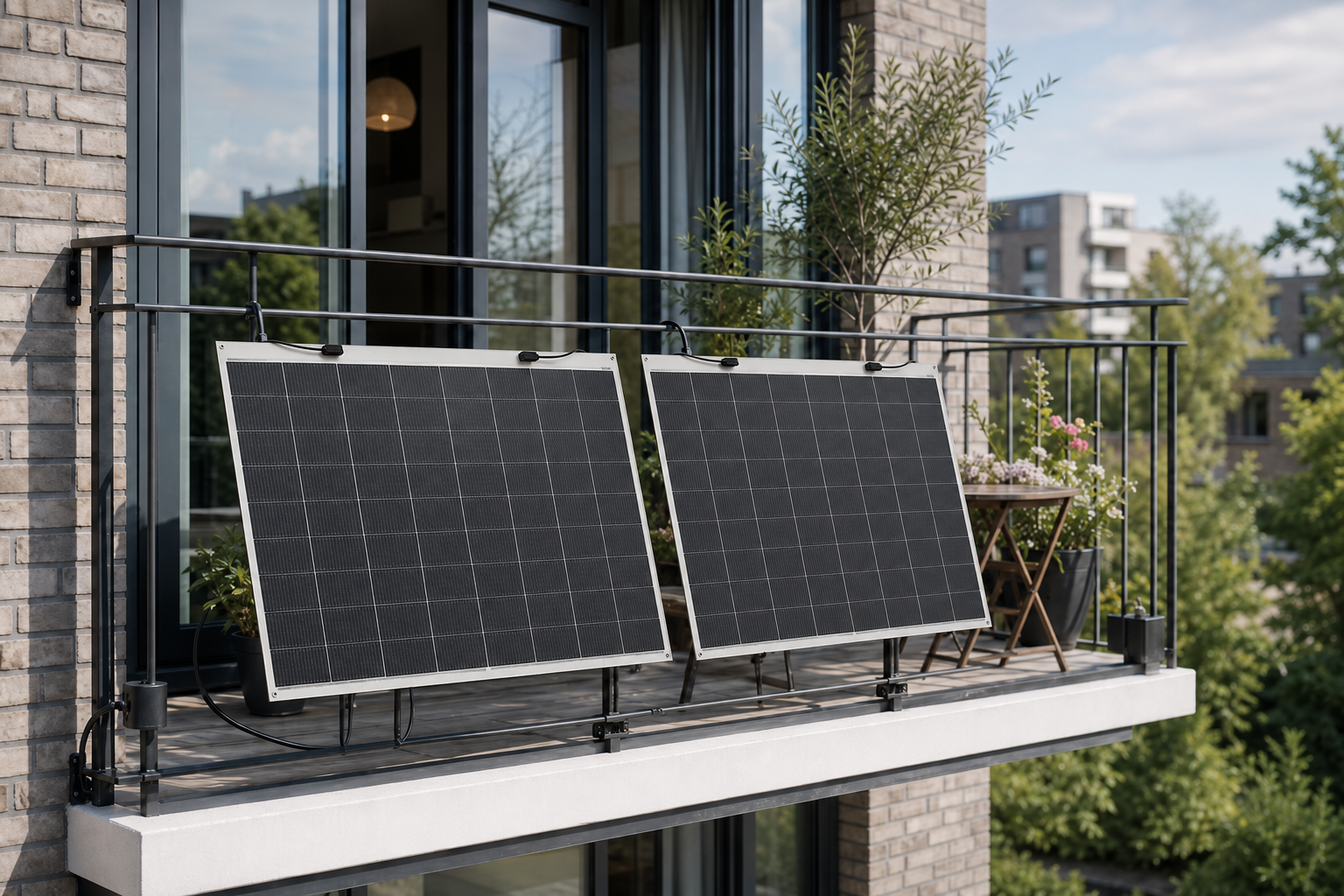
- The panel, microinverter, plug, cable, mounting method, and instructions should be evaluated as one system.
- Panel wattage is not the same as inverter output or household export capacity.
- The UK interim product specification applies to plug-in solar devices specifically. It does not automatically cover plug-in batteries.
- The current framework is still developing, so retailers should verify the latest government guidance before making legal or safety claims.
- Buyers should check sunlight, shading, socket conditions, mounting, permissions, and documentation before purchase.
Plug-in solar is moving from a niche product category into a more visible UK energy conversation. It is often presented as an easier alternative to a conventional rooftop installation. That description is useful, but incomplete.
A plug-in product still needs a suitable installation location, a compatible electrical design, stable mounting, and clear instructions. For retailers and system brands, the central question is not only whether the panel can generate power. It is whether the complete package can be supplied and used within its intended conditions.
Is Plug-in Solar Suitable for Every UK Home?
No. A plug-in solar product may be practical for some flats, rented homes, balconies, gardens, and small properties. However, the same product may not be suitable for every building or electrical installation.
The first question is not simply, “How many watts can the solar panel produce?” A better starting point is whether the complete product package can be installed safely and used as intended in that specific home.
Several factors affect the answer:
- available sunlight;
- partial shading from buildings, trees, or balconies;
- the condition and location of the socket;
- cable routing;
- mounting stability;
- exposure to wind and rain;
- the condition of the household electrical installation;
- landlord, freeholder, or building-management requirements.
This is especially important for older properties, flats with shared structures, and rented homes where the user may not control the installation surface.
A plug-in solar kit should include clear instructions about suitable locations, unsuitable locations, mounting limits, cable routing, and when additional review may be necessary. Buyers who are comparing apartment options can also review this apartment solar installation guide.
What Is Different About UK Plug-in Solar in 2026?
The UK government has been developing a specific framework for plug-in solar devices. The Department for Energy Security and Net Zero has published a government response and an interim product specification for this product category.
The official framework is intended to define the conditions under which compliant plug-in solar devices can be connected to a low-voltage installation using a standard UK plug and socket. It is not a general approval for every product sold as “plug-in solar.”
The government response also makes an important distinction: the interim product specification applies specifically to plug-in solar products. It does not automatically extend to other plug-in technologies, such as plug-in batteries. The official DESNZ update should be checked for the latest implementation position before publication or sale.
This means product pages should avoid statements such as, “Any household can use plug-in solar without checking anything.” A more accurate statement is:
Panel Wattage Is Not the Same as System Output
One common source of confusion is the difference between panel wattage and inverter output.
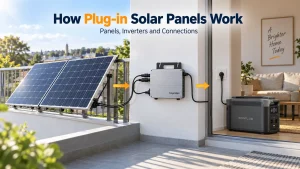
A solar panel may have a rated DC power. The microinverter converts this DC power into AC power for the household circuit. The AC output is controlled by the inverter and the complete system design.
| Item | What it describes |
|---|---|
| Panel rated power | The panel’s nominal DC power under defined test conditions. |
| Microinverter input | The voltage and current range the inverter can accept. |
| Microinverter output | The AC power delivered to the household circuit. |
| Plug and cable | The connection method and electrical interface. |
| Household circuit | The installation into which the system is connected. |
| Actual generation | The output under real sunlight, temperature, angle, and shading. |
The interim UK specification refers to the inverter’s apparent power boundary. This should not be presented as a simple universal panel-wattage limit.
For manufacturers and retailers, the important point is that the system should be described using both panel-side specifications and AC-side system specifications. This avoids a common mistake where a buyer sees a high-wattage panel and assumes the entire plug-in system will export the same amount of power.
What Counts as a Complete Plug-in Solar Kit?
A complete plug-in solar kit normally needs more than a panel.
Depending on the product design, the package may include:
- Solar panel or panels.
- Microinverter.
- AC cable and approved connection method.
- DC cables and connectors.
- Mounting hardware.
- Cable-management components.
- Installation and safety instructions.
- Product identification and technical documentation.
- Warnings about unsuitable installation conditions.
- Information about registration or notification where applicable.
The exact package depends on the product design and target market.
A panel manufacturer should not describe a flexible module as a complete compliant UK plug-in system unless the complete system has been assessed for that purpose. A flexible panel can be one part of a kit. It does not, by itself, establish microinverter compatibility, plug compliance, export behaviour, or household circuit suitability.
This distinction is important for private-label brands and distributors. The panel specification, inverter specification, mounting method, and user instructions should be reviewed together before mass production.
What Did the UK Electrical Safety Study Find?
The DESNZ electrical safety study tested representative plug-in PV systems under defined UK domestic circuit conditions.
The study found that plug-in PV systems could operate safely within the tested conditions. It also identified variation between products, including differences in export limitation behaviour and electromagnetic compatibility.
The report does not support the idea that every plug-in PV product is automatically suitable for unrestricted use. It describes the evidence as a structured pre-compliance and feasibility assessment, not a replacement for full product certification, long-term field evidence, or every future regulatory requirement. The full electrical safety study is available from GOV.UK.
What Should Homeowners and Renters Check?
1. Sunlight and shading
A balcony or garden may look bright but still receive limited direct sunlight during important hours.
Check nearby buildings, balcony floors above, railings, trees, seasonal shade, panel orientation, and the distance between the panel and the connection point.
If the location has repeated partial shading, an anti-shading panel or a different panel layout may deserve review. The correct choice depends on the module design, wiring architecture, and system configuration. It does not follow from the product name alone.
2. Mounting surface
A plug-in solar panel still needs a stable and suitable mounting method.
The buyer should confirm whether the panel is mounted on a balcony, wall, roof, garden structure, or another surface; whether the fixing method is compatible with that surface; whether wind exposure has been considered; whether the panel can be inspected and maintained; and whether the cable can be routed without abrasion or trapping.
A lightweight panel may reduce handling difficulty, but it does not remove the need for suitable mounting.
3. Socket and cable route
The socket should not be treated as an afterthought.
The user should know where the cable should enter the building, whether the cable will be exposed to water or mechanical damage, whether extension arrangements are permitted by the product instructions, whether the socket and circuit assumptions match the supplied guidance, and when a qualified person should review the installation.
Retailers should avoid encouraging users to improvise with adapters, damaged sockets, uncontrolled cable extensions, or unsuitable outdoor connections.
4. Building permissions
A renter, leaseholder, or apartment resident may need permission before attaching equipment to a balcony, wall, railing, or shared structure.
This is separate from electrical safety. A product may be electrically suitable but still require landlord approval, freeholder approval, building-management approval, planning or property review, or compliance with restrictions on external appearance.
The correct requirement depends on the property and location. Product marketing should not promise that installation permission is unnecessary in every case.
Does Plug-in Solar Include a Battery?
Not automatically.
The UK interim product specification applies specifically to plug-in solar devices. The government’s published material distinguishes this category from plug-in batteries.
A battery changes the system architecture. It may introduce additional DC or AC conversion, battery management requirements, thermal and enclosure considerations, charging and discharge controls, different installation conditions, and additional product documentation.
Therefore, a plug-in solar kit with storage should not be presented as the same product category as a panel-and-microinverter system.
For a system brand, the panel, microinverter, battery, control logic, and user instructions should be reviewed as a complete design. A panel supplier can support panel selection, but the complete storage system requires separate system-level validation.
What Should Retailers Check Before Selling Plug-in Solar?
Retailers should ask for more than a product image and a headline wattage.
| Buyer question | Evidence to request |
|---|---|
| Is the product intended for the UK market? | Target-market product documentation. |
| What is the AC output? | Microinverter datasheet. |
| What is the panel-side input range? | Panel and inverter compatibility data. |
| What connection method is supplied? | Plug, cable, and installation documentation. |
| How is export behaviour controlled? | Product test information or technical documentation. |
| Where can the product be mounted? | Mounting instructions and limitations. |
| What conditions are unsuitable? | User warnings and installation guidance. |
| Is a battery included? | Clear system configuration and battery documentation. |
| What market requirements apply? | Current official guidance and model-specific evidence. |
| What happens after purchase? | Warranty, support, replacement, and safety process. |
Retailers should also avoid mixing components without confirming compatibility. A panel from one supplier, a microinverter from another, and a mounting system from a third supplier may not form a validated package.
What Should Manufacturers Prepare?
For a manufacturer or private-label brand, a UK plug-in solar package should be supported by a clear evidence file.
That file may include a product datasheet, electrical ratings, model and serial identification, microinverter documentation, cable and connector information, mounting instructions, installation limitations, environmental-use conditions, user safety guidance, test reports relevant to the complete system, target-market declaration or compliance information, and an after-sales and replacement process.
Not every document applies to every module. The evidence should match the exact model, construction, electrical design, and intended application.
For example, a flexible solar panel designed for a balcony package may require different mounting, cable, and environmental information from a lightweight panel designed for an RV or marine project.
How Sungold Can Support Plug-in Solar Projects
Sungold can support system brands, distributors, and project buyers with flexible, lightweight, and custom solar panel options for application-specific development.
For balcony projects, buyers can review the Sungold balcony solar solution as a starting point for system planning.
For projects where installation weight and panel format matter, the PA219 flexible solar panel and PA621 lightweight solar panel can be reviewed against the intended mounting surface, dimensions, voltage, wiring, and system architecture.
For a private-label or application-specific product, Sungold can also review requirements through its custom solar panel solution.
The final UK suitability of a plug-in product must be confirmed for the complete package. A panel supplier should not present a component as proof that an entire plug-in system meets every market requirement.
FAQ
Are plug-in solar panels legal in the UK?
The UK government is developing a specific framework for compliant plug-in solar devices. The government response states an intention to proceed with the proposed regulatory amendments and interim product specification. Buyers and retailers should verify the current implementation status and product requirements before sale or use.
Does the 800 VA figure mean the panel can only be 800W?
Not necessarily. The 800 VA reference concerns the inverter-side apparent power boundary in the product specification. Panel DC rating and inverter AC output are different technical values and should be reviewed separately.
Can I add a plug-in battery to a plug-in solar kit?
Do not assume so. The UK interim product specification applies specifically to plug-in solar devices and does not automatically cover plug-in batteries. A battery changes the system design and requires separate technical and safety review.
Can I install plug-in solar on any balcony?
No. The panel must have a suitable mounting method, adequate stability, safe cable routing, appropriate exposure conditions, and permission where required. Balcony structure, wind exposure, shading, and building-management rules should be checked before installation.
Should retailers sell panels and microinverters separately?
They can, but compatibility and responsibility must be clear. If the components are marketed as a kit, the complete package should be reviewed and documented as a system rather than presented as unrelated products.
Final Thoughts
Plug-in solar could make solar power more accessible to households that cannot install a conventional rooftop system. But the product category should not be reduced to a panel, a plug, and a simple savings claim.
The better approach is to review the complete system: panel, microinverter, cable and plug, mounting, household conditions, product documentation, and current UK requirements.
For retailers and system brands, clear boundaries are part of product quality. A well-designed package should tell users where it can be used, where it cannot be used, what must be checked, and which claims depend on model-specific evidence.