 EN
EN
 Deutsch
 Italiano
 Español
 Français
 日本語
日本語
- Solar backup sizing means matching solar input, usable battery reserve, daily loads, and inverter capacity.
- A larger battery does not solve an undersized solar array, and a larger solar array does not solve an inverter limitation.
- A charge-to-load comparison can support early system planning, but it is not a universal performance threshold.
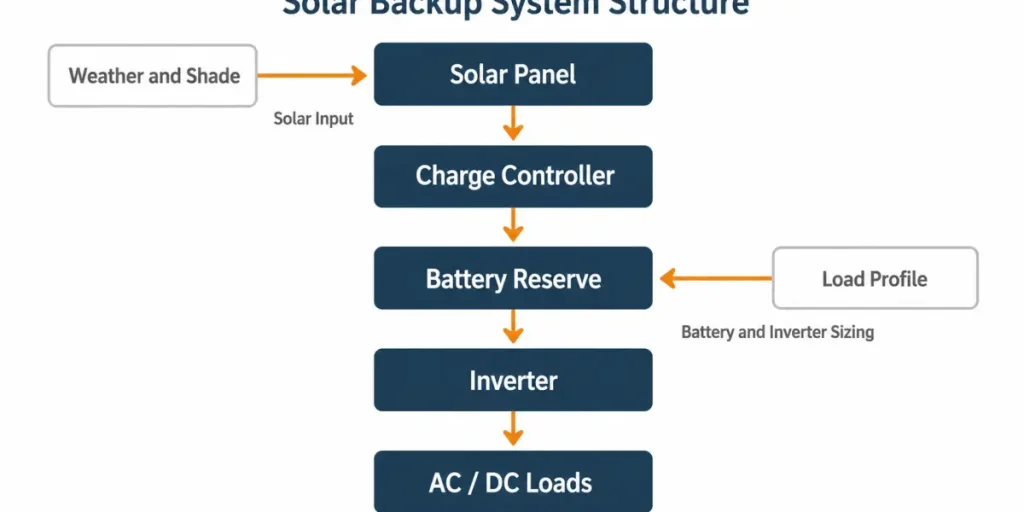
- Panel, controller, battery, inverter, cable, and load profile should be reviewed as one operating system.
Solar backup sizing is the process of matching solar input, usable battery reserve, daily loads, and inverter capacity. Panel wattage alone cannot determine whether a backup system will recharge reliably or support the required loads.
A larger battery does not solve an undersized solar array. A larger solar array does not solve an inverter or battery discharge limitation. The complete system must be reviewed around its expected load profile, weather conditions, operating schedule, and electrical architecture.
This guide explains the relationship between solar input, battery reserve, daily energy demand, and inverter power for portable power, RV, off-grid, and custom solar backup projects.
What Does Solar Backup Sizing Actually Mean?
Solar backup sizing means deciding how much energy a system can produce, store, and deliver under expected operating conditions.
| Question | Main system factor |
|---|---|
| How much energy can the solar array produce? | Panel power, solar resource, temperature, shade, wiring, and charge controller |
| How much energy can be used later? | Battery capacity, permitted usable range, BMS, and conversion losses |
| How much power can run at one time? | Inverter output, battery discharge capability, and wiring |
The U.S. Department of Energy distinguishes between energy capacity and power capacity in storage systems. Energy capacity describes how much energy can be stored. Power capacity describes how much power can be released at a given time. These values solve different system problems.
A battery may store enough energy for several hours of low-power loads but still be unable to start a high-power appliance. That is an inverter and discharge-power issue, not only a battery-capacity issue.
Solar Input vs Daily Energy Demand
The first practical step is to estimate daily energy demand. A basic planning formula is:
For multiple loads:
The load list may include lighting, refrigeration, fans, communications equipment, computers, pumps, heating or cooling equipment, charging loads, and standby consumption.
The estimate should also separate normal running power from startup power. Motors, compressors, and some appliances may require a short surge when they start.
Daily energy and peak power should therefore be calculated separately. Daily energy helps determine battery and solar requirements. Peak power helps determine inverter and battery discharge requirements.
Solar production is not a fixed number
A solar panel’s rated power is measured under defined test conditions. Actual energy production changes with the operating environment.
- Location and season
- Time of day and cloud cover
- Panel orientation and tilt
- Partial shading
- Surface temperature
- Dust, dirt, rain, and haze
- Cable length and controller efficiency
- Battery state of charge
The U.S. Department of Energy notes that solar production can be affected by clouds, shadows, rain, snow, dust, haze, and other obstructions. A panel’s rated wattage should not be treated as a guaranteed daily energy source.
The result is a planning estimate. It is not a universal performance guarantee.
Battery Reserve: Nameplate Capacity vs Usable Energy
Battery nameplate capacity is not always the same as the energy available to the load.
The actual usable value depends on battery chemistry, battery management settings, permitted depth of discharge, temperature, charge and discharge current, inverter efficiency, and system protection settings.
Before choosing a battery, buyers should ask:
- Is the stated capacity nominal or usable?
- Is the value measured at a specific discharge rate?
- Does the battery include a BMS?
- What is the maximum continuous discharge power?
- What is the peak discharge capability?
- What happens when the battery reaches its low-voltage limit?
The battery should be sized around the required load profile, not only the largest capacity number in the product description.
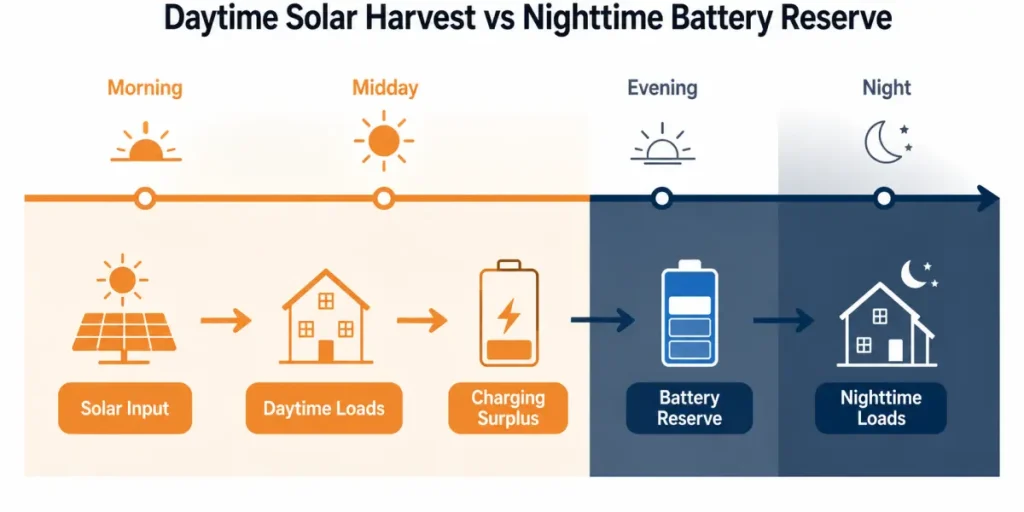
How to Balance Daytime Solar Harvest and Nighttime Battery Reserve
The main purpose of a solar-plus-storage system is to move energy from one time period to another.
Nighttime: battery reserve → nighttime loads
| Operating condition | Typical system behavior |
|---|---|
| Solar production is higher than daytime demand | Excess energy can be sent to the battery, subject to controller and battery limits |
| Solar production is close to daytime demand | Battery charging may be limited |
| Solar production is lower than daytime demand | The battery may continue discharging |
| No solar production at night | Loads depend on stored energy or another power source |
The design question is not simply “How large should the battery be?” It is whether the solar array can replace the energy used during the day while preserving enough battery reserve for the night and the next operating period.
How Can a Charge-to-Load Comparison Help Buyers?
A charge-to-load comparison helps buyers compare the energy available for charging with the energy consumed by the system.
In this article, the charge-to-load comparison is used as a planning method. It is not a universal certification metric or a fixed pass-or-fail standard.
A lower result may indicate the need for more solar input, lower daily loads, a longer charging window, or another energy source. A higher result may provide more opportunity to recharge the battery, but the controller, battery charging limit, cable system, and inverter architecture must still accept the additional input.
Weather, shade, system losses, and battery state of charge can change the result. The comparison is useful for early planning, not for making an unsupported performance promise.
What Happens When Loads Exceed Inverter Capacity?
A battery and an inverter solve different problems.
- The battery determines how much energy can be stored and discharged.
- The inverter determines how much AC power can be delivered at once.
- The solar array determines how quickly energy can be replenished.
- The controller manages the charging path between the array and battery.
If the connected load exceeds the inverter’s continuous output rating, the inverter may limit output, trigger overload protection, or shut down. Short startup loads can also exceed the continuous rating even when an appliance’s normal running power appears acceptable.
Review continuous load, surge load, battery discharge capability, inverter temperature, and cable protection together. The inverter heat and performance guide provides additional context for thermal and system-matching checks.
Multi-Day Backup: Cloud, Shade and Recharge Conditions
A system designed for one night of backup is not automatically suitable for several days of backup.
Multi-day planning should consider:
- Initial battery state of charge
- Daily energy demand
- Solar resource during the period
- Cloud and rain conditions
- Partial shading
- Battery recharge limits
- Availability of grid or generator support
- Priority loads
A system may support essential communications, lighting, and refrigeration while limiting high-power appliances. This can be more practical than trying to operate every load during an extended outage.
The Department of Energy explains that storage can shift solar energy from periods of high generation to periods when demand is higher or solar production is low. It also notes that charging and discharging are not perfectly efficient. DOE Solar Integration and Storage Basics
NREL technical guidance also treats solar resource and system load as important inputs in PV and battery sizing. The same panel capacity can produce different results in different locations and operating schedules. NREL PV System With Battery Storage
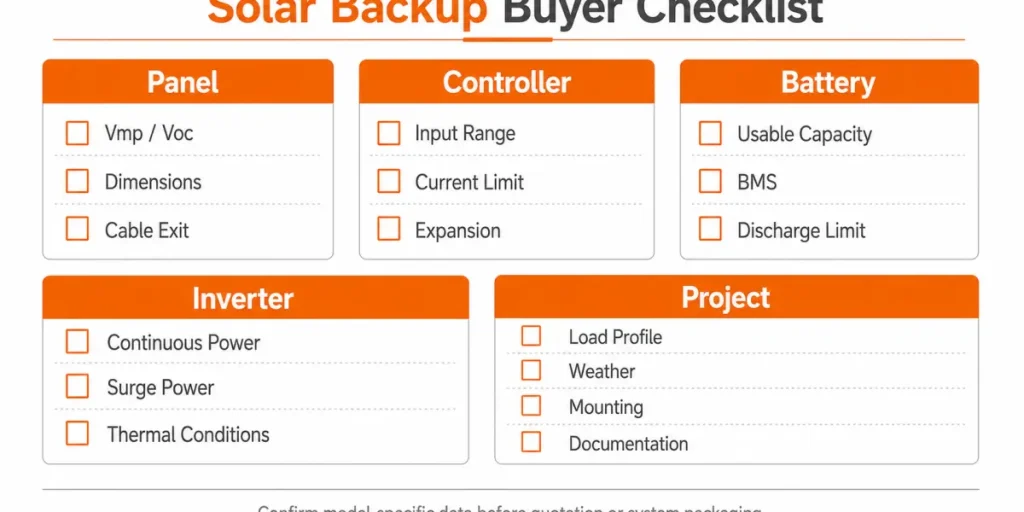
Solar Panel, Battery and Inverter Matching Checklist
| System area | What to confirm |
|---|---|
| Solar panel | Rated power, Vmp, Voc, Imp, Isc, dimensions, surface material |
| Charge controller | Input voltage range, current limit, MPPT or PWM architecture, expansion capacity |
| Battery | Nominal capacity, usable capacity, BMS, charge and discharge limits |
| Inverter | Continuous power, surge power, output type, ventilation requirements |
| Cable system | Length, conductor size, connector type, voltage drop and protection |
| Load profile | Daily energy use, peak loads, startup loads and priority loads |
| Environment | Temperature, shade, rain, dust, mounting location and maintenance access |
| Documentation | Datasheet, wiring diagram, installation guide, test scope and model mapping |
The basic electrical relationship is Power (W) = Voltage (V) × Current (A). It is useful when checking panel and controller data, but it does not predict daily energy production. Buyers can also review the solar panel amps-to-watts guide.
What System Brands Should Confirm Before Packaging a Kit?
For a portable power brand, RV system brand, or off-grid kit supplier, a sellable package needs more than a panel and a battery.
- Panel voltage matches the controller input range.
- Controller output matches the battery charging requirements.
- Battery discharge capability matches the inverter.
- Inverter output matches continuous and peak loads.
- Cable and connector specifications match the current.
- User instructions explain what the system can and cannot support.
- Different market versions use the correct electrical assumptions.
- Product documentation refers to the correct model.
- Expansion options do not exceed controller, battery, inverter, or wiring limits.
- Commercial terms, sample timing, and final specifications are confirmed separately.
This process helps prevent a common product-positioning problem: describing a solar panel as if it were a complete backup system.
How Sungold Can Support Solar Backup Projects
Sungold can support the panel-side planning of portable, RV, off-grid, and custom solar backup projects.
The review can include panel format, available installation area, electrical requirements, cable and connector position, flexible or lightweight construction, custom dimensions, and the application environment.
For portable systems, buyers can review the portable power station solar panel pairing guide.
For larger system applications, see the off-grid solar kit solution and RV solar kit solution.
For unusual dimensions, cable exits, or application constraints, the custom solar panel solution is the appropriate starting point.
Final system performance depends on the complete design, including the battery, controller, inverter, cable system, load profile, solar resource, and operating environment.
FAQ
How Much Solar Panel Wattage Do I Need for My Battery Bank?
The answer depends on how much energy the battery uses, how quickly it needs to recharge, the daily solar resource, daytime loads, and system losses. Start with the energy removed from the battery, then check whether the solar array and controller can replace that energy within the available charging window.
Can I Use This Solar Panel With My Portable Power Station?
Only if the panel’s voltage, current, connector, and polarity are compatible with the power station’s solar input. Check Vmp, Voc, Imp, Isc, and the power station’s maximum solar input range. Do not rely only on a label such as “12V panel” or “portable solar panel.”
Will a Power Station Limit the Solar Input if I Connect More Panel Wattage?
Some power stations limit the charging input, but the permitted voltage and current range must still not be exceeded. Buyers should follow the manufacturer’s input limits and wiring instructions. Do not assume that internal protection makes every oversized panel arrangement safe.
Can a Solar Generator Run High-Power Loads Such as Air Conditioning?
It depends on the inverter’s continuous and surge ratings, battery discharge capability, operating duration, thermal conditions, and the appliance’s actual demand. Solar panels alone do not determine whether an air conditioner or other high-power appliance can run. The battery and inverter must support the load at the same time.
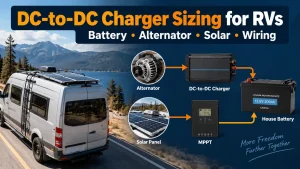
How Do I Keep My House Battery Charged Every Day?
Start by calculating the daily load and comparing it with the expected solar input. If solar charging is inconsistent, the system may also require alternator charging, shore power, a generator, or a larger reserve. The correct choice depends on the vehicle or site, battery architecture, charging equipment, and intended operating pattern.
Final Thoughts
Solar backup sizing is not a single-number decision.
The panel must produce enough energy for the operating conditions. The battery must provide enough usable reserve. The inverter must support the highest expected load. The controller and cable system must connect those parts within their rated limits.
For a reliable design, start with the load profile. Then review battery reserve, solar input, inverter output, weather conditions, and installation environment together.
That approach gives RV owners, system brands, distributors, and OEM buyers a more realistic basis for selecting or developing a solar backup package.