 EN
EN
 Deutsch
 Italiano
 Español
 Français
 日本語
日本語
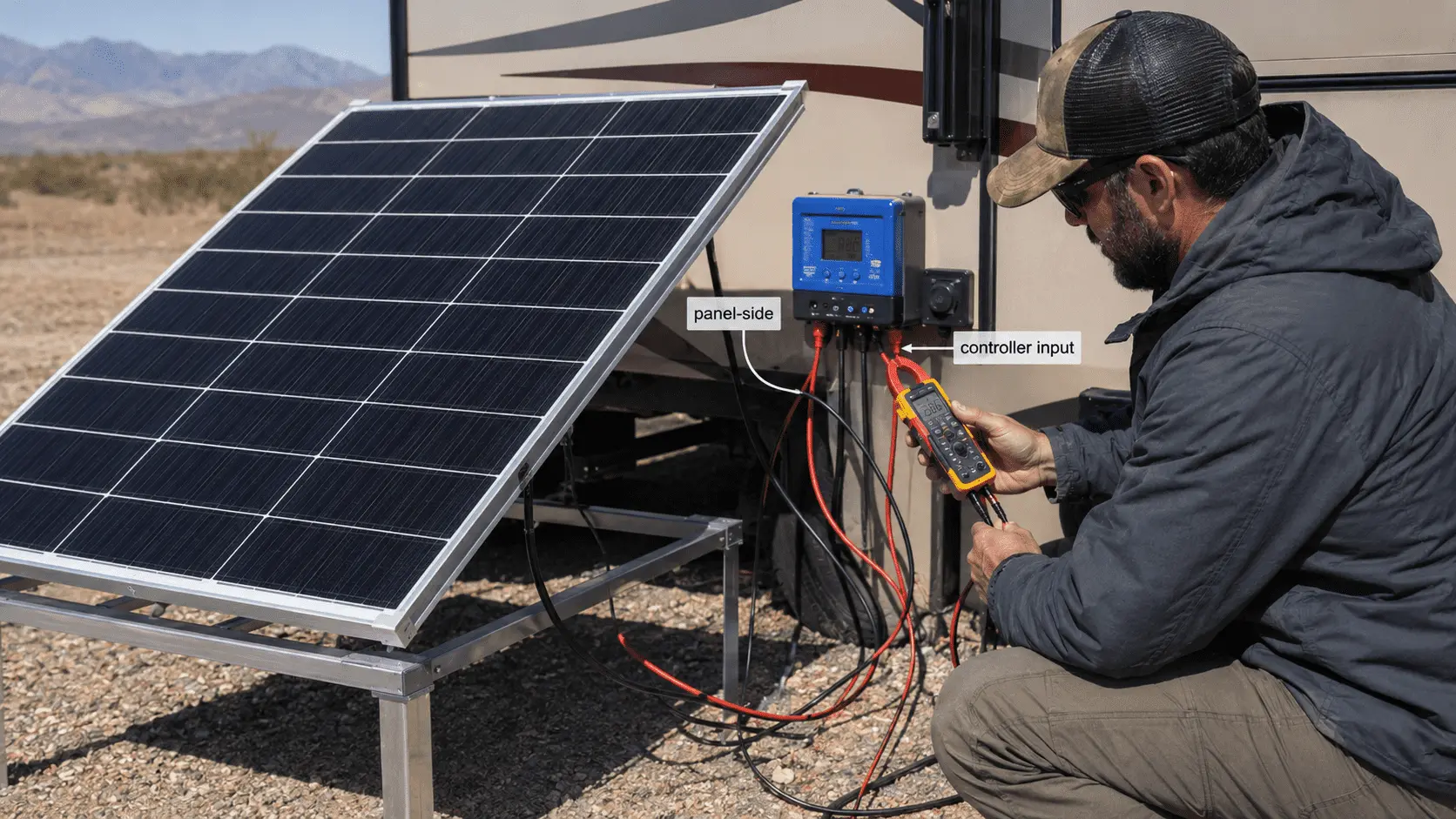
The practical approach is to compare the panel datasheet with the actual operating conditions and then check the rest of the system.
Why is my 390W solar panel only producing 245W? This is a common question from RV, marine, balcony, and portable power users.
First, check where the 245W reading was taken:
- At the panel output
- At the charge controller input
- At the controller output
- At the battery
- At the inverter output
These are different measurement points. A reading taken at the battery may not represent the panel’s direct DC output.
The test conditions also matter. If the panel is warm, partly shaded, mounted at a poor angle, or operating under changing sunlight, its output can be below the nameplate value. One low reading should be treated as a troubleshooting signal, not an immediate quality verdict.
What Does Rated Solar Panel Wattage Mean?
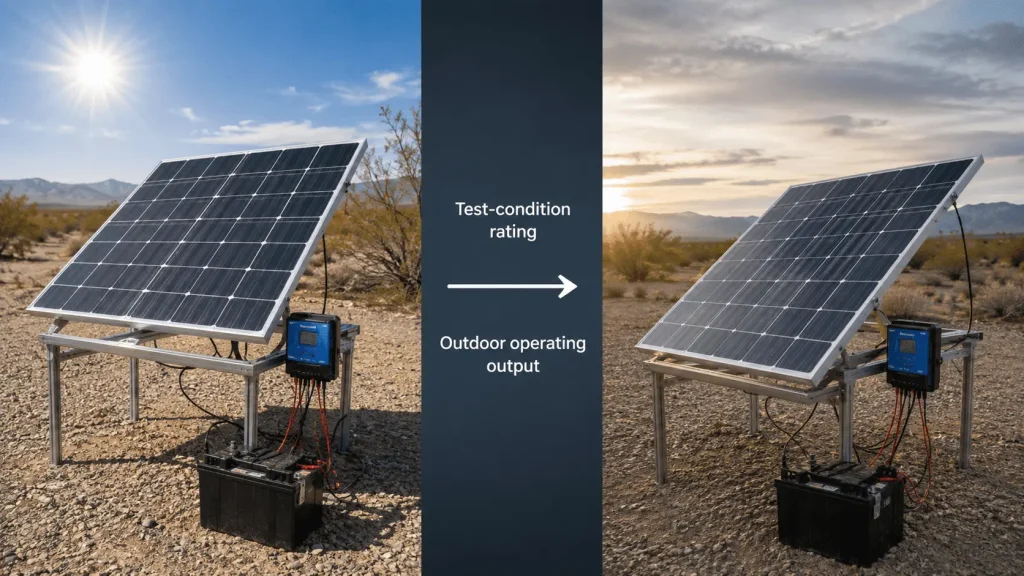
Rated Wattage Is a Test-Condition Value
Solar modules are rated under defined laboratory conditions. The PV Performance Modeling Collaborative, supported by Sandia National Laboratories, uses reference irradiance and cell temperature as key inputs when modeling module power. Its PVWatts model uses 1,000 W/m2 irradiance and 25°C cell temperature as reference values. See the PVWatts reference model.
Outdoor conditions rarely remain identical to those reference conditions. A datasheet rating is useful for comparing modules, but it should not be interpreted as the output a panel will produce continuously on a roof, balcony, boat, or RV.
Nameplate Power Comes From Voltage and Current
The basic relationship is:
A panel datasheet normally includes several electrical values:
| Parameter | What It Describes |
|---|---|
| Rated power | Maximum power under defined test conditions. |
| Vmp | Voltage at the maximum power point. |
| Imp | Current at the maximum power point. |
| Voc | Open-circuit voltage. |
| Isc | Short-circuit current. |
| Temperature coefficient | How electrical output changes with temperature. |
Two panels with the same rated wattage may still behave differently if their voltage and current characteristics are different.
What Changes Real-World Solar Output?
Irradiance
Irradiance is the amount of sunlight reaching the panel surface. It changes with cloud cover, time of day, season, sun position, atmospheric conditions, panel orientation, and nearby obstructions.
When effective irradiance falls, panel current generally falls as well. A cloudy sky may still produce useful power, but the output will not necessarily match a clear-sky reading.
The PVPMC modeling guide treats irradiance, module temperature, electrical characteristics, and system design as separate inputs in the performance calculation.
Panel Temperature
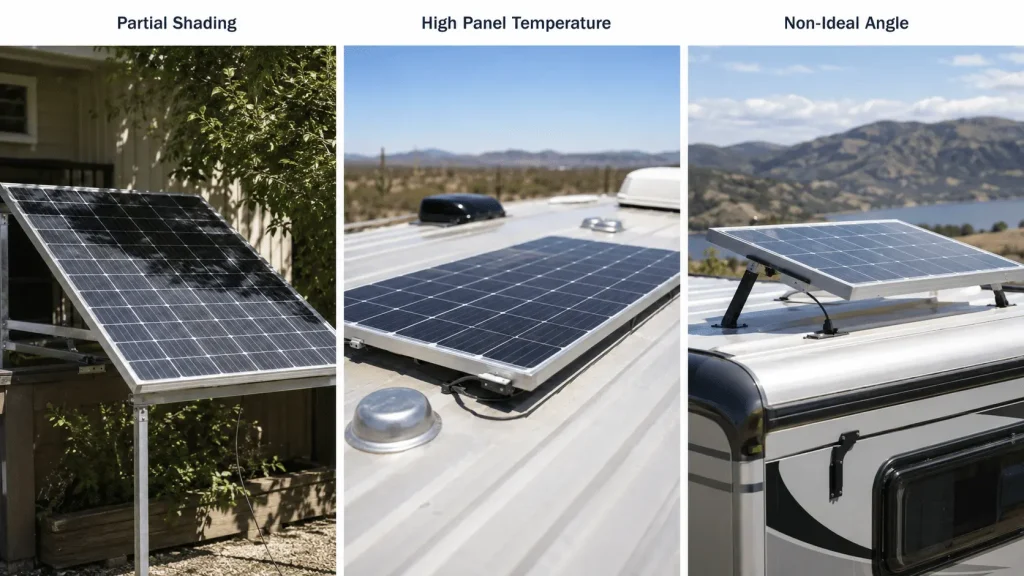
Panel temperature is not the same as outdoor air temperature. A panel installed close to a roof or vehicle surface can become much hotter than the surrounding air.
Module temperature depends on irradiance, wind, mounting conditions, and the module structure. PVPMC module temperature guidance describes these factors in its performance models.
Higher cell temperature can reduce operating voltage. Since power depends on voltage and current, this can reduce the panel’s maximum power output.
This is especially relevant for flat RV roofs, close-mounted balcony panels, panels installed on metal surfaces, flexible panels with limited rear ventilation, and marine panels installed on enclosed or dark surfaces.
Angle and Orientation
A panel facing the sun directly usually receives more effective irradiance than a panel placed at a poor angle. Many applications do not allow ideal positioning:
- RV panels may be installed flat.
- Balcony panels may face east or west.
- Marine panels may follow a curved deck.
- Portable panels may be moved during the day.
- Vehicle panels may be fixed to a horizontal roof.
A lower reading caused by installation geometry is not necessarily a product failure. It is an application condition that should be considered during system planning.
Partial Shading
Partial shading is often more important than users expect. Common sources include roof vents, air-conditioning units, roof racks, railings, masts and rigging, trees, nearby buildings, balcony structures, antennas, and storage boxes.
A small shadow can affect the electrical behavior of a module or panel group. A panel exposed to open sunlight should not always be compared directly with another panel installed beside an obstruction.
For applications where recurring shade is part of the design problem, buyers can review Sungold anti-shading solar panel options as a starting point for panel-side evaluation.
Panel Output Is Not the Same as Battery Charging Power
A system may show different power values at different locations:
Where Is the Power Being Measured?
| Measurement Point | What It Shows | Common Limitation |
|---|---|---|
| Panel output | DC power generated by the panel. | May change quickly with sunlight. |
| Controller input | Power entering the charge controller. | Can be limited by controller ratings. |
| Controller output | Power sent toward the battery. | Depends on conversion and charging stage. |
| Battery display | Charging power received by the battery. | May be reduced when the battery is nearly full. |
| Inverter output | AC power delivered to loads. | Includes conversion and load conditions. |
Why Battery Charging Power Can Look Lower
Battery-side power can be lower than the panel-side reading because of controller conversion, cable voltage drop, battery charge-stage limits, battery state of charge, battery management system limits, active system loads, or controller power limiting.
A battery that is nearly full may accept less charging power even when sunlight is available. Comparing a panel’s rated wattage directly with the battery charging display can therefore lead to the wrong conclusion.
How to Check Whether Low Output Is Normal
One number is not enough. Check the system in the same order each time.
- Confirm the measurement point. Identify whether the value is panel-side DC input, battery charging power, or inverter output.
- Check the weather and sunlight. Record the date, time, cloud conditions, sun position, and panel orientation.
- Inspect the panel surface. Check for dirt, water droplets, snow, leaves, bird droppings, localized shadows, surface damage, or loose mounting.
- Review panel temperature. Do not rely only on the weather app. The panel surface may be much warmer than ambient air.
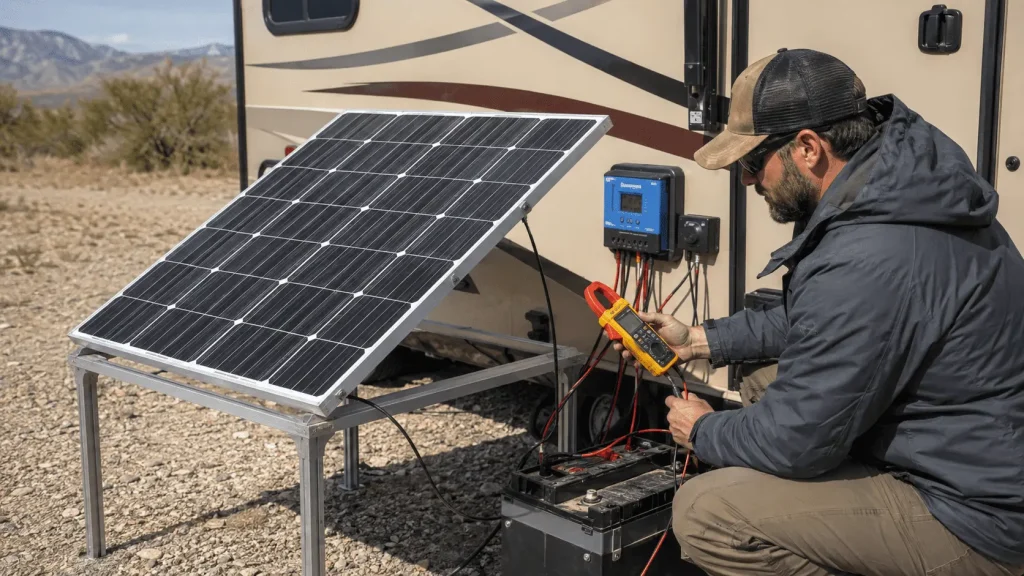
- Compare the electrical values. Use suitable equipment and compare measured voltage and current with Vmp, Voc, Imp, Isc, and the temperature coefficient on the datasheet.
- Check the controller. Confirm maximum PV voltage, input current, charging current, permitted PV power, and battery voltage.
- Inspect the wiring. Review cable length, cable size, connector condition, fuse or breaker condition, crimp quality, corrosion, loose terminals, and water ingress.
- Repeat the test. Compare readings under more stable sunlight before drawing a conclusion.
Follow the equipment manufacturer’s instructions when using a multimeter or other test equipment. Do not bypass protective devices as a troubleshooting shortcut.
How Different Applications Change the Diagnosis
RV and Van Solar
RV roofs often include several sources of shade and limited usable space. Check roof vents, air-conditioning equipment, antennas, roof racks, flat mounting, cable routing, and portable panel connections before judging output.
A lightweight panel such as PA621 lightweight solar panels may be considered when roof weight and available mounting area are important. The panel choice still needs to match the controller and battery architecture. For broader system planning, see the RV solar panel selection guide.
Marine Solar
Marine installations can experience moving shade from masts and rigging, curved or uneven surfaces, different panel orientations, salt-air exposure, long cable routes, and moisture around connectors.
A panel on the cabin roof may receive very different sunlight from one installed on a deck or rail structure. These panels should not be compared only by their rated wattage.
Balcony Solar
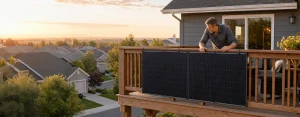
Balcony panels usually have less freedom in orientation and mounting angle. Possible factors include building shadows, railings, neighboring balconies, east or west orientation, limited ventilation, microinverter input limits, and battery or storage charging limits.
A low output reading may reflect the balcony environment rather than a component defect. The system brand should define where output is measured and how users should interpret the display.
OEM and Distributor Projects
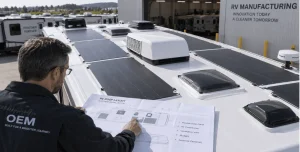
For OEM projects, output validation needs to be repeatable. The buyer should first define the approved module model, datasheet version, test conditions, and measurement point.
The test record should also include the controller, wiring configuration, equipment used, and acceptance criteria. Any change to the panel, cable length, controller, or mounting method should trigger a new review.
When Should Buyers Request a Supplier Inspection?
A supplier review may be appropriate when the same panel repeatedly shows abnormal readings under stable sunlight and the measurement point, wiring, controller, and installation conditions have already been checked.
Prepare the following information:
- Panel model and serial number
- Datasheet version
- Test date and time
- Weather and installation conditions
- Panel angle and surface temperature, if available
- Voltage and current readings
- Controller and battery model
- Cable length and connector type
- Photos of the installation and monitoring display
A useful technical review needs the complete test context. A single low wattage reading is not enough to judge a panel.
How Sungold Can Support Panel-Side Evaluation
Sungold can review panel-side requirements for RV, marine, balcony, vehicle, portable, and off-grid applications after the system inputs are defined.
The review may include required power range, electrical operating window, panel dimensions and weight, surface material, mounting conditions, cable and connector position, expected shade pattern, controller and battery interface, and documentation requirements.
For applications where recurring shade is part of the design review, anti-shading panel options can be considered. For projects where panel weight and available installation space matter, PA621 can be reviewed as a lightweight panel option.
The final system output still depends on the controller, battery, wiring, inverter, installation conditions, and operating environment. Complete-system approval should be confirmed by the responsible system designer or equipment provider.
FAQ
A 390W panel producing 245W at one moment may be affected by irradiance, temperature, angle, shade, wiring, controller limits, or the measurement point. The reading is about 63% of the nameplate rating, but it cannot identify the cause by itself.
Yes. Rated wattage is measured under defined test conditions. Outdoor output changes with sunlight, temperature, angle, shading, soiling, and the connected system.
It can. Cloud cover changes the irradiance reaching the panel. The effect depends on cloud conditions, panel orientation, location, and system configuration. There is no single reduction percentage for every installation.
Yes. Higher module temperature can affect operating voltage and maximum power. The effect depends on the module’s temperature coefficient and installation conditions.
Measure panel-side voltage and current first, then compare them with the datasheet. Check the controller’s PV voltage, current, and power limits. If panel-side readings look reasonable but the battery-side value is lower, the controller, battery state, wiring, or active load may be limiting the result.
Request a review when the low reading is repeatable under stable sunlight and the measurement point, wiring, controller, and installation conditions have already been checked. Provide the supplier with the full test record rather than only a single wattage value.
Final Thoughts
Solar panels do not produce their rated wattage continuously. The nameplate value is a reference point. Actual output depends on irradiance, cell temperature, angle, shading, wiring, controller limits, battery status, and the location of the measurement.
When a 390W panel shows 245W, do not assume failure. First identify where the number came from. Then compare the operating conditions with the datasheet and check the rest of the system.
For RV, marine, balcony, and OEM projects, output evaluation should include both the panel and the installation environment. A structured test record is more useful than a single display reading. It helps buyers separate normal operating variation from a genuine panel or system problem.