 EN
EN
 Deutsch
 Italiano
 Español
 Français
 日本語
日本語
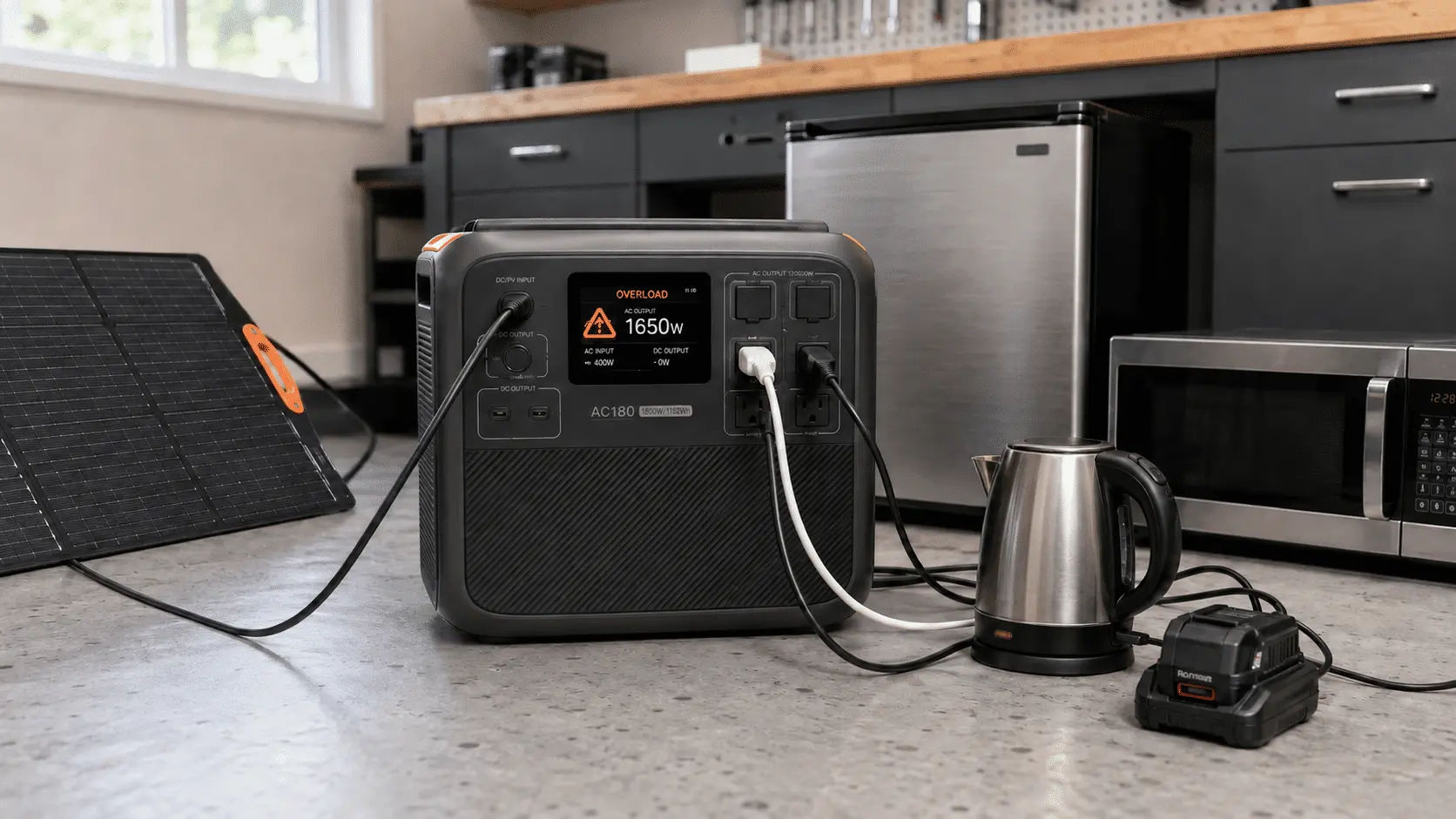
- A solar generator can shut down even when the battery is still charged if the connected load exceeds the inverter’s output limit.
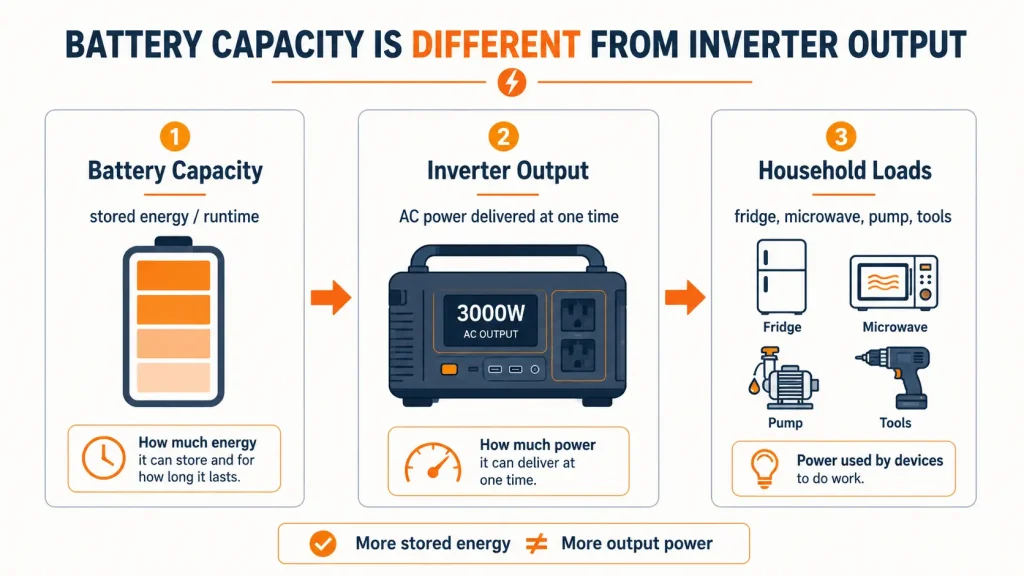
- Battery capacity decides how long a system may run. The inverter decides how much AC power can be delivered at one time.
- Refrigerators, pumps, air conditioners, microwaves, and power tools may need more startup power than their normal running wattage.
- Adding more solar panels can help recharge the battery, but it does not increase the inverter’s AC output capacity.
- Buyers should check continuous output, surge rating, battery discharge limits, PV input range, wiring, and the actual load profile before choosing a solar generator or solar kit.
Solar generator inverter overload happens when the connected load asks for more AC power than the inverter can safely deliver, even if the battery still has charge.
A solar generator does not fail only because the battery is empty.
In many cases, the battery still has charge, the display still looks normal, and the user expects the appliance to run. But when the appliance starts, the unit alarms, cuts output, or shuts down. This usually means the problem is not stored energy. It is output power.
For solar kit buyers, distributors, and system brands, this distinction matters. A system can have enough battery capacity for runtime but still be unable to start or support a specific household load. That is why inverter output should be reviewed separately from battery size and solar panel input.
Solar Generator Inverter Overload: What It Means
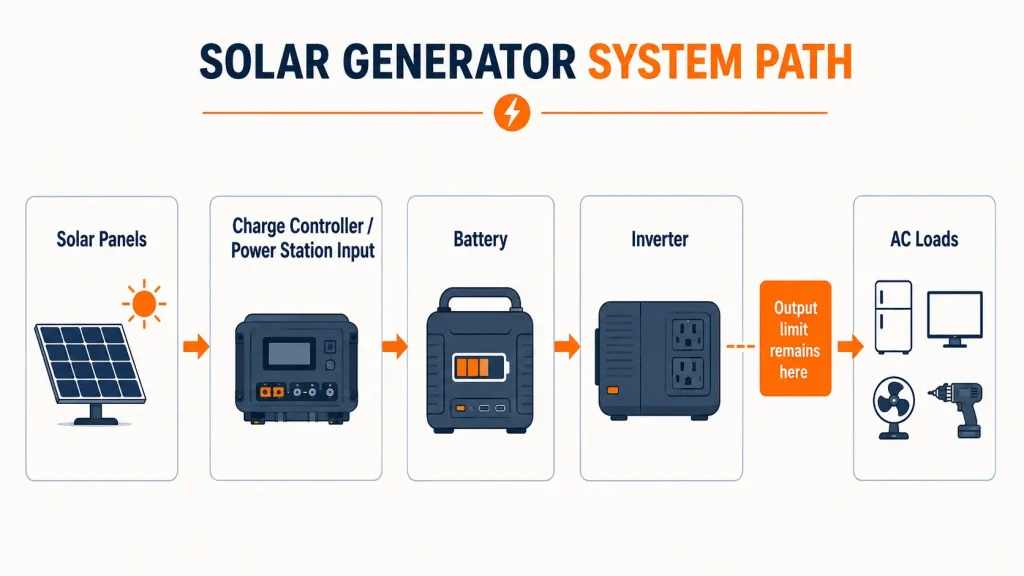
The inverter is the part of a solar generator or backup system that converts DC power from the battery into AC power for household appliances.
Its limit is not the same as battery capacity.
| Specification | What It Controls | Common Mistake |
|---|---|---|
| Battery capacity | How much energy is stored | Assuming more capacity means any appliance can run |
| Inverter continuous output | How much AC power can be supplied steadily | Only checking battery size |
| Inverter surge rating | Whether short startup loads can be handled | Ignoring motor and compressor startup demand |
| Solar panel input | How quickly the system can recharge | Assuming more panels increase AC output |
| Battery/BMS discharge limit | How much power the battery can safely release | Treating the inverter rating as the only limit |
A larger battery increases stored energy, but it does not change the inverter’s rated AC output path. This is why a 2 kWh battery system may still fail to run a high-power appliance if its inverter output is too low.
What Happens When Loads Exceed the Inverter Rating?
When connected loads exceed the inverter’s allowed output, the system usually protects itself.
Depending on the unit design, the result may include:
- an overload warning;
- AC output shutting off;
- the appliance failing to start;
- repeated restart attempts;
- reduced output under heat;
- full shutdown until the load is removed or the system is reset.
Victron’s inverter documentation describes overload behavior where the inverter may reduce output voltage, shut down, wait, and restart if overcurrent continues. After repeated overload events, it may remain off until manually restarted. This is a protection behavior, not simply a battery problem.
For users, the symptom can be confusing. The battery display may still show 60%, but the microwave or compressor may not start. That does not automatically mean the solar generator is defective. It may mean the load is larger than the inverter can support.
Continuous Power vs Surge Power
Most buyers notice the main wattage number first. That is usually the continuous output rating.
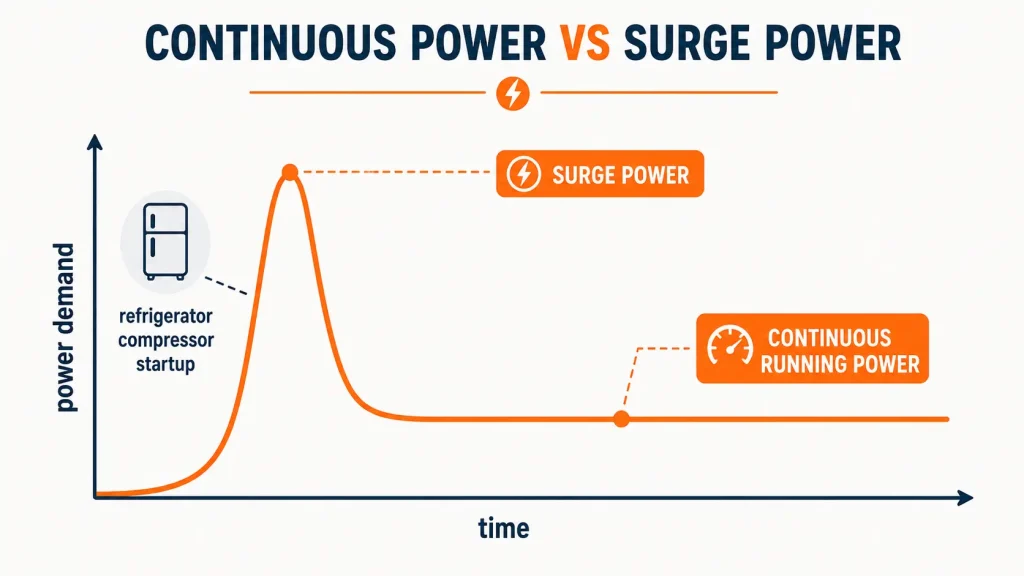
Continuous power is the amount of AC power the inverter can support steadily. If several appliances are running at the same time, their running watts must stay within this limit.
Surge power is different. It is a short burst of power used when certain appliances start. Motors and compressors often need a higher startup draw before they settle into normal running wattage.
| Load Type | Why It Can Cause Overload |
|---|---|
| Refrigerator | Compressor startup may be much higher than running wattage. |
| Water pump | Motor startup can create a short surge. |
| Air conditioner | High startup and high running load can both matter. |
| Microwave | High continuous power during use. |
| Power tools | Motor load changes quickly under resistance. |
| Kettle or heater | Usually no startup surge, but heavy continuous draw. |
This is why a refrigerator labeled around a modest running wattage may still trip a smaller inverter when the compressor starts.
Samlex notes that motor-driven compressor and pump loads can require several times their running power during startup, and that very short surge ratings may not be enough for loads that need several seconds to start. For real system planning, continuous rating and startup behavior both matter.
Why a Bigger Battery Does Not Always Solve the Problem
A bigger battery may help runtime. It does not automatically solve inverter overload.
For example:
- A larger battery can keep lights, router, and small electronics running longer.
- It may not help if the inverter cannot start a refrigerator compressor.
- It may not help if the battery management system limits discharge power.
- It may not help if cables, connectors, or protection devices are undersized.
- It may not help if the inverter is thermally derating under high temperature.
This is one of the most common mistakes in backup system planning.
Buyers ask, “Should I choose a bigger battery?” The better question is, “What load needs to run, and what is its startup and running power?”
Runtime and output are different design problems.
For runtime planning, buyers can refer to the existing solar backup sizing guide. For inverter overload, the first step is to check the actual AC load and inverter rating.
How Multiple Loads Create Overload
Another common problem is simultaneous use.
A solar generator may run one appliance without trouble. But it may overload when several devices run together.
| Situation | Why It Matters |
|---|---|
| Refrigerator + microwave | Compressor startup and microwave draw may overlap. |
| Coffee maker + kettle | Both are high continuous loads. |
| Pump + lights + router | The pump may create a startup spike. |
| RV air conditioner + charger | Running load may already be near the limit. |
| Food truck equipment + refrigerator | Commercial loads often stack quickly. |
The system does not only care about one appliance name. It cares about what is running at the same moment.
For this reason, buyers should create a simple load profile before choosing a solar generator or solar kit:
- List all appliances that may run at the same time.
- Separate running watts from startup loads.
- Identify the largest motor or compressor load.
- Check inverter continuous output.
- Check surge rating and surge duration.
- Confirm whether the battery and BMS can support the discharge demand.
This does not need to be complicated. But it must be done before using marketing wattage as the only decision point.
Where Solar Panels Fit in the System
Solar panels are important, but they do not remove the inverter limit.
Solar panels help recharge the battery. They can extend operating time when sunlight is available. They can reduce dependence on grid charging or fuel generators. But once the load is using AC power, the inverter still controls how much power can be delivered at that moment.
More solar input may help if the problem is poor daily recharge. It will not make a 1,000 W inverter behave like a 3,000 W inverter.
This is also why panel-side planning should be connected to the rest of the system. Buyers need to check:
- panel wattage;
- operating voltage and current;
- controller or power station input range;
- Voc limit;
- cable length and connector type;
- roof or mounting area;
- expected daily sunlight;
- actual load schedule.
For buyers who are still checking electrical basics, the solar panel amps to watts guide can help translate panel current and voltage into usable planning language.
Why Solar Input and AC Output Are Often Confused
Many users see a solar generator as one box. That is understandable. But inside the system, different parts have different limits.
A portable power station or solar generator may have:
- a solar input limit;
- a battery capacity limit;
- a battery discharge limit;
- an inverter continuous output limit;
- a surge output limit;
- thermal protection;
- cable and connector limits.
If the solar input is too low, the system recharges slowly.
If the battery capacity is too small, runtime is short.
If the inverter output is too low, the load may not run.
If the system overheats, the inverter may reduce output or shut down for protection. That topic is covered separately in the inverter heat performance guide.
Each problem looks similar to the user: the system does not do what they expected. But the cause is different.
What Solar Kit Buyers Should Check Before Choosing a System
For B2B buyers, system brands, and distributors, the practical issue is not only product selection. It is also user expectation.
A solar kit that is sold with unclear output claims can create support problems later. Users may assume that a large battery can run every household appliance. That is rarely the right message.
| Checkpoint | Why It Matters |
|---|---|
| Continuous inverter output | Confirms what can run steadily. |
| Surge rating | Helps judge startup loads. |
| Surge duration | Short surge may not support difficult motor loads. |
| Battery discharge limit | May restrict real output even if inverter rating looks high. |
| PV input range | Controls compatible solar panel configuration. |
| Cable and connector design | Affects voltage drop and system reliability. |
| Load examples | Helps users understand realistic use. |
| Product manual wording | Reduces misuse and after-sales disputes. |
The safest product communication separates three claims:
- how much energy the battery stores;
- how much AC power the inverter can deliver;
- how much solar input the system can accept.
These should not be merged into one vague “whole-home backup” message unless the system is actually designed, tested, and documented for that use.
For System Brands and Distributors: Product Package Readiness
For system brands, the biggest risk is not only technical mismatch. It is unclear product positioning.
A customer may buy a solar generator kit expecting it to support refrigerators, microwaves, heaters, pumps, and air conditioning at the same time. If the manual does not explain continuous output and surge limits, the product may appear unreliable even when it is working as designed.
A better product package should include:
- supported load examples;
- unsupported or high-risk load examples;
- continuous and surge output explanation;
- recommended solar panel input range;
- charging time assumptions;
- battery runtime examples with conservative wording;
- warning that local wiring, transfer switches, and household circuits require qualified review.
For distributors, this is especially important. Clear product boundaries reduce returns, complaints, and unrealistic claims.
How Sungold Can Support Panel-Side Matching
Sungold’s role in this type of system planning is mainly on the solar panel side.
For solar generator, portable power, RV, outdoor event, and off-grid kit projects, Sungold can support panel-side review, including panel format, wattage range, voltage matching, application environment, cable and connector planning, and mounting constraints.
For projects where the buyer is building a full solar kit, Sungold’s off-grid solar kit solutions and portable solar panel options can be reviewed as part of the panel input design.
Sungold’s support is focused on the solar panel input side; inverter, battery, BMS, transfer switch, and household wiring decisions should be verified by the system provider or qualified electrical professional.
FAQ
The connected load may exceed the inverter’s output limit, or the startup surge may be too high. Battery percentage shows stored energy, but the inverter controls how much AC power can be delivered at one time.
Not always. A bigger battery can increase runtime, but it does not automatically increase inverter output. If the inverter cannot support the appliance’s running or startup power, the appliance may still fail to run.
Continuous power is the steady output the inverter can provide. Surge power is a short burst used for startup loads such as compressors, pumps, and motors. Both ratings should be checked.
No. More solar panels can improve recharge speed if the controller or power station input allows it. They do not increase the inverter’s AC output rating.
The total simultaneous load may exceed the inverter’s continuous output, or a startup surge may occur while other devices are already running. Buyers should check the combined load, not only one appliance.
Final Thoughts
A solar generator is not defined by one number.
Battery capacity tells you how much energy is stored. Solar panel input tells you how the battery can be recharged. The inverter tells you what can run at one time.
When household demand exceeds the inverter limit, the system may alarm, shut down, restart, or refuse to power the load. That behavior is often protection, not a simple product failure.
For buyers and system brands, the better approach is to match the load profile, inverter output, battery discharge capability, and solar input together before choosing the final kit.