




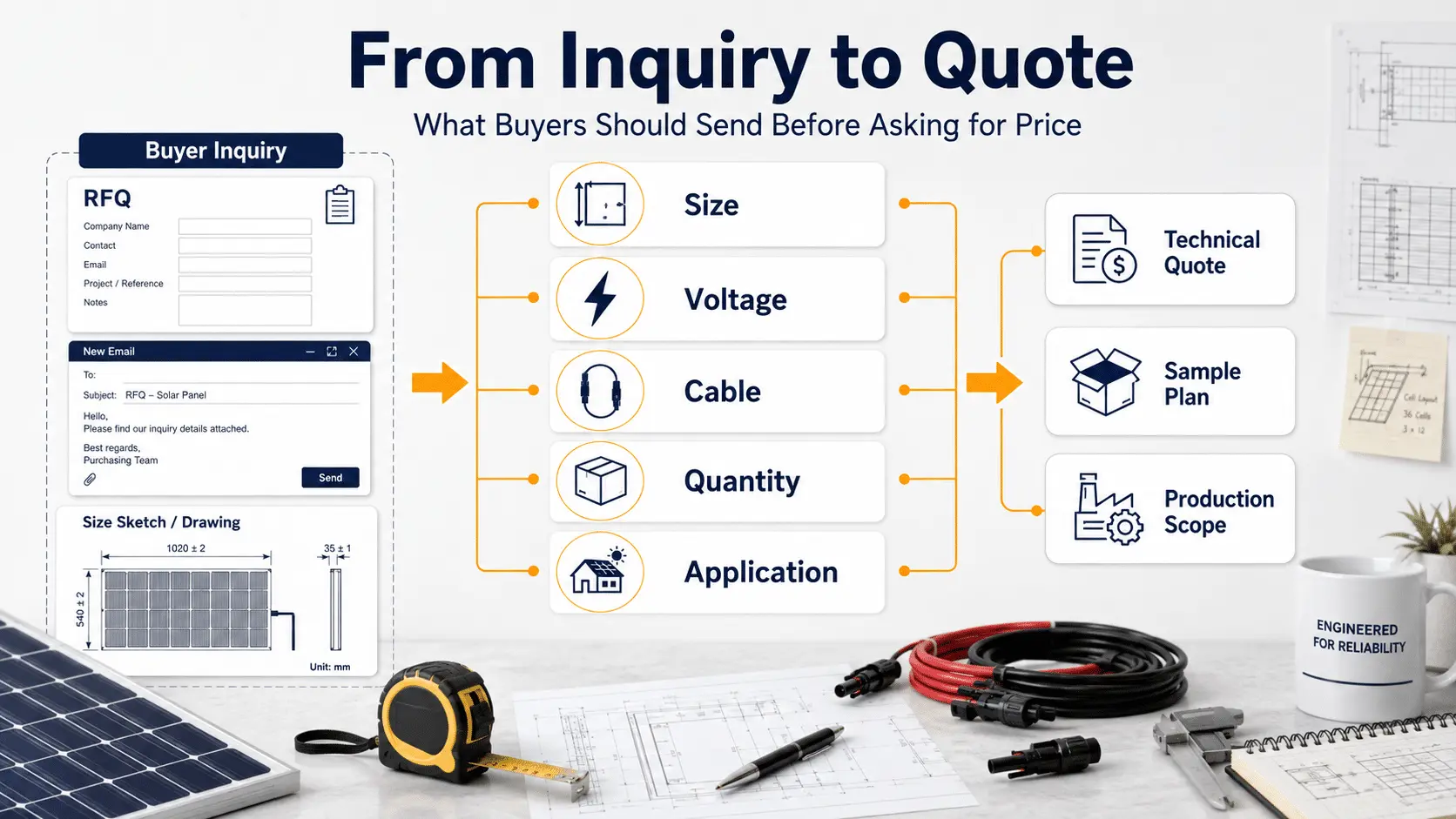
Solar panel quotation requirements are different for a B2B supplier quote than for a residential installation quote. A home installation quote usually starts with roof area, electricity bills, labor, permits, and financing. A supplier quotation for custom solar panels starts with application, panel size, voltage target, cable layout, connector, quantity, target market, packaging, and documentation.
If a buyer only asks for “best price,” the answer may be fast, but it may not describe the right product. A quote for a bare standard panel is not the same as a quote that includes custom cables, labels, packaging, sample confirmation, and sales documents.
For distributors, OEM buyers, and project teams, the better first question is not only “How much is it?” It is “What information do we need to send so the supplier can quote the right panel?”
Quick Answer: Solar Panel Quotation Requirements for B2B Buyers
Solar panel quotation requirements are the inputs a supplier needs to quote the right panel instead of only a fast price. For B2B buyers, the essential inputs are application, size, wattage, voltage, cable and connector design, quantity, target market, packaging, and documentation. These details decide whether the supplier should quote a standard model, a modified standard model, or a custom solar panel project.
Why Do Solar Panel Suppliers Ask for Size, Voltage, Cable, Quantity, and Application?
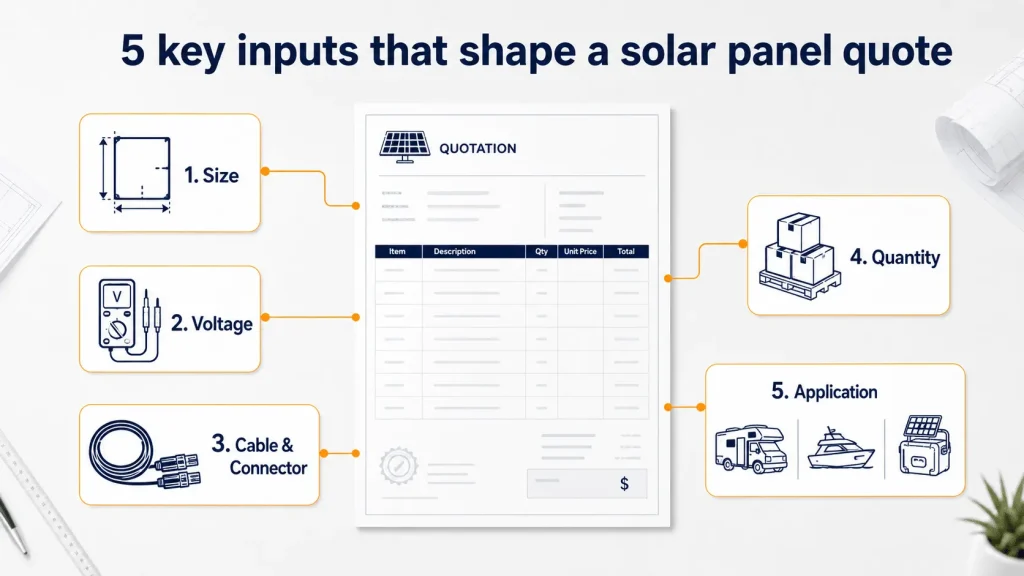
Solar panel suppliers ask for these details because a panel is not quoted by wattage alone. Size determines whether the panel can physically fit and how cells may be arranged. Voltage shows whether the panel can match the battery, controller, inverter, or power station. Cable and connector details affect installation and compatibility. Quantity changes the sample, MOQ, production, and packaging discussion. Application tells the supplier what design risks to check first.
Many solar panel inquiries start with one short sentence: “Please send your best price.”
That is understandable. Buyers are comparing suppliers, checking a new product idea, or trying to see whether a project budget is realistic. Price feels like the fastest place to start.
But in solar panel sourcing, especially for B2B orders, price is rarely the first thing that can be confirmed with confidence. A supplier may need to know where the panel will be used, how much space is available, what voltage or current is required, what cable and connector the system needs, and whether the product will be sold through a distributor channel.
Without that information, a quote can still be issued. The problem is that it may not be a quote you can safely use for purchasing decisions.
What Are Solar Panel Quotation Requirements?
Solar panel quotation requirements are the project details a supplier needs before preparing a useful price, sample plan, and delivery scope. They usually include application, wattage, dimensions, voltage, cable and connector design, quantity, target market, packaging, and documentation needs.
The exact list depends on the project. A standard rigid panel for a simple off-grid order may need fewer details. A custom flexible panel for an RV, marine deck, portable power product, equipment shell, or distributor SKU usually needs more review before the quotation is reliable.
This is where many early inquiries slow down. The buyer thinks the request is simple: “I need a 100W panel.” The supplier sees several unanswered questions: what size, what voltage, which connector, what cable length, what market, and what application?
Solar Panel Quotation Requirements: Installation Quote vs Supplier Quote
A solar installation quote and a solar panel supplier quotation are not the same document. This distinction matters because AI search results often answer the broad keyword as if the buyer is comparing home installers. Sungold’s quotation process is closer to a B2B RFQ: the supplier needs enough product and application detail to quote the correct panel scope.
| Quote type | What the buyer usually provides | What the quote is trying to decide |
|---|---|---|
| Residential solar installation quote | Electricity bill, roof area, roof direction, shading, address, utility information, battery or financing preference. | System size, annual production estimate, installed cost, permits, labor, incentives, and installer warranty scope. |
| B2B solar panel supplier quotation | Application, panel size, wattage, voltage target, cable length, connector, junction box position, quantity, target market, packaging, labels, and documents. | Whether to quote a standard panel, modified standard panel, or custom solar panel with project-specific production and documentation scope. |
| Distributor or OEM quotation | Sample plan, first order quantity, forecast volume, branding needs, certification documents, sales packaging, and local compliance expectations. | Whether the product can move from sample review to repeatable bulk supply without changing the approved specification. |
Why Each Specification Affects the Solar Panel Quote
A first inquiry does not need to be perfect. But the more complete it is, the faster the supplier can respond with a quote that matches the real buying situation.
| Information requested | What the supplier needs to know | Why it affects the quote |
|---|---|---|
| Size | Length, width, thickness, usable installation area, shape, mounting space, and cable-exit clearance. | Size affects cell layout, wattage range, material use, packaging, mounting method, and whether a standard production format can be used. |
| Voltage | Nominal battery voltage, operating voltage target, open-circuit voltage limit, and controller, inverter, or power-station input range. | Voltage determines electrical compatibility. A panel for a 12V battery system, 24V auxiliary system, power station, or inverter input may need different review. |
| Cable and connector | Cable length, exit position, polarity, connector type, plug compatibility, and whether the cable needs special outdoor, marine, or handling requirements. | Cable and connector choices affect installation, voltage drop, compatibility, packaging, and after-sales clarity. |
| Quantity | Sample quantity, first order quantity, expected repeat volume, and whether the project is a trial, distributor SKU, or OEM program. | Quantity affects MOQ discussion, sample feasibility, material planning, production scheduling, packaging, and whether customization is commercially practical. |
| Application | RV, marine, balcony, portable power, off-grid, outdoor monitoring, vehicle roof, equipment integration, or distributor resale. | Application defines the design target: weight, durability, mounting, connector, appearance, documentation, and market-readiness may all change by use case. |
Why Size Determines What Can Be Built
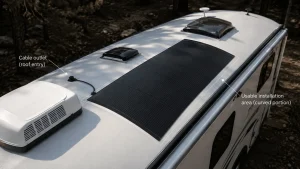
Size usually means more than the outside dimensions of the panel. A supplier may need to know the maximum length and width, thickness limit, mounting space, reserved area for the junction box, cable exit position, and whether the panel needs to fit a flat, curved, or irregular surface.
For example, a buyer may ask for a 100W solar panel but only have a narrow installation area. The supplier then has to check whether the requested power is realistic within that footprint, whether a standard model can fit, or whether the cell layout needs to be customized.
The U.S. Department of Energy notes that the size, shape, and slope of a roof can affect solar suitability. For B2B projects, the same principle applies more broadly: physical space changes product selection.
Why Voltage Determines System Compatibility
The word “voltage” can mean several different things in a solar panel inquiry. Buyers may refer to a 12V or 24V battery system, while the panel datasheet may list operating voltage, open-circuit voltage, peak-power voltage, and current values.
These values are not interchangeable. A panel described for a 12V battery system may produce a higher operating voltage so it can charge the battery through a suitable controller. The supplier therefore needs to know what the panel will connect to, not just the battery label.
A panel intended for battery charging may need a different electrical review from one intended for a power station, inverter input, small load, or larger system package.
Why Cable and Connector Details Matter
Cable questions are not just about adding a wire to the box. The supplier needs to know how far the panel is from the controller or load, what connector must mate with the buyer’s equipment, where the cable should exit the panel, and whether the installation has outdoor, marine, heat, or handling requirements.
A long cable run, low-voltage system, or high-current configuration can create more voltage-drop concern than a short cable on a different system. Several panels connected together may also change the current and connector review.
PV cable and connector choices should be matched to the DC voltage and environmental conditions of the installation. IEC 62930 covers electric cables for photovoltaic systems with a 1.5 kV DC voltage rating, while IEC 62852 covers safety requirements and tests for DC connectors used in photovoltaic systems.
Why Quantity Changes MOQ, Sample Cost, and Lead Time
Quantity helps the supplier understand whether the inquiry is for a sample, a small trial order, a distributor SKU, a private-label product, or a recurring OEM supply program.
For a standard product, MOQ and lead time may be easier to discuss. For a custom solar panel, the first sample may involve layout review, drawing confirmation, cable design, packaging review, and sample testing before bulk production can be planned.
That is why a supplier may ask about both the immediate sample quantity and the expected production quantity. It helps determine whether a custom design is practical and how the quotation should separate sample cost, production cost, packaging, and documentation.
Why Application Defines the Solar Panel Design Target
Application is one of the most useful details, but it is often missing from early inquiries.
| Application | Likely design concerns |
|---|---|
| RV or camper | Limited roof area, lightweight construction, vibration, cable routing, and 12V or 24V battery compatibility. |
| Marine use | Salt-air exposure, sealing, UV resistance, corrosion concerns, and cable protection. |
| Portable power kit | Folding or compact format, connector compatibility, storage packaging, and repeated handling. |
| Balcony or apartment product | Low weight, visible appearance, mounting boundary, cable route, and market-specific user instructions. |
| Outdoor monitoring or equipment | Small load profile, battery charging, weather exposure, custom shape, and repeatability. |
| Distributor or OEM product | SKU consistency, labeling, manuals, packaging, sample approval, and repeat production control. |
Application tells the supplier what kind of risk to check first. Without it, the quotation is only partly informed.
How a Solar Panel Inquiry Becomes a Quote
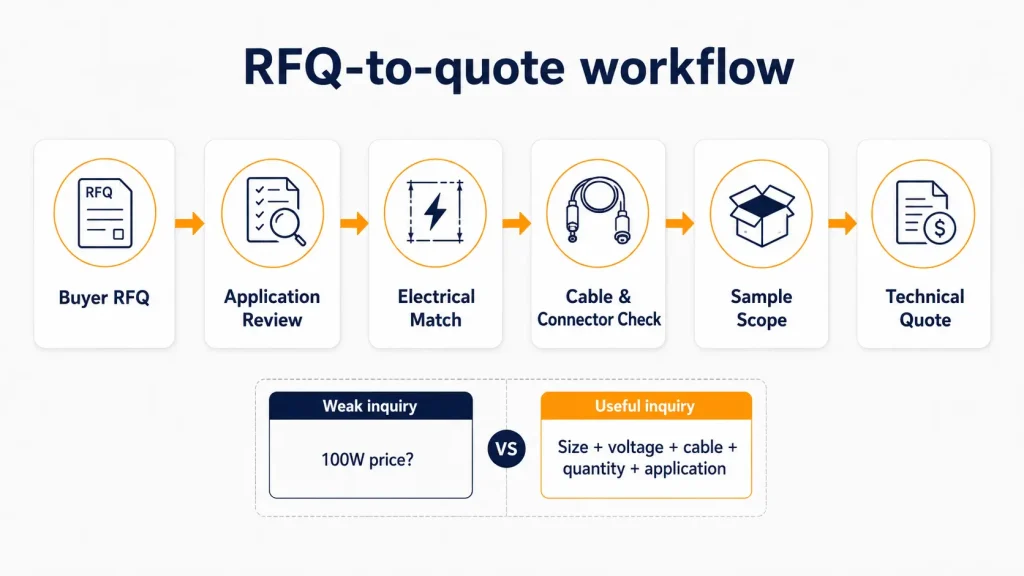
A typical supplier workflow is not just “receive request, send price.” For a useful quotation, the process usually looks more like this:
- Review the application and available space.
- Check whether the requested size and power are physically realistic.
- Select or review the electrical configuration for voltage, current, and system compatibility.
- Define the wiring package, including cable length, connector, exit position, and polarity.
- Check manufacturing requirements such as custom shape, surface material, labeling, packaging, and documentation.
- Prepare the technical and commercial quotation, including model scope, sample plan, quantity basis, lead-time assumptions, and delivery terms.
The stronger the inquiry, the fewer assumptions the supplier has to make during this workflow.
A Useful Solar Panel Inquiry Example
A weak inquiry is short, but not very quotable:
Weak inquiry: Please quote a 100W solar panel.
A more useful inquiry gives the supplier enough context to review both product fit and quotation scope:
Useful inquiry: We need flexible solar panels for an RV roof. Maximum available size is about 1000 mm x 400 mm per panel. Target output is around 100W each. The system will charge a 12V battery through an MPPT charge controller. We need a 2 m cable, rear cable exit, standard PV connectors, adhesive mounting review, sample pricing, and a production quote for 100 units. Please also advise lead time, datasheet, and any information needed before sample confirmation.
This second version does not answer every engineering question, but it gives the supplier enough direction to decide whether a standard product is suitable or whether a custom design needs review.
Minimum RFQ Checklist for Solar Panel Buyers
When possible, include these items in the first RFQ:
- Application and expected operating environment.
- Target wattage or daily energy requirement.
- Required panel dimensions, thickness, or available installation space.
- Nominal battery or system voltage.
- Controller, inverter, power station, or load input limits if already known.
- Cable length, connector type, cable exit position, and polarity requirements.
- Mounting method or installation surface.
- Sample quantity and estimated production quantity.
- Destination country or target market.
- Packaging, labeling, branding, or documentation needs.
If some items are not known yet, say so. “Not sure” is better than leaving the supplier to guess.
Common Inquiry Gaps That Slow Down Solar Panel Quotes
The slowest quotations are not always caused by difficult products. Often, they are caused by missing details.
- The buyer asks for “best price” but does not mention the application.
- The buyer gives wattage, but not the available installation size.
- The buyer says the panel is “for battery” but does not explain the battery voltage, controller, or power station input.
- The buyer wants a custom panel but has no drawing, dimensions, or reference sample.
- The buyer asks for certification but does not mention the target country or sales channel.
- The buyer needs a logo or package but does not say whether the product is for retail, distributor stock, or project use.
- The buyer compares suppliers, but each supplier receives a different request scope.
None of these gaps are unusual. Buyers often start early, before every detail is known. The important thing is to be clear about what is confirmed and what still needs supplier review.
A Better Solar Panel Inquiry Template for Buyers
If you want a faster and more useful quotation, send a short project brief instead of only a product name. It can be simple:
Solar panel inquiry template
We are looking for solar panels for [application].
Target wattage: [W]
Available size or installation space: [length x width]
System voltage or battery type: [12V / 24V / power station / other]
Cable length: [cm or m]
Connector type: [MC4 / DC plug / Anderson / custom / not sure]
Quantity: [sample quantity + estimated bulk quantity]
Target market: [country or region]
Need: [standard product / custom size / logo / packaging / certification documents]
You do not need to know every answer before contacting the supplier. “Not sure” is still useful if the application is clear. For example, “We are not sure about the connector, but the panel will be used with a portable power station sold in the EU market” gives the supplier more direction than “quote 200W panel.”
How Complete Inquiry Details Help Distributors Compare Suppliers
For distributors, the quotation stage is not only about getting a lower price. It is also a way to check whether each supplier is quoting the same product scope.
If one supplier quotes only the panel and another includes custom cable, retail packaging, labels, manuals, and support documents, the two prices are not directly comparable. The cheaper quote may still be valid, but it may be incomplete for the channel you are building.
A complete inquiry makes supplier comparison fairer. It helps you see who asks relevant technical questions, who includes the right accessories and documentation, and who can support sample-to-bulk consistency.
If your team is already comparing multiple offers, this guide on how to compare solar panel quotes from different suppliers can help separate product price, documentation, delivery terms, and total procurement scope.
When a Standard Solar Panel Quote Is Enough
Not every project needs customization. If the application can use an existing panel size, regular voltage range, common connector, and normal packaging, a standard product may be the fastest and most cost-effective option.
This is often suitable when the buyer is testing a market, preparing a small trial order, or working on an application where the installation space is flexible.
Even then, the buyer should still confirm the exact model, cable and connector, packaging, documents, warranty wording, and replacement process. These details matter more when the product will be resold through a channel.
When a Custom Solar Panel Quote Makes More Sense
A custom solar panel quote makes more sense when the installation space is fixed, the electrical target is specific, the cable exit direction matters, or the buyer needs private-label packaging.
Custom projects are common in OEM equipment, RV and marine applications, portable solar products, special mounting spaces, and distributor programs where the buyer wants a differentiated SKU.
In these cases, the quote should not only list a panel price. It should clarify what is being customized, what the sample will confirm, and what needs to stay consistent during bulk production.
For projects involving panel size, voltage, cable route, connector selection, and application-specific review, buyers can start with Sungold’s custom solar panel solutions. If the application needs a lightweight or flexible module format, the PA219 flexible solar panel page can be reviewed as one possible product path. Final suitability still depends on the project drawing, system input, mounting method, target market, and documentation requirements.
Where Sungold Fits in Solar Panel Inquiry and Quotation Support
Sungold Solar treats the inquiry stage as the first technical clarification step, especially for flexible solar panels, portable solar panels, RV and marine applications, and distributor projects.
The goal is not only to send a number. The goal is to understand whether the buyer needs a standard model, a modified standard model, or a custom product path.
For B2B customers, this may include reviewing application, size, wattage, voltage target, cable and connector requirements, packaging needs, target market, and expected order plan. Those details help reduce quotation errors and make the sample stage more useful.
Buyers working on portable power or kit-based products can also review Sungold’s portable solar panel options before sending connector, cable, and system-input requirements.
FAQ
Buyers should provide the application, target wattage, available size, system voltage or battery type, cable length, connector type, quantity, target market, and any packaging or branding needs. If some details are not confirmed yet, explain the application first.
Application affects product selection, material review, cable layout, connector choice, packaging, and documentation needs. A panel for RV use, marine use, portable power, balcony solar, or OEM equipment may require different checks.
No. A residential installation quote usually evaluates the home, roof, labor, permits, financing, and expected system output. A solar panel supplier quotation evaluates the product scope: application, dimensions, voltage, cable and connector design, quantity, target market, packaging, labels, and documents.
You may get a rough quote, but it may not be accurate enough for purchasing decisions. Wattage and quantity do not explain size, voltage, cable, connector, packaging, or target market requirements.
MOQ can change when the project requires custom size, custom voltage, special cable, special connector, private-label packaging, or other non-standard production steps. Standard products are usually easier to quote than customized products.
For distributor, OEM, or customized projects, samples are useful for confirming product design, output, cable layout, packaging, and compatibility before bulk production. The sample should match the intended bulk order as closely as possible.
Final Thoughts
A strong solar panel quotation is not just a low number. It is a clear match between product design, application, quantity, documentation, packaging, and delivery expectations.
If you want a faster quote, start by sending the information that affects the product. If you want a safer purchasing decision, compare suppliers against the same written scope.
That small change can save a surprising amount of time before samples, bulk orders, and distributor launches.
Source NotesThe U.S. Department of Energy notes that solar suitability depends on practical site factors such as roof size, shape, and slope: Department of Energy homeowner solar guide.
IEC 62930 covers electric cables for photovoltaic systems with a 1.5 kV DC voltage rating: IEC 62930.
IEC 62852 covers safety requirements and tests for DC connectors used in photovoltaic systems: IEC 62852.