 EN
EN
 Deutsch
 Italiano
 Español
 Français
 日本語
日本語
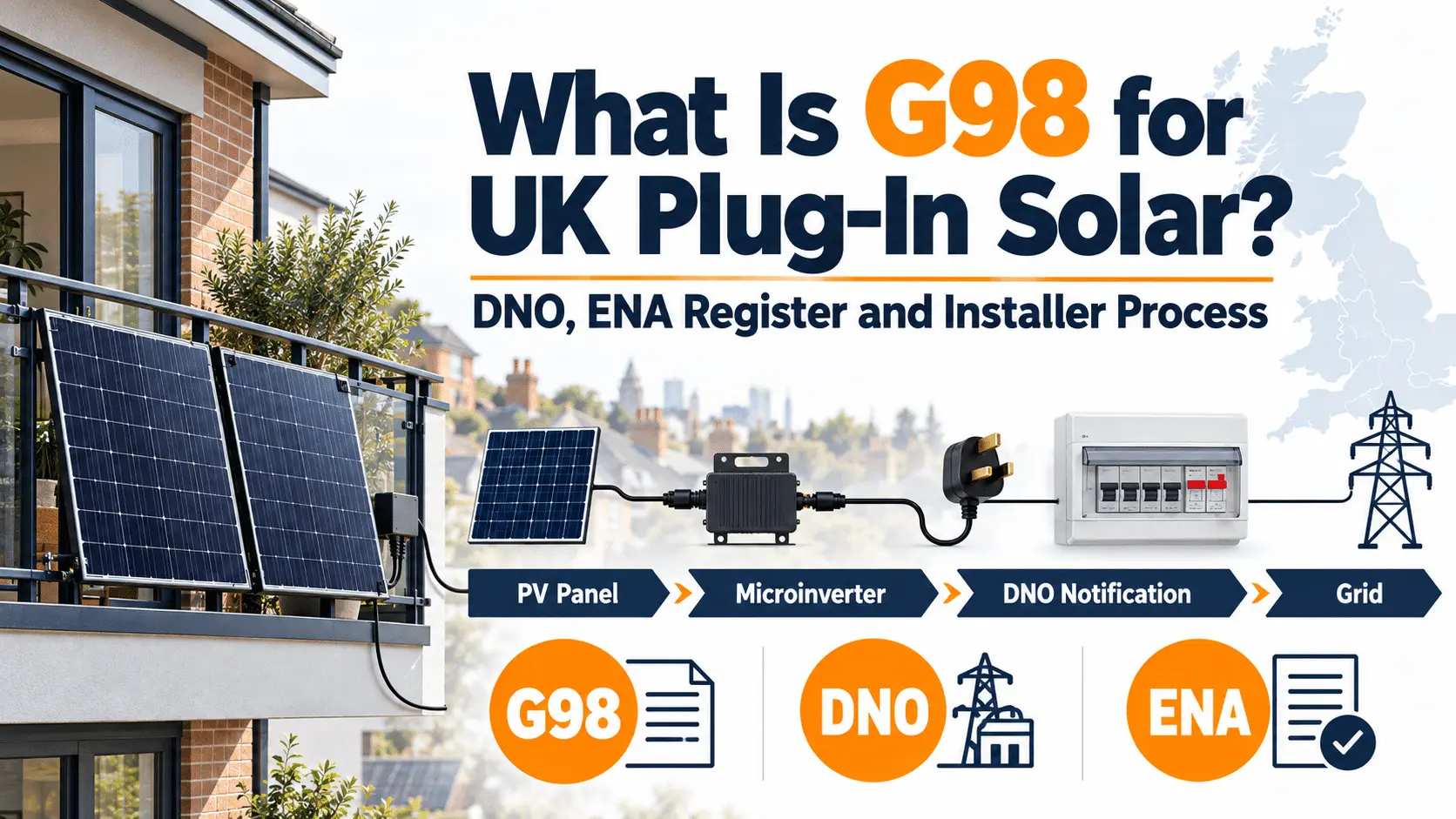
Quick answer: G98 for UK plug-in solar is the grid-connection framework for eligible, fully type-tested microgenerators operating in parallel with Great Britain’s public low-voltage network. It is not a solar panel certification or a complete product approval. Buyers and installers must verify the exact inverter model, type-test reference, ENA record, local DNO process and matching installation documents.
What does G98 mean for UK plug-in solar?
G98 is an Engineering Recommendation published through the Energy Networks Association. It sets requirements for fully type-tested microgenerators operating in parallel with public low-voltage distribution networks.
In practical terms, G98 focuses on how generating equipment interacts with the electricity grid. It covers grid synchronisation, loss-of-mains protection, voltage and frequency response, power quality, protective functions, type-test evidence and DNO notification records.
G98 does not prove that every solar panel, mounting system, cable, plug or building installation is safe. Those items must be checked separately against the applicable product specification, BS 7671, building requirements and intended installation method.
G98, DNO and ENA Register: what is the difference?
| Term | Meaning | Main responsibility |
|---|---|---|
| G98 | Technical requirements for connecting eligible microgenerators | Connection and grid-behaviour framework |
| DNO | Distribution Network Operator serving the installation address | Receives and processes connection information |
| ENA | Energy Networks Association | Coordinates network guidance and technical frameworks |
| ENA Type Test Register | Record of type-tested generation equipment and manufacturer references | Manufacturer evidence and installer verification |
| Installer | Person or company responsible for the site installation | Site checks, commissioning, forms and notification |
The Energy Networks Association has also introduced Connect Direct for product registration and connection workflows. Check the current ENA platform and the relevant DNO instructions instead of relying on an old PDF form or outdated register URL.
Why does the inverter matter?
For a grid-connected plug-in solar system, the inverter converts DC power from the solar panels into AC power that interacts with the household circuit and public network. G98 review therefore focuses on the generating unit and its grid interface, not only on the PV module.
- Inverter manufacturer and exact model number
- AC rated output and phase configuration
- Grid-code setting and anti-islanding protection
- Type-test reference and manufacturer reference
- Installation and commissioning instructions
- Whether the tested model matches the supplied model
A G98 reference for one inverter does not automatically cover a different inverter. It may also not cover a modified product with different firmware, output settings, battery architecture or connection method.
Configuration rule: Treat the product as one defined system: PV modules + inverter + cables + plug + mounting method + operating instructions. Changing one element may require a separate technical review.
What is the ENA Type Test Register used for?
The ENA Type Test Register allows installers and network stakeholders to check whether a generation device has a relevant type-test record and manufacturer reference.
A manufacturer should be able to provide the exact model reference, type-test documentation, manufacturer reference number, rated electrical output, test scope, product configuration and supporting technical documents.
The register is evidence that the relevant generation equipment has been type-tested. It should not be interpreted as blanket approval for every possible installation configuration.
How does the G98 installer process work?
- Confirm the market: Establish whether the project is in Great Britain or Northern Ireland and whether it is domestic, commercial or multi-property.
- Identify the local DNO: Use the installation address and postcode to confirm the network operator and connection conditions.
- Confirm equipment details: Record the exact inverter model, AC rating, phase, type-test reference and commissioning information.
- Check the ENA record: Confirm that the exact model and manufacturer reference can be verified.
- Choose the correct route: Determine whether the project qualifies for connect-and-notify or requires an apply-to-connect process.
- Install and commission: Follow the manufacturer’s wiring, protection, isolation, labelling and mounting instructions.
- Submit DNO information: Send the required form and supporting details to the local DNO.
- Give the customer records: Provide the installation record, notification confirmation, product manual and relevant test reference.
Connect-and-notify vs apply-to-connect
| Question | Connect-and-notify | Apply-to-connect |
|---|---|---|
| When is the DNO contacted? | Usually after installation | Before installation |
| Is prior approval normally required? | Not normally when the system qualifies | Yes |
| Typical framework | G98 | G99 or another applicable route |
| Main risk | Incorrect or late notification | Installing before approval |
| Who decides? | Competent installer | Competent installer and DNO |
The classification should be confirmed from current DNO guidance. It should not be decided only from the panel wattage. The relevant capacity may depend on inverter AC output, aggregate generation at the property, connection type and existing storage or generation.
What should manufacturers prepare?
- Exact PV module and inverter models
- AC output and DC input limits
- Approved panel configuration and wiring diagrams
- Cable, connector and plug details
- Protection and anti-islanding information
- G98 type-test documentation
- ENA manufacturer reference
- Installation and commissioning instructions
- Product labels and market-specific warnings
- Change-control records for firmware, hardware and BOM changes
The documentation should state whether the test applies to the inverter, the complete microgenerator, a defined product family or a complete plug-in solar kit. Rebranding a product does not remove the need for configuration control.
G98 for UK plug-in solar: what should installers check?
- The DNO serving the property
- The applicable G98, G99 or G98/NI route
- The exact inverter and ENA reference
- Existing generation or storage at the property
- Whether batteries are included
- Whether supplied plugs and cables match the approved design
- Mounting, isolation, protection and cable routing
- Customer documentation and notification requirements
A product designed for Germany, the United States or another market cannot be assumed to meet UK requirements because the inverter brand is familiar.
G98 vs G99 vs G98/NI
| Framework | General role | Important boundary |
|---|---|---|
| G98 | Fully type-tested small-scale generation using a simplified connection route where eligible | Exact equipment and DNO conditions still need verification |
| G99 | Connection cases needing a more detailed application or assessment | Do not install before required approval |
| G98/NI | Northern Ireland connection requirements | Do not automatically reuse Great Britain G98 documents |
Buyer and OEM checklist
- Is the exact inverter model listed in the current ENA system?
- What is the manufacturer reference number?
- Does the test cover the complete microgenerator or only one component?
- What AC output is declared?
- Is the product intended for Great Britain or Northern Ireland?
- Who submits the DNO notification?
- Which documents will the customer receive?
- Does the product include a battery?
- Do the supplied plug, cables and panel configuration match the approved design?
If the supplier cannot answer these questions, the product should not yet be treated as ready for UK distribution.
Frequently asked questions
Does G98 certify solar panels?
No. G98 primarily addresses the connection and grid behaviour of generating equipment. Solar module safety certification, mounting safety and complete product compliance must be checked separately.
Is a G98 inverter automatically approved for every solar panel?
No. The inverter record does not automatically approve every PV module, cable, connector or mounting configuration. The complete system must match the tested and documented design.
Does the installer or manufacturer submit the G98 information?
The manufacturer is responsible for type-test evidence and product registration. The installer is responsible for installation information and forwarding the relevant details to the local DNO.
Can a product listed in the ENA Register be sold anywhere in the UK?
Not automatically. Great Britain and Northern Ireland have different connection requirements, and product legality, electrical safety and consumer documentation remain separate issues.
Is G98 the same as product certification?
No. G98 is a grid-connection engineering recommendation. It does not replace product safety testing, electrical installation requirements or market-specific certification.
Final thoughts
G98 for UK plug-in solar should be treated as a system and process requirement, not as a marketing badge. A reliable procurement review connects the exact inverter model, type-test evidence, ENA reference, local DNO process and matching installation documents.
For manufacturers and OEM brands, define the complete product configuration before testing, registration, packaging and quotation. For installers, verify the equipment, follow the correct DNO route and provide a complete customer record.
For a UK plug-in solar project, review the Sungold balcony solar solution or contact the team with the target market, inverter model, PV configuration and installation requirements.