 EN
EN
 Deutsch
 Italiano
 Español
 Français
 日本語
日本語

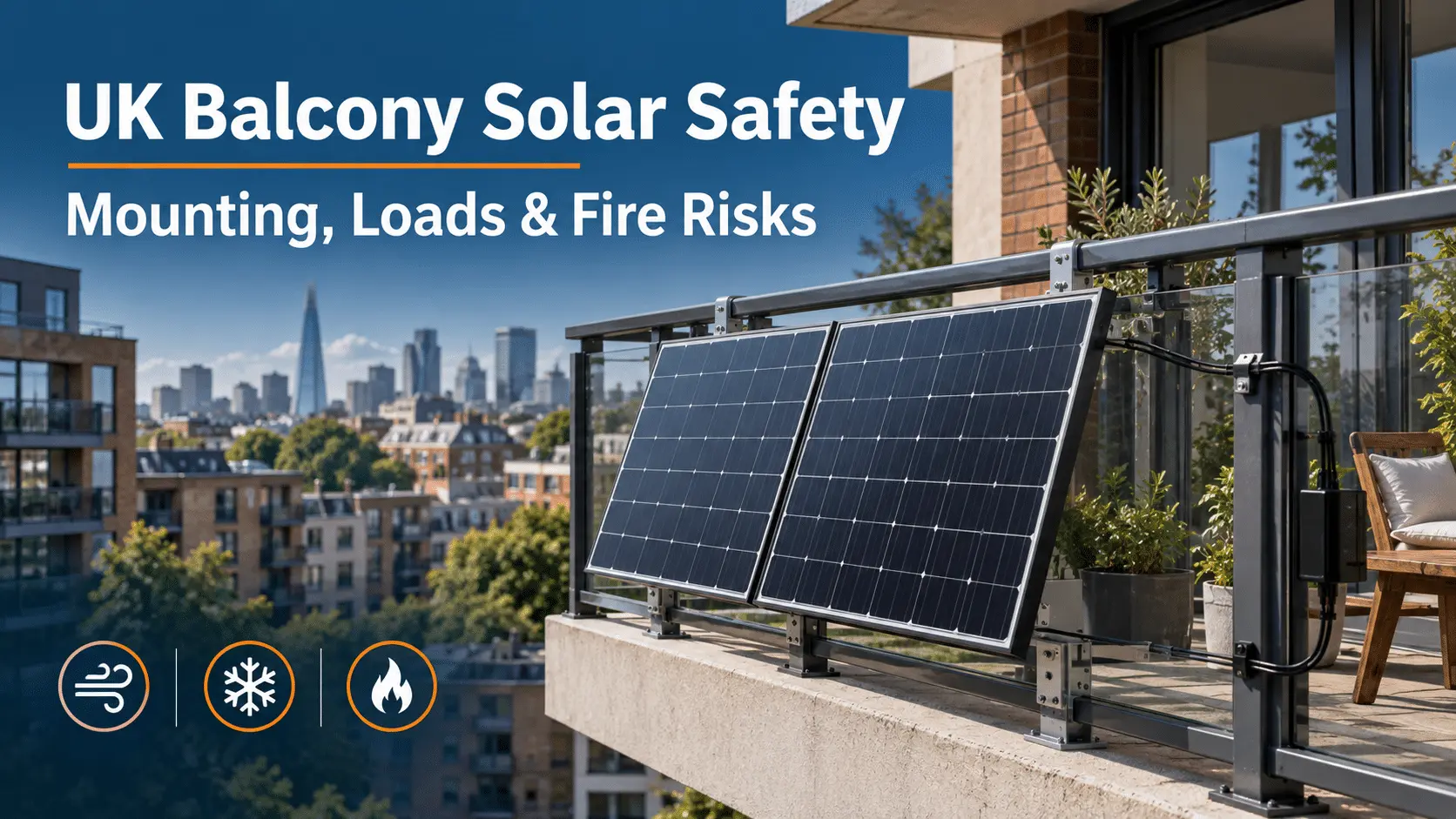
Quick answer: UK balcony solar safety depends on the building, balcony structure, mounting geometry, weather exposure, electrical design and fire access conditions. A suitable panel or inverter certificate does not by itself approve a balcony installation. Before ordering or installing, confirm the balcony can carry the proposed loads, select manufacturer-approved fixings, keep escape routes clear, protect cables and connectors, and use a competent installer for work at height and electrical work.
What UK balcony solar safety covers
For a balcony PV system, safety is a site-and-system question rather than a panel-only question. The review should cover:
- the balcony slab, railing, parapet or frame used for support;
- dead load, wind uplift, overturning, vibration and any snow or ice exposure;
- fixing compatibility with the building substrate and corrosion environment;
- fire access, combustible materials, shared walkways, windows and escape routes;
- DC cable routing, connector protection, inverter position and isolation;
- safe access, work-at-height planning and the risk of falling tools or components.
For work at height, the UK Health and Safety Executive says work must be properly planned, supervised and carried out by competent people using suitable equipment. The same principles apply when a balcony mount is being surveyed or installed. See the HSE work at height guidance.
UK balcony solar safety: check the structure first
Do not choose a bracket first and try to make the balcony fit it. The responsible designer or installer should identify the load path from the module and mount into the balcony structure, then check the condition and capacity of the supporting elements.
Important questions include:
- Is the support a reinforced concrete slab, masonry wall, steel railing, aluminium frame or another substrate?
- Can the proposed fixing resist pull-out, shear, uplift and repeated vibration?
- Is the railing designed to accept solar loads, or is it only a guardrail for people?
- Could drilling damage reinforcement, waterproofing, thermal insulation or drainage?
- Are there signs of cracking, corrosion, movement, water ingress or previous unapproved alterations?
A lightweight module does not make the complete installation lightweight. Brackets, rails, clamps, ballast, cable protection and any maintenance access must be included in the assessment. For higher buildings, exposed balconies and shared properties, obtain the building owner, landlord, freeholder or management company approval required for the project.
Wind load, snow load and exposure
There is no single wind or snow-load number that is safe for every UK balcony. The design value depends on location, building height, edge exposure, orientation, parapets, nearby buildings, module angle, array size, fixing spacing and the local structural design basis.
Wind is often the governing issue because a balcony array can behave like a sail. The assessment should consider positive pressure, suction and uplift, local turbulence at building corners and the possibility of a panel or bracket becoming a falling object. Snow and ice may add vertical load and can change how forces are transferred through the mount.
Ask the supplier or engineer for the design assumptions and the permitted installation configuration. Do not copy a roof-mount spacing or a ground-mount ballast value into a balcony project without checking the different load path and exposure.
Choosing fixings and mounting hardware
Use the mounting hardware, clamps and fasteners specified for the module and the installation substrate. The fixing schedule should identify the fastener type, embedment or clamping method, spacing, torque where applicable, corrosion protection and inspection requirements.
A safe mounting review should also check:
- compatibility between the frame, clamp and module load zones;
- galvanic corrosion between dissimilar metals;
- edge distances and the risk of cracking or crushing the substrate;
- drainage paths and water ingress around penetrations;
- movement, thermal expansion and vibration over the service life;
- retention of small parts so that no component can fall onto people below.
Avoid improvised clamps, household adhesives, unverified railing hooks or unrestrained ballast. If the installation cannot be inspected and maintained without creating a new fall risk, the mounting concept needs to be reconsidered.
UK balcony solar safety: fire and escape routes
Balcony PV must not obstruct a shared walkway, access route, window, door, firefighting position or escape route. Keep panels, inverters, batteries, cables and connectors away from combustible storage and maintain the clearances specified by the equipment manufacturer and the building’s fire-safety process.
The London Fire Brigade guidance on plug-in solar panels advises residents to keep combustible materials away from panels, batteries, inverters and electrical connections, and not to block balconies, walkways, windows or fire escape routes. It also recommends manufacturer-specified brackets and accessories and competent electrical installation.
Do not describe a balcony array as fireproof unless a specific, applicable test supports that wording. A product test report is not a substitute for a site-specific fire-risk review, landlord approval or emergency-access plan.
Cable routing, connectors and inverter placement
Balcony cables should be short enough to avoid unnecessary loops and secured so that wind, abrasion, water and movement cannot damage them. Keep connectors off standing water, away from sharp edges and protected from accidental contact. Do not leave DC connectors loose behind a panel or route cables where a door, railing or footpath can pinch them.
- Follow the polarity, connector and cable-size requirements of the equipment manufacturer.
- Provide strain relief where cables enter an enclosure or pass through a mount.
- Protect penetrations with suitable glands or seals rather than relying on tape.
- Keep the inverter accessible for inspection and isolation, but away from direct water exposure and combustible storage.
- Label isolation points and keep documentation with the installation.
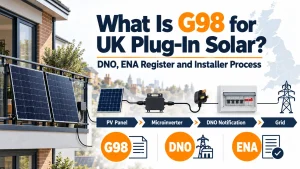
Grid-connected plug-in systems also need a separate electrical and network-connection review. For the UK connection pathway, see our guide to G98 and UK plug-in solar. The connection route does not remove the need for a balcony structural and fire-safety assessment.
Installation and work-at-height risks
Installing from a balcony edge creates risks that are not present in a factory test. Plan how modules, tools and packaging will be moved, how workers will be protected from falls, and how the area below will be controlled. Do not rely on a temporary rope, a domestic ladder or a second person holding a panel as the main fall-protection method.
HSE guidance expects work at height to be planned and carried out with suitable equipment, inspection and competent people. Stop work when wind, rain, ice, poor visibility or other conditions make handling unsafe. On shared or high-rise buildings, coordinate access, resident communication and exclusion zones before delivery.
What buyers and installers should document
A procurement file for a balcony solar project should normally include:
- module, inverter and mounting-system identification;
- installation drawings showing dimensions, angles, fixing points and cable routes;
- site assumptions for structure, wind, snow, exposure and corrosion environment;
- load calculations or an engineer’s confirmation where required;
- manufacturer installation instructions and approved accessory list;
- electrical diagrams, isolation arrangements and connection documentation;
- fire-access review, approvals and maintenance instructions;
- inspection photographs and a record of any changes made on site.
Keep the file specific to the actual balcony and equipment. A generic product brochure cannot confirm the capacity of an individual building.
Unsafe assumptions to avoid
- “The module is certified, so the balcony is approved.” Product evidence and site approval are different questions.
- “A railing is strong enough because it supports people.” Guardrail loads and solar wind loads are not automatically equivalent.
- “The lightest panel needs no structural check.” Wind uplift and fixing forces can govern even when dead load is low.
- “A plug-in connection makes installation risk-free.” Electrical connection, fire access, cable routing and building approvals still matter.
- “The same bracket works on every balcony.” Substrate, geometry, corrosion and access vary by building.
UK balcony solar safety checklist for buyers and installers
- Confirm the building owner or management approval route.
- Survey the balcony, railing, parapet and drainage condition.
- Define the module, mount, inverter and cable configuration.
- Assess site-specific wind, snow, vibration, corrosion and falling-object risks.
- Verify fixings, clamps, torque, spacing and substrate compatibility.
- Keep fire routes, windows, doors and shared access clear.
- Plan work at height, delivery, exclusion zones and maintenance access.
- Complete electrical, connection and commissioning documentation.
- Record the final installation and provide inspection guidance.
FAQ
Can any balcony support solar panels?
No. Support depends on the balcony structure, condition, fixing method, wind exposure and the complete system weight. A competent designer or installer should confirm the load path and site suitability before installation.
What wind and snow loads should a balcony solar mount withstand?
There is no universal value for every UK balcony. The required design loads depend on location, height, exposure, geometry, orientation, fixing arrangement and the applicable structural design basis. Request site-specific assumptions and calculations instead of reusing a generic roof value.
Is drilling into a balcony railing safe for solar mounting?
Not automatically. Drilling can weaken or damage a railing, protective coating, waterproofing or concealed structure. Use only a fixing method approved for the actual substrate and confirmed by the responsible designer or installer.
Can balcony solar panels block a fire escape or shared walkway?
No. The installation should keep escape routes, shared walkways, doors, windows and emergency access clear. Fire-safety guidance should be checked with the building owner or management process for the property.
How should balcony solar cables be routed?
Secure cables against wind, abrasion, water, sharp edges and pinching. Keep connectors protected and accessible, provide suitable strain relief and follow the equipment manufacturer’s cable, connector and isolation instructions.
Does a product certificate replace a site-specific balcony assessment?
No. A product certificate can address the tested product or component scope. It does not automatically confirm balcony structural capacity, mounting suitability, fire access, building approval, electrical installation or grid-connection requirements.
Final takeaway
UK balcony solar safety is achieved by matching the product, mounting system and installation method to the actual building. Treat structure, weather exposure, fixings, fire access, cables and work at height as one review. For projects in Great Britain or Northern Ireland, also confirm the applicable electrical, building, landlord and connection requirements for the specific site.