

Solar tariffs 2026 are changing how buyers think about panel prices. The main concern is no longer only whether solar modules are cheap or expensive. Buyers also need to understand where the product was made, how it is classified, when it enters the United States and which costs are included in the quotation.
The short answer is that solar prices may increase, but not every buyer will see the same change at the same time. Existing inventory, contract terms, shipping schedules, product origin and customs treatment can all affect the final price.
Solar Tariffs 2026: What Is Changing?
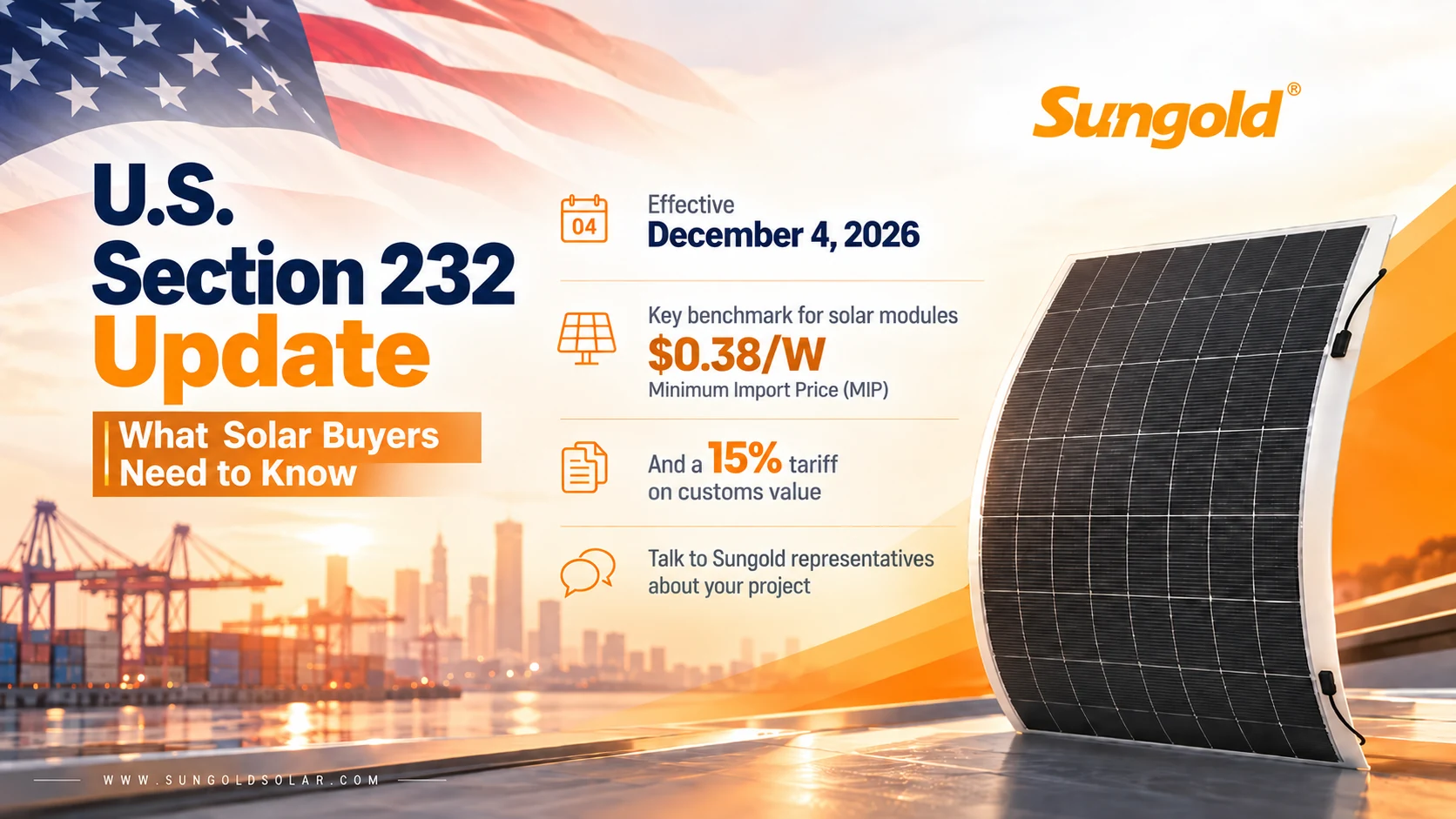
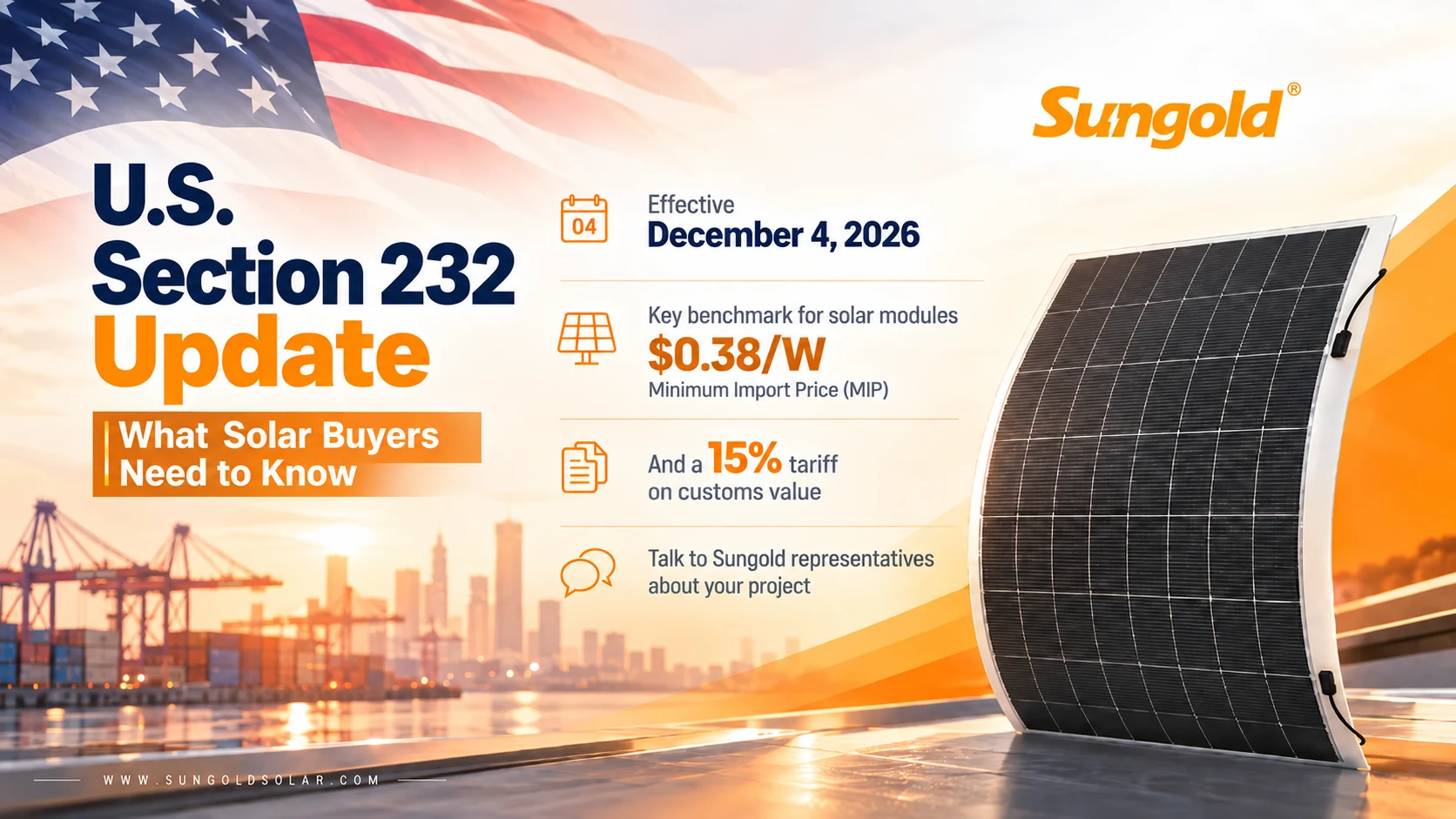
A new Section 232 action establishes minimum import prices for certain polysilicon products and solar derivatives. For covered solar modules, the listed minimum import price is $0.38 per watt. The measure is scheduled to apply to relevant goods entered for consumption on or after December 4, 2026.
The same action also lists different reference values for polysilicon, wafers and solar cells. These are not all treated in exactly the same way.
| Section 232 reference | Figure in the published measure | How buyers should read it |
|---|---|---|
| Effective date | December 4, 2026 | Applies to relevant goods entered for consumption on or after the stated effective time. |
| Solar modules | $0.38/W minimum import price | A minimum import price mechanism for covered modules, not a universal U.S. retail price. |
| Solar cells | $0.22/W minimum import price | Applies to the covered cell products and should be checked against the exact classification. |
| Polysilicon | $21/kg minimum import price | Applies to the covered polysilicon products. |
| Ingots and wafers | $100/kg minimum import price | Applies to the covered ingot and wafer products. |
| Ad valorem tariff | 15% of customs value for covered products under the applicable rule | Origin, product scope, existing duties and partner-specific treatment must be reviewed; do not add 15% to every module automatically. |
In practical terms, the policy uses two different ways of expressing cost exposure. The MIP figures are stated per watt or kilogram. The ad valorem tariff is calculated as a percentage of the relevant customs value. They should not be combined by simply treating $0.38/W as the final selling price and adding 15% without reviewing the product and origin.
The important point for buyers is this:
The $0.38/W figure should not be treated as a universal retail price for every solar panel in the United States.
The actual treatment depends on the product, HTS classification, country of origin, declared value, contract status and entry documentation. Buyers should review the exact product with a customs broker or trade advisor before shipment.
The official Federal Register notice provides the applicable minimum price figures and effective date.
Will Solar Panels Become More Expensive?
Some products may become more expensive, especially when the supplier’s previous price was below the applicable import threshold or when the shipment is exposed to additional duties.
However, the change may not appear as one simple increase across the entire market.
A supplier may already have:
- Inventory imported before the effective date;
- A fixed-term contract;
- A different manufacturing route;
- A domestic assembly arrangement;
- A product that falls outside the specific scope;
- A quotation that already includes some duties and logistics costs.
This is why a headline such as “solar panels will cost 15% more” can be misleading. The effect depends on how the product moves through the supply chain.
A buyer should ask not only, “What is the panel price per watt?” The better question is:
What will this product cost when it is cleared, delivered and ready for the intended project?
Why the Factory Price Is Not the Landed Cost
A factory quotation is only one part of the final purchase cost. For background on related U.S. solar trade-cost considerations, see our guide to AD/CVD and solar panel sourcing costs.
| Cost component | What it may include |
|---|---|
| Factory price | Module price under the quoted Incoterm |
| Logistics | Freight, insurance, port charges and handling |
| Import costs | Customs duties, brokerage and related entry charges |
| Commercial risk | Storage, delay, documentation or replacement costs |
A more realistic calculation is:
Landed cost = factory price + freight + insurance + customs duties + brokerage + port charges + storage or delay cost + compliance documentation cost
For example, two suppliers may quote different prices per watt. The lower quote may look better at first, but the buyer may later discover that it excludes freight, customs handling or additional import charges.
The higher quote may already include some of these costs.
This is especially important for distributors and installers who prepare customer quotations several months before the equipment arrives. A small change in the landed cost can affect the project margin, installation price and final customer decision.
What Does the December 4 Deadline Mean?
The date matters because customs treatment is generally connected to when the goods enter the relevant import process. It is not automatically determined by the day the buyer sends a purchase order.
| Milestone | Why it matters |
|---|---|
| Quote date | Shows when the supplier offered the price |
| Contract date | May affect whether fixed terms exist |
| Production or shipping date | Shows the supply timeline, but may not decide customs treatment |
| Customs entry date | May affect which rule applies to the imported goods |
A buyer who signs a contract before December 4 should not assume that the shipment is automatically protected. The contract may need to meet specific conditions, and the importer may still need supporting documentation.
The same caution applies to goods that have already been produced but have not yet entered the United States.
Before making a timing decision, ask the supplier and customs broker to confirm:
- The expected entry date;
- The applicable product classification;
- The contract terms;
- The origin documentation;
- The duty treatment;
- The documents required at entry.
Who Will Feel the Impact First?
Homeowners
Homeowners may notice the effect through installer quotations rather than through a direct customs bill. If an installer’s equipment cost increases, the change may appear in:
- A revised system proposal;
- A shorter quotation validity period;
- Higher equipment deposits;
- Longer lead times;
- Fewer product choices.
A homeowner should compare the complete installation price instead of looking only at the panel line item.
Installers
Installers need to protect project margins while keeping customer proposals realistic. They may need to review how long a quotation remains valid, whether the quoted equipment is already in the United States, whether the supplier can hold the quoted price, whether an alternative module is technically interchangeable and whether a change in module model affects the permit or design package.
Substituting a panel only because it has a similar wattage can create new problems. Voltage, dimensions, connectors, mounting, certifications and availability may all be different.
Distributors
Distributors face a different risk. They must manage inventory before the final customer order is placed.
Their main questions may include:
- How much inventory should be ordered?
- Which products will remain competitive after the effective date?
- Can the supplier provide stable origin documentation?
- Will the same model be available for repeat orders?
- How should tariffs be reflected in customer pricing?
For distributors, a dependable documentation process can be as important as the module price.
Does Country of Origin Change the Result?
Country of origin can affect the applicable trade treatment, but the shipping country alone does not answer the question.
A product shipped from Indonesia is not automatically treated the same way as a product manufactured in Indonesia. Buyers may need to review:
- Where the cells were produced;
- Where the module was assembled;
- Which manufacturing operations took place in each country;
- The applicable HTS classification;
- Whether the supplier can provide traceability records;
- Whether current AD, CVD, Section 301 or Section 232 rules apply.
This is where a manufacturer with more than one production location can give buyers more options. Sungold operates manufacturing facilities in Shenzhen and Batam, Indonesia. The Indonesia route may provide an additional supply-chain option for U.S. buyers, but the final customs treatment still depends on the exact product, origin, documentation and current trade rules.
The correct question is not, “Is Indonesia tariff-free?” A better question is:
Can this specific product be manufactured, documented and imported under a supply route that fits the buyer’s target market and compliance requirements?
What Can a Solar Manufacturer Help Confirm?
A professional manufacturer should be able to help the buyer identify the product and supply-chain information needed for a proper review.
Before placing an order, request:
- Exact module model;
- Rated wattage and electrical specifications;
- Manufacturing location;
- Cell and module origin information;
- Bill of materials or traceability documents;
- Product datasheet;
- Certification records;
- Packaging and label information;
- Incoterm and shipping scope;
- Expected production and delivery schedule;
- Change-control process between sample and bulk production.
This information does not replace a customs ruling. It gives the buyer and customs broker the information needed to make a more reliable assessment.
For OEM projects, the process should begin even earlier. A change in cell type, module construction, production location, packaging or model number may affect the documents used for the shipment.
How Could Tariffs Affect Different Solar Products?
Tariffs and import rules should not be evaluated only by product name.
A buyer may compare:
- Standard rigid solar panels;
- Flexible solar panels;
- Lightweight modules;
- Custom-shaped panels;
- Portable solar panels;
- Complete solar kits.
The product format does not automatically determine the duty treatment. The exact classification, origin and documentation still matter.
Product design can nevertheless affect the commercial result. A lightweight or custom module may reduce installation difficulty or improve space usage. A higher-power module may reduce the number of panels needed. A custom panel may reduce wasted mounting area.
These benefits should be compared with:
- Manufacturing cost;
- Packaging size;
- Shipping weight;
- Minimum order quantity;
- Sample and production lead time;
- Certification requirements;
- Replacement availability.
A lower price per watt is not always the lowest total project cost.
What Should Buyers Ask Before Ordering?
A practical inquiry should include more than a target wattage.
| RFQ item | What to provide or confirm |
|---|---|
| Destination | Country, state or market and port of entry |
| Product | Exact module model and rated wattage |
| Origin | Cell origin and module manufacturing location |
| Trade information | HTS classification used for the quotation and duty assumptions |
| Commercial terms | Incoterm, expected entry date and contract status |
| Documents | BOM, traceability records and certification documents |
This information helps separate a real comparison from a simple factory-price comparison. It also gives the manufacturer enough information to recommend the appropriate production route instead of sending a generic quotation.
What Solar Tariffs Do Not Mean
The 2026 changes do not automatically mean:
- Every solar panel will have the same final price;
- Every product will increase by exactly 15%;
- $0.38/W is the final retail price;
- A shipment ordered before December 4 is automatically exempt;
- Shipping from a particular country guarantees a specific tariff result;
- A manufacturer can guarantee the buyer’s final customs treatment.
The market will also be affected by inventory, freight costs, exchange rates, domestic supply, demand and project timing.
Buyers should avoid making a decision based on one headline number.
Final Takeaway
Solar tariffs in 2026 will make product origin, documentation and landed cost more important than before.
For homeowners, the main issue may be a change in the installer’s quotation. For installers and distributors, the larger challenge is managing price validity, inventory and margin risk. For manufacturers, the ability to provide clear product information and stable supply-chain documentation becomes part of the product value.
Sungold’s Shenzhen and Indonesia manufacturing options can give buyers more supply-chain choices. The advantage is not an automatic promise of lower tariffs. The advantage is the ability to discuss the product, manufacturing route, documentation and target market before the order is finalized.
The best buying decision will come from comparing the complete landed cost and the supporting documents, not from comparing the factory price per watt alone.
Will solar panels cost more in 2026?
Some products may become more expensive, but the effect will depend on inventory, origin, contract terms, import treatment, freight and the final landed cost.
What happens to solar panel prices after December 4, 2026?
Covered products entering the relevant U.S. import process may be affected by the new minimum import price mechanism and related duties. Confirm the exact treatment for the product and shipment.
Does the $0.38/W rule apply to every solar panel?
Do not assume so. The applicable scope depends on the product, classification, origin and current implementation guidance.
Does manufacturing in Indonesia automatically avoid U.S. solar tariffs?
No. Manufacturing location can be relevant, but the final treatment depends on the exact product, manufacturing record, classification and documentation.
Should buyers lock in solar panel prices before December 4?
Not automatically. Buyers should compare contract terms, entry timing, inventory position, documentation and the complete landed cost before making a timing decision.
Source note: This article is for procurement planning and does not replace a customs ruling, legal opinion or importer-specific tariff classification. Buyers should confirm the current treatment with their customs broker or trade advisor before shipment.