




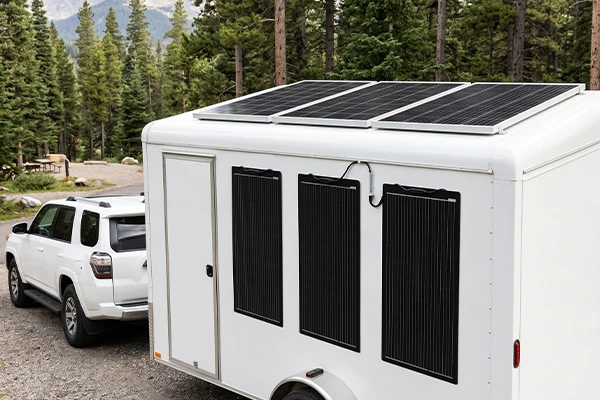
If you need to mount solar panels on a curved roof without drilling, the panel shape is only one part of the decision. The roof curvature, panel bending limit, mounting surface, edge support, heat path, cable route, wind exposure and future service plan must be reviewed together.
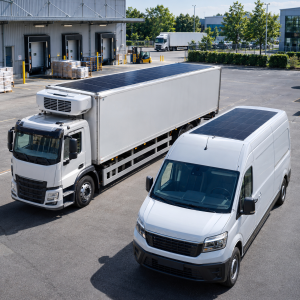
That is why curved-roof installations create more questions than a flat roof project. RV and van owners often ask whether a rigid panel will sit correctly, whether a flexible panel can be bonded directly to the roof, and whether a no-drill method will remain secure at highway speed. Similar questions also appear in marine and custom equipment projects.
In owner discussions, people describe roofs that curve in two directions, compare flexible panels with brackets, and worry about adhesive failure or difficult panel removal. These discussions are useful for identifying real installation concerns, but they are not a substitute for the panel supplier’s technical documentation or a project-specific mounting review.
Why Is a Curved Roof Difficult for Solar Panel Installation?
A rigid solar panel is designed to remain flat. Its frame distributes the load through a defined mounting structure. On a curved roof, the frame may contact the surface at only a few points, leaving gaps or creating concentrated pressure.
If the roof curves from front to back and from side to side, the problem becomes more difficult. Pressing a flat panel down to match the roof can transfer stress into the frame, glass, mounting points or roof surface. A small gap at the leading edge can also allow air to enter underneath the panel when the vehicle is moving.
The first question should therefore be:
Does the panel and mounting method match the shape and movement of the roof?
Can Flexible Solar Panels Follow a Curved Roof?
They can be suitable for some curved roofs, but only within the panel’s approved mechanical limits. Flexible does not mean foldable. A flexible module still contains solar cells, conductive paths, encapsulation layers, a backsheet and electrical connection points.
Before selecting a panel for a curved roof, confirm:
- the permitted bending direction;
- the minimum bending radius;
- whether the curve is smooth or contains sharp transitions;
- whether the panel must bend in one direction or two;
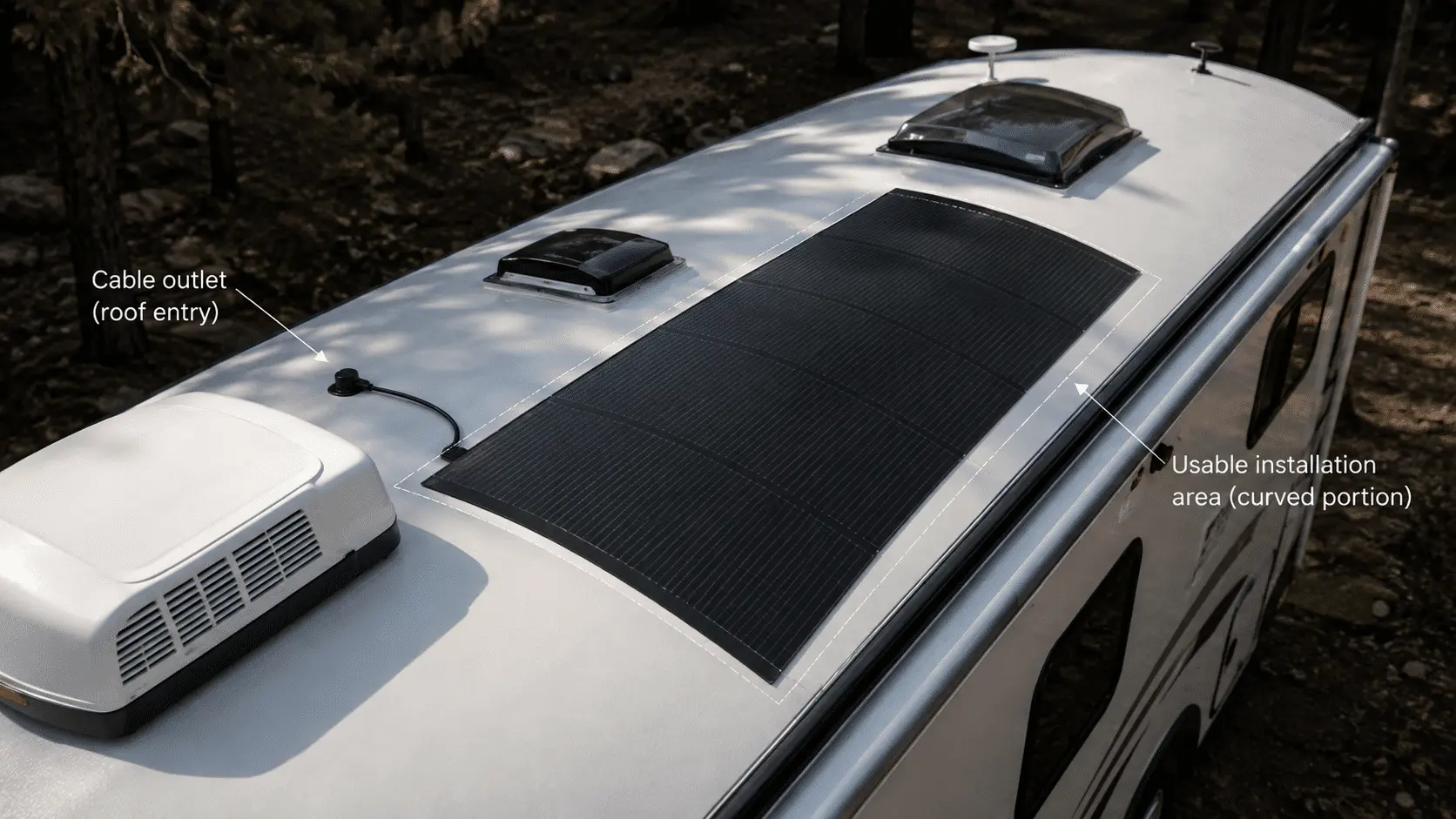
- the location of the junction box and cable exit;
- whether the panel edge will remain supported; and
- whether the roof itself moves or vibrates during use.
A smooth, continuous curve is easier to manage than a compound surface with tight corners. If the panel must twist, fold around a corner or bridge an uneven section, the project needs a more detailed mechanical review.
How to Mount Solar Panels on a Curved Roof Without Drilling
In some applications, yes. A no-drill installation may use direct bonding, adhesive with edge protection, a non-penetrating rack, a removable frame or existing roof hardware.
Direct bonding keeps the profile low and avoids roof penetrations. It may be practical when the roof is stable, clean, compatible with the bonding system and not expected to move excessively. The tradeoff is serviceability. Removing a bonded panel can be difficult, and the roof may need cleaning or repair before a replacement is installed.
A mechanical or semi-mechanical system usually adds weight and height, but can improve inspection access, airflow, drainage and replacement. It may be more suitable when the panel must be serviced regularly or when the roof is exposed to significant vibration.
No drilling is an installation preference, not a complete engineering method. The complete mounting system still needs to address edge movement, moisture, temperature changes, cable strain and wind exposure.
Flexible Solar Panels or Brackets: Which Is Better for a Curved Roof?
Neither method is automatically better. The correct choice depends on what the project needs to protect: low profile, low weight, ventilation, service access or mechanical support.
| Project condition | Flexible panel approach | Bracket or framed approach |
|---|---|---|
| Curved or compound roof | Often easier to fit when the curve is within the panel limit. | Requires a shaped or adjustable support structure. |
| Weight-sensitive vehicle | May reduce the added mounting load. | Frame and hardware weight must be included. |
| Low-profile appearance | Strong advantage. | Usually creates a higher profile. |
| Need for airflow | More difficult if bonded directly. | Easier to create a ventilation gap. |
| Frequent replacement | Removal may be difficult. | Usually easier to inspect and replace. |
| High vibration or wind exposure | Edge bonding and cable strain need careful review. | Mechanical load paths may be easier to control. |
Flexible panels are often practical when the surface is curved, weight is limited or a low-profile installation is important. A bracketed rigid panel may be more practical when airflow, inspection, replacement or mechanical support is the priority.
Why Do Flexible Solar Panels Lift or Peel After Installation?
When a flexible panel begins to lift, the problem is usually not caused by one factor alone. Common causes include:
- dust, oil, wax or oxidation on the roof;
- incompatibility between the adhesive and the roof surface;
- incompatibility between the adhesive and the panel backsheet;
- uneven or discontinuous adhesive coverage;
- poor edge preparation or insufficient curing time;
- a cable pulling against the junction box;
- repeated thermal expansion and contraction;
- a bending radius that is too tight; or
- wind entering under the leading edge.
The front edge deserves particular attention. Once air gets underneath the panel, the adhesive is no longer carrying only the panel’s weight. It is exposed to peel forces that can increase as vehicle speed rises.
For a technical distinction between structural bonding and simple sealing, see this PV framing and bonding technical manual. It is a reference for bonding design and validation, not universal approval for every panel or roof.
Edge sealing may reduce the opportunity for air and water to enter, but it is not a substitute for proper surface preparation or a compatible bonding system.
Does Direct Bonding Make Flexible Panels Run Hotter?
It can affect heat management, but the result depends on the complete installation. A panel bonded directly to a roof has less air movement beneath it than a raised rigid panel. Roof material, roof color, ambient temperature, solar irradiance, panel construction and adhesive layout all influence operating temperature.
Higher temperature can affect instantaneous electrical output and can also increase thermal movement in the panel, adhesive and roof surface. This does not mean every bonded flexible panel will overheat or fail. It means heat should be considered before the mounting method is finalized.
If airflow or service access is important, a raised or semi-mechanical installation may be worth considering. If a low-profile bonded installation is selected, follow the supplier’s mounting guidance and avoid creating unnecessary moisture traps.
How Should the Cable Be Routed on a Curved Roof?
Cable routing is part of the mechanical design, not an afterthought. The cable should not pull directly on the junction box, hang loose where it can flap against the roof, sit in a drainage path, bend sharply at the panel exit or rub against a metal edge.
Before installation or production, confirm:
- cable exit location and length;
- connector type and polarity;
- entry point into the vehicle or equipment;
- strain relief method;
- water protection around the entry;
- distance from hot components; and
- space available for inspection and replacement.
For OEM projects, the cable exit should be shown on the approved drawing. Moving it after sampling may affect the panel layout, wiring, packaging and installation instructions.
What Should OEM Buyers Provide Before Requesting a Custom Panel?
A manufacturer can quote a wattage from limited information. That does not mean the panel will fit the final application. For a non-standard surface, provide:
- usable length and width;
- roof or equipment drawings;
- photos showing the real installation surface;
- curve direction and approximate curvature;
- available clearance around the panel;
- required power and system voltage;
- controller, inverter or battery limits;
- cable exit and connector requirements;
- preferred mounting method;
- temperature, vibration, wind, moisture or salt exposure;
- sample quantity and expected production quantity; and
- packaging, labeling and documentation requirements.
A marked-up photo is often more useful than a general statement such as “the roof is curved.” The manufacturer needs to understand where the panel will sit, where the cable will run and which areas may experience movement or shading.
Without the mounting drawing and system limits, a manufacturer can quote wattage, but cannot responsibly confirm project fit.
How Can OEM Buyers Avoid Sample-to-Bulk Changes?
The sample should not be approved only by appearance. Before placing a bulk order, confirm that the approved sample and production model match in:
- overall dimensions and tolerances;
- thickness and weight;
- cell layout;
- electrical output;
- backing or surface material;
- cable length and exit position;
- connector type;
- labels and markings;
- packaging;
- datasheet revision; and
- inspection criteria.
The buyer should also ask how production changes are controlled. A change to the cell layout, backing material, cable position or laminate structure can affect adhesive compatibility, installation clearance or replacement planning.
Final Thoughts
Mounting solar panels on a curved roof without drilling is possible, but the decision should not be reduced to “flexible versus rigid.” A reliable installation depends on the relationship between the roof shape, panel mechanical limits, mounting surface, bonding or bracket system, heat path, cable route, vehicle movement and future service plan.
Flexible panels are often practical for curved, lightweight and low-profile applications. They are not automatically the right choice for every non-standard surface.
Before you mount solar panels on a curved roof, confirm the surface shape, panel bending limit, adhesive or bracket method, cable route and replacement plan.
For OEM and distributor projects, start with a complete application review. Share the roof drawing, usable dimensions, electrical requirements, cable layout, environmental conditions and preferred mounting method before requesting a final panel recommendation. Sungold’s PA219 flexible solar panel series and custom solar panel solution can be reviewed as possible paths when the project requires a curved, low-profile or application-specific module.
Frequently Asked Questions
Can flexible solar panels be installed on a curved roof?
They can be suitable for some curved roofs when the curve is smooth and remains within the panel’s approved bending limits. The roof surface, panel support, cable exit, adhesive compatibility and long-term movement should be checked before installation.
Can I mount solar panels on a curved roof without drilling?
In some applications, yes. Direct bonding, non-penetrating brackets or removable mounting systems may avoid roof holes. However, the installation still needs to address wind uplift, edge movement, surface preparation, cable routing, drainage and future removal.
Why do flexible solar panels lift or peel after installation?
Lifting can result from poor surface preparation, incompatible adhesive, insufficient curing, edge exposure, cable strain, thermal movement or excessive bending. If air enters under the leading edge, wind can increase the peel force while the vehicle is moving.
Review a Curved or Non-Standard Solar Application
Share the installation drawing, usable dimensions, system voltage, cable requirements and mounting conditions before requesting a project recommendation.