



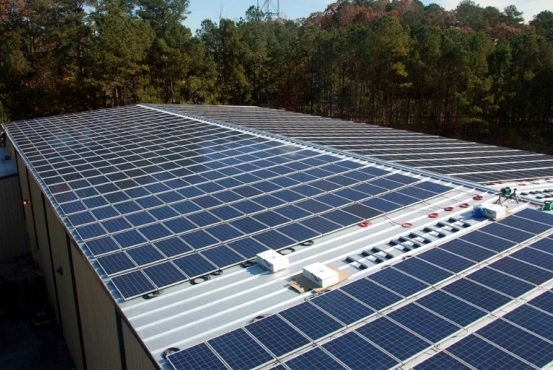
Flexible solar panels on a metal roof can be bonded directly in some applications, but a clean metal surface is not enough to confirm that the installation will remain reliable. Roof coating, panel backsheet, adhesive compatibility, temperature changes, wind exposure, drainage, cable routing, and future maintenance all need to be reviewed together.
This is why installing a flexible module on metal is different from mounting a framed glass panel. A glass module normally transfers its load through clamps, rails, hooks, or another mechanical structure. A bonded flexible module depends much more on the relationship between the roof surface, adhesive layer, panel backsheet, and the movement of the roof itself.
The right question is not simply, “Can this panel stick to metal?” It is: Can this panel, roof, bonding method, and operating environment work as one assembly?

Why Is a Metal Roof Different From a Glass Panel Mounting System?
Metal roofs can be lightweight, smooth, curved, coated, ribbed, or formed into standing-seam and trapezoidal profiles. Each surface changes the installation problem.
A metal roof also expands and contracts as its temperature changes. The roof, adhesive, and solar panel may not move in exactly the same way. Over time, this can create shear stress in the adhesive layer or peel stress at the panel edge.
A directly bonded panel may also have less airflow behind it than a raised framed panel. That changes the thermal path and can affect the temperature of the panel, adhesive, and roof surface.
These differences do not mean direct bonding is always unsuitable. They mean that a metal roof should not be treated as a simple substitute for glass or concrete.
Start With the Roof Profile, Not the Adhesive
Before choosing an adhesive or mounting product, identify the actual metal roof type.
| Metal roof condition | Main installation question |
|---|---|
| Flat coated metal sheet | Is the coating stable and compatible with the bonding system? |
| Smooth aluminum or steel surface | Can the substrate and panel backsheet be paired and tested? |
| Standing-seam roof | Can the panel bridge or follow the seam pattern without local stress? |
| Trapezoidal metal sheet | Does the module sit on continuous support, or does it bridge the ribs? |
| Corrugated or R-panel roof | Is direct bonding allowed for this exact profile and module? |
| Aged or weathered roof | Can the existing coating carry the bond, or is the surface already degraded? |
The same roof name can lead to different conclusions depending on the module manufacturer’s approved installation scope. Some flexible PV manuals separate direct adhesive, support-assisted, removable-fixture, and replacement-module methods. Others limit direct bonding to approved, flat and smooth roof elements and exclude corrugated or R-panel systems.
For that reason, the roof profile should be confirmed before a buyer selects an adhesive or requests a final installation drawing.
Can Flexible Solar Panels on a Metal Roof Be Bonded Directly?
Direct bonding is the lowest-profile approach. The module is bonded to the roof surface with a structural adhesive, adhesive tape, or a combination defined by the module supplier.
This method is usually considered when:
- the metal roof is flat or has a smooth, continuous curve;
- the panel remains within its permitted bending range;
- the roof coating is stable;
- the adhesive is compatible with both surfaces;
- the panel does not need frequent removal;
- the roof has a controlled drainage path; and
- the installation environment is within the supplier’s approved limits.
The advantage is a clean, low-profile installation with fewer visible components. The limitation is that the roof, adhesive, and module behave as one assembly. If one part moves, heats, ages, or fails differently from the others, the stress has to be absorbed somewhere in the system.
A structural PV bonding guide distinguishes structural bonding from simple frame sealing and emphasizes the need for validation because module and frame designs vary. An adhesive label alone does not establish that a particular panel and roof combination is suitable.
What Does Adhesive Compatibility Mean on a Metal Roof?
“Strong adhesive” is not a complete installation specification. The same adhesive can behave differently on bare metal, painted metal, PVDF-coated metal, galvanized steel, aluminum, aged coating, or a surface containing old sealant.
The panel backsheet matters as well. The adhesive must bond to the actual backsheet or laminate surface supplied with the module, not merely to a generic plastic or metal sample.
A professional review may include:
- surface cleaning requirements;
- primer requirements;
- small-area adhesion testing;
- pull-off or peel testing;
- curing time;
- temperature and humidity limits;
- edge treatment;
- compatibility with the roof warranty; and
- inspection after environmental exposure.
A test result from one roof coating cannot automatically be transferred to another coating or panel backsheet. The substrate, adhesive, panel, and application process should be treated as one test combination.
Does Metal Roof Expansion Affect the Bond?
Metal roofs can change temperature quickly. The roof expands during heating and contracts as it cools. The panel and adhesive layer respond to that movement according to their own material properties.
Possible concerns include:
- shear stress in the adhesive layer;
- edge peel;
- coating separation;
- local wrinkles or deformation;
- changes in panel temperature;
- condensation or moisture trapped beneath the module; and
- difficulty removing the panel later.
Direct bonding does not eliminate thermal movement. It transfers that movement into the panel, adhesive layer, and roof surface.
This does not mean direct bonding is automatically thermally unacceptable. It means the thermal behavior should be considered alongside the roof material, climate, roof color, panel construction, adhesive geometry, and airflow.
What Are the Alternatives to Direct Bonding?
Market installation practices generally fall into several groups. Each method solves a different problem and creates its own review points.
| Method | Main strength | Main issue to investigate |
|---|---|---|
| Direct adhesive bonding | Low profile and simple appearance | Roof, adhesive, and panel compatibility over time |
| Adhesive with aluminum strips or carrier rails | More support and a defined load path | Additional interfaces and possible local stress |
| Rails or mechanical supports | Better inspection access and airflow | Weight, wind exposure, structure, and fasteners |
| Factory-bonded roof assembly | Controlled production and protected cabling | Repair, replacement, and warranty boundaries |
| Removable fixtures | Easier service and module replacement | Wind movement, abrasion, and fixture loads |
Adhesive Bonding With Aluminum Strips or Carrier Rails
A second approach uses narrow aluminum strips, rails, or carrier sections to distribute the bond and control the panel edge. This can provide additional support without building a full framed system.
The carrier may help with edge restraint, load distribution, cable protection, partial airflow, or future replacement. It does not automatically solve the roof-profile problem. If the metal roof has deep ribs or sharp changes in height, the carrier itself may need to be shaped, spaced, or supported.
This method also introduces more interfaces: roof to adhesive, adhesive to rail, rail to panel, and panel to cable or junction box. Every interface becomes part of the inspection plan.
Rails, Seam Clamps, and Profile-Specific Supports
A mechanical support system keeps the flexible module separate from the primary metal roof and uses rails, seam clamps, profile-specific brackets, a carrier plate, or a custom aluminum frame.
The advantage is serviceability. A supported installation may provide more airflow and make inspection or replacement easier. It can also avoid forcing a flat module to follow a roof profile that exceeds its mechanical limit.
The tradeoffs include additional structural weight, greater wind exposure, a higher installation profile, visible hardware, corrosion considerations, and possible roof penetration.
This is closer to the way conventional glass modules are mounted, but it is not automatically interchangeable with a glass-panel racking system. A lightweight flexible module may need different edge support, clamp pressure, load distribution, and protection against local deformation.
Factory-Bonded Metal Roof Assemblies
A more controlled approach is to bond the photovoltaic material to a metal sheet, roof panel, or carrier in a factory rather than bonding the flexible module directly to an existing roof on site.
This approach can control surface preparation, adhesive application, pressure, curing, cable concealment, inspection, and final handling. It is more relevant to new-build metal roof systems, repeatable commercial projects, OEM roof panels, and projects where cable protection and appearance matter.
The limitation is flexibility after installation. Once the roof and photovoltaic layer become one fabricated product, replacement, repair, warranty responsibility, and roof renewal need to be defined before production.
Removable Fixtures and Replacement Modules
Some flexible PV systems are designed around removable fixtures or replaceable modules instead of permanent bonding. These systems may use mechanical edge fixtures, removable rails, clips, a carrier plate, or a replaceable panel section.
The benefit is serviceability. The roof owner can access the roof and replace the module without cutting through a large bonded surface.
The fixture must still control wind movement, panel edge lift, friction, abrasion, water paths, cable strain, and local pressure on the module. Removable does not mean maintenance-free.
What Happens When the Metal Roof Gets Hot?
A metal roof can absorb and release heat quickly. A directly bonded flexible panel has a different thermal path from a raised framed panel, and the difference can affect the panel, adhesive, roof coating, and cable environment.
Potential concerns include higher operating temperature, thermal cycling, adhesive movement, condensation, and reduced inspection access. The actual result depends on the panel construction, roof color, climate, mounting method, airflow, and installation instructions.
It is safer to describe this as a design tradeoff than as a universal failure rule. A low-profile bonded installation may fit a project where appearance and roof penetration are priorities. A supported installation may deserve consideration where airflow, inspection, and replacement are more important.
What About Wind and Edge Lift?
Wind exposure is one of the main reasons flexible panels need careful edge treatment. A panel can experience shear as wind moves across the roof, while the leading edge can experience peel if air enters beneath the laminate.
Review:
- roof orientation;
- vehicle speed, if mobile;
- leading-edge geometry;
- panel edge support;
- adhesive continuity;
- cable restraint;
- edge protection;
- local turbulence from roof equipment; and
- inspection access after storms or high-wind events.
Edge sealing can help protect the bond line from water and air, but it should not be treated as a replacement for structural attachment. The module supplier’s approved installation method should define which materials and application patterns are allowed.
What Should OEM Buyers Confirm Before Ordering?
For an OEM or distributor project, request more than the module wattage. Confirm:
- roof material and coating;
- roof profile and surface flatness;
- permitted bonding substrate;
- panel backsheet compatibility;
- mounting method;
- edge support and wind exposure;
- cable exit and routing;
- drainage path;
- operating temperature;
- inspection and replacement method;
- sample test procedure;
- production-change control; and
- warranty responsibility between the roof and PV supplier.
A useful project package should include a roof drawing, installation photos, panel dimensions, cable layout, environmental conditions, and the intended attachment method.
If the roof profile is corrugated, ribbed, or uneven, ask specifically whether direct bonding is approved for that profile and module. Do not infer approval from the fact that the panel is flexible.
How Sungold Can Support a Metal-Roof Solar Project
For a metal-roof project, the panel discussion should start with the roof drawing, substrate information, electrical requirements, cable layout, environmental conditions, and intended installation method.
Sungold can discuss flexible, lightweight, and application-specific solar panel requirements when the project needs a low-profile or non-standard module. The final mounting method remains tied to the approved panel model, roof surface, bonding system, and project conditions.
For a project requiring a non-standard panel or mounting layout, review the Sungold custom solar panel solution and the PA219 flexible solar panel series as starting points for a technical discussion.
Final Thoughts
Flexible solar panels can be bonded directly to some metal roofs, but the installation is not simply a matter of cleaning the surface and applying adhesive.
The mature approaches in the market include direct bonding to approved smooth substrates, adhesive-assisted carrier strips, profile-specific mechanical supports, factory-bonded roof assemblies, and removable or replaceable mounting systems.
Each method solves a different problem. Direct bonding reduces profile and hardware. Supported systems can improve inspection and airflow. Factory bonding provides process control. Removable systems improve serviceability.
For OEM buyers and system brands, the important question is whether the selected method can be documented, tested, repeated in production, and maintained after installation.
Frequently Asked Questions
Can flexible solar panels be bonded directly to a metal roof?
They may be suitable for some metal roofs, especially when the substrate is approved, smooth, stable, and compatible with the panel and adhesive system. The roof profile, coating, thermal movement, wind exposure, drainage, and maintenance plan should be checked before installation.
Is direct bonding better than using rails on a metal roof?
Neither method is automatically better. Direct bonding offers a low-profile installation, while rails or supports may provide better airflow, inspection access, and replacement options. The choice depends on the roof profile, project environment, service requirements, and approved installation documentation.
Can flexible solar panels be bonded to corrugated metal roofing?
Not always. Some module installation manuals require additional support for uneven profiles, and some specifically prohibit direct bonding to corrugated or R-panel systems. The exact roof profile and the module manufacturer’s installation scope must be checked before selecting a bonding method.
Technical reference notes: The installation discussion is based on publicly available flexible-PV and metal-roof guidance, including an Amerisolar flexible module installation manual, a BIPVco FLEXTRON installation manual, DuPont PV bonding guidance, MCRMA metal-roof guidance, and a Crestabond flexible PV installation guide. These references describe their own products or systems and should not be treated as universal approval for every flexible module or roof.
Amerisolar flexible PV installation manual · BIPVco FLEXTRON installation manual · DuPont PV bonding manual · MCRMA metal-roof guidance · Crestabond flexible PV guide