 EN
EN
 Deutsch
 Italiano
 Español
 Français
 日本語
日本語
To find a reliable OEM flexible solar panel manufacturer China, you must verify their in-house production capabilities, cell-level shadow management technology, and rigorous quality systems. This guide exposes industry “paper spec” traps while providing a strategic model for technical customization, helping brands avoid costly warranty failures and achieve 30%–45% cost optimization through direct factory partnership and verified engineering expertise.
What Is an OEM Flexible Solar Panel Manufacturer?
An OEM flexible solar panel manufacturer is a specialized factory that designs and produces bendable solar modules according to a buyer’s unique technical specifications and branding. Unlike resellers, a true OEM partner like Sungold Solar controls every step of the production cycle—from cell sorting and stringing to advanced ETFE/PET lamination and final electroluminescence (EL) testing. Since flexible panels lack a rigid aluminum frame, their quality depends entirely on the chemical bonding of polymer sheets and cell resilience, requiring a manufacturer with deep R&D expertise in vibration-prone environments like RVs and yachts.
- Brief history of flexible solar panel manufacturing in China
- Why China dominates the global OEM flexible solar panel supply chain (production volume, cost structure, R&D infrastructure)
- OEM vs. ODM vs. White-label: clarifying the differences for solar buyers
Core Differences: OEM, ODM, and White Label Products
Feature | OEM (Original Equipment Mfg) | ODM (Original Design Mfg) | White Label / Stock |
|---|---|---|---|
Design Ownership | Buyer provides specs or co-designs | Factory provides the design | Standard factory stock |
Customization Range | Extremely High (Size, Voltage, Circuitry) | Moderate (Logo, Color, Packaging) | Minimal (Logo Only) |
Initial Lead Time | 25–40 Days (Incl. Tooling/Circuit Design) | 15–25 Days | 7–10 Days |
Investment Cost | Higher (R&D and tooling allocation) | Moderate | Low |
Best For | Brands with unique R&D needs | Small brands seeking quick entry | Traders/Initial market testing |
Why Is China Leading the Flexible Solar OEM Market?
China dominates the global flexible solar sector by offering a unique combination of supply chain speed, massive scale, and integrated cost-efficiency.
Hyper-Integrated Supply Chain Clusters: In major hubs like Shenzhen and Ningbo, the entire ecosystem—from silicon wafers and POE/EVA films to junction boxes—is concentrated within a 50-kilometer radius. This allows OEM manufacturers to maintain low inventory costs and execute custom design modifications in days rather than weeks.
Pioneering Technology Adoption: Chinese factories are the first to successfully integrate high-efficiency N-type TOPCon and Back Contact (BC) technology into flexible form factors. These “all-black” designs eliminate front-side busbars, maximizing the light absorption area and providing the premium, sleek aesthetic required for North American and European BIPV markets.
Frictionless Global Compliance: Established manufacturers operate with an “export-first” mindset. By strictly adhering to IEC 61215 and IEC 61730 standards, they ensure that OEM products are pre-cleared for immediate entry into highly regulated markets like the EU, USA, and Australia.
How Can You Evaluate a Reliable Chinese OEM Manufacturer?
Evaluating a manufacturer effectively requires looking beyond the price quote and auditing their internal quality control chain.
1. Verify Manufacturing Status: Always check if their business license includes “Module R&D and Production” rather than just “Sales.”
2. Cell Sorting Standards: Demand to see their EL (Electroluminescence) testing process. Grade B cells contain micro-cracks that are invisible to the eye but will cause module failure under the vibration of a moving vehicle or boat.
3. Lamination Expertise: Confirm they use high-temperature vacuum lamination. For permanent outdoor installations, a 0.05mm ETFE film is the industry standard for UV resistance, whereas inferior 0.025mm films will degrade rapidly.
What Are the Hidden Pitfalls in OEM Sourcing?
The “unwritten rules” of the solar industry are often hidden in technical details that determine whether your product is a long-term asset or a brand-damaging liability.
Why the Cheapest Quote Is Almost Always a Trap
Minimum quotes often signify compromises in material thickness and cell grade that result in premature field failure. Internal industry data shows that panels sourced purely on price have a 3.2x higher failure rate within the first 18 months, primarily due to “delamination”—the peeling apart of material layers. Using low-cost PET backsheets instead of composite materials further accelerates this degradation in high-humidity or marine environments.
Certification Is Not a Guarantee of Batch Consistency
A certification only proves a single sample passed a test; a true OEM partner must provide batch-specific test reports. Certificates from TÜV or UL confirm the product design is safe, but continuous quality relies on ISO 9001 systems and 100% EL inspection of every cell string. A reliable factory should be able to provide thermal imaging and flash test data for your specific production batch upon request.
The Truth About Lead Times
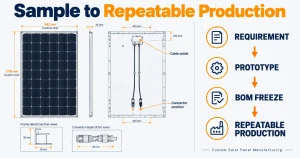
Manufacturers promising a fully custom OEM order in under 15 days are likely not performing true customization. A genuine OEM production run involves four distinct stages:
Technical Review (3-5 Days): Ensuring the electrical layout (Vmp/Imp) matches your battery system.
Custom Tooling/Cell Cutting (5-7 Days): Preparing unique molds or laser-cutting cells.
Lamination and Curing (3-5 Days): Ensuring the polymers are fully cross-linked for durability.
Rigorous QC (2-3 Days): Including salt spray or high-low temperature cycling simulations. Conclusion: A realistic first-run delivery timeframe is 25–35 days.
Why Choose Sungold Solar as Your Strategic OEM Partner?
Sungold Solar is more than a manufacturer; we are a specialized engineering partner for SMEs looking to build a high-performance energy brand. Headquartered in Shenzhen with a tariff-friendly satellite facility in Batam, Indonesia, we have specialized in customized flexible solutions since 2008.
Technological Edge: Our PA621 and PA219 series feature cell-level shadow management, allowing panels to maintain 50% output even when partially shaded—a feature that earned us the industry’s first TÜV Class A Shadow Resistance Certification.
Proven Durability: We utilize patented composite materials and premium ETFE lamination to ensure our panels withstand the harshest marine and off-grid conditions.
Inquiry Entry Point: We invite you to explore our Factory Strength Gallery to view our automated production lines and core testing procedures in action.
2026 Market Trends Driving OEM Demand
Walkable Solar Modules: High demand for RV and yacht roofs where panels must be durable enough to be stepped on without cell damage.
Marine-Grade Resilience: OEM requirements are shifting toward IEC 61701 salt spray resistance for all coastal and marine applications.
Vehicle-Integrated PV (VIPV): Integration of ultra-thin panels on commercial fleet vehicles to power liftgates and extend electric range.
Frequently Asked Questions (FAQ)
Q: How can I verify if an OEM manufacturer is a source factory or just a trader? A: A genuine source factory will have a business license listing “Solar Module Production” and should be able to provide a raw production line video. You should look for in-house R&D patents and a dedicated testing lab featuring EL testers and solar simulators to confirm they control the entire quality process.
Q: What is the typical MOQ for custom flexible solar panels from China? A: To lower the barrier for startup brands, Sungold Solar offers tiered MOQs. Simple branding on existing models starts at 50–100 units, while deep customization involving new dimensions or electrical layouts typically requires 200–500 units. This allows for a balance between design innovation and manufacturing cost-efficiency.
Q: How do you handle anti-dumping duties or trade barriers for US/EU clients? A: We provide strategic logistics through our Indonesian manufacturing facility in Batam. This “China Tech + Overseas Manufacturing” model allows our clients to bypass high AD/CVD duties on Chinese-made cells while benefiting from our 17 years of specialized R&D and a stable, high-efficiency supply chain.
Strategic Sourcing for Long-Term Brand Success
In an era of mobile energy where “shade happens” and “vibration is constant,” choosing an OEM flexible solar panel manufacturer in China requires a commitment to transparency over price. Partnering with a factory that values engineering depth and batch-specific quality control is the only way to build a sustainable, trusted brand in the solar industry.
Ready to start your first OEM inquiry? Contact Sungold Solar Experts → Watch our core production videos and see the quality of true Chinese manufacturing.
Keywords: OEM flexible solar panel manufacturer China, custom solar panels, ETFE flexible modules, RV solar OEM, Marine solar supplier, Sungold Solar BC technology.