




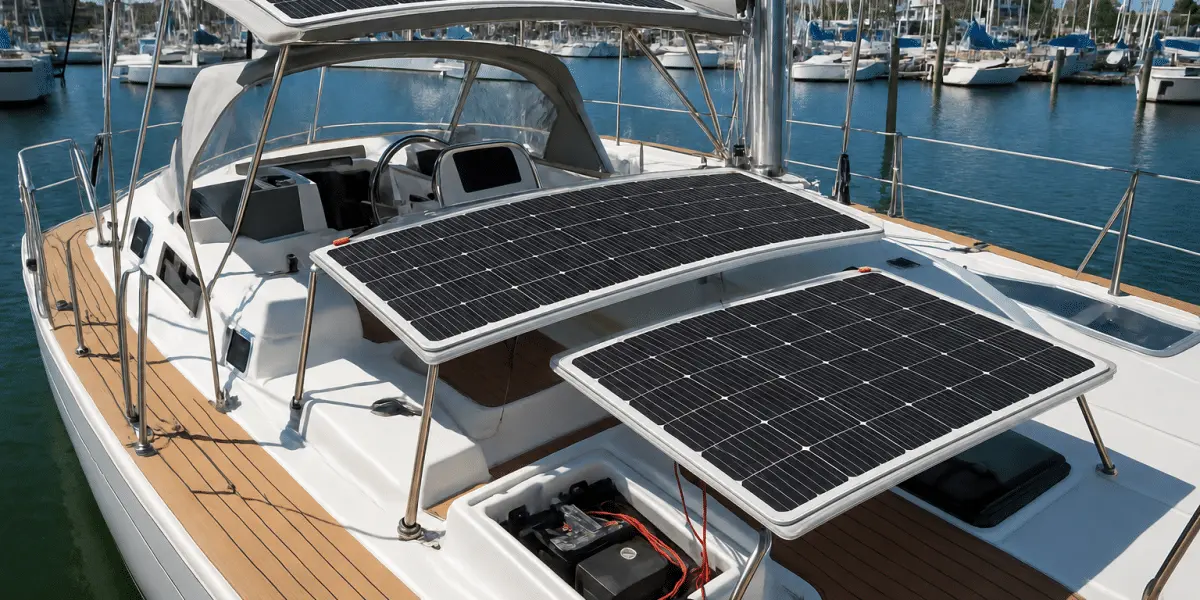
Marine flexible solar panels can work well on yachts and boats, but only when the panel fits the real installation conditions. For a yacht project, wattage is only one part of the decision.
Buyers also need to look at the surface material, salt-air exposure, cable exit, mounting surface, controller match, and how the panel will be cleaned or serviced later.
A flexible panel that works on an RV roof may not be right for a yacht. Boats bring different problems: humidity, salt spray, curved surfaces, tight cable routes, moving hardware, and shade from masts or antennas.
Why Yacht Projects Need a Different Solar Panel Review
Yacht solar projects are rarely simple rectangle-on-roof installations.
The roof may be curved. The usable space may be narrow. The cable may need to pass through a cabin roof or run around a hatch. The panel may sit near ropes, rails, deck hardware, cleaning water, salt air, or occasional foot traffic.
That changes the buying decision.
The first question is not, “How many watts can I fit?” A better question is, “Can this panel fit the surface, survive the marine environment, route the cable cleanly, and work with the boat’s electrical system?”
That is why marine flexible solar panels should be selected by use case, not by wattage alone.
ETFE vs Other Surface Materials in Marine Use
ETFE is often preferred for outdoor flexible solar panels. It can be a good fit where the panel needs surface durability, easier cleaning, and resistance to outdoor exposure.
But ETFE is not magic. A weak panel does not become a marine-grade product just because the surface layer says ETFE.
ETFE is the surface film or protective laminate. It is different from EVA or POE, which are internal encapsulant layers inside the module.
For yacht projects, buyers need to look at the whole panel structure.
| Surface Type | Marine Project Consideration |
|---|---|
| ETFE | Often a stronger fit for outdoor flexible PV when the backing, cable, junction box, and full module structure also match the project. |
| PET | May fit some lower-cost uses, but needs careful review for UV, humidity, and long outdoor exposure. |
| Glass | Durable, but heavier and less suitable for curved, lightweight, or low-profile yacht surfaces. |
| Coated polymer surface | Must be checked by datasheet, aging data, and real application conditions. The coating name alone is not enough. |
The better question is not “Is it ETFE?” It is “Does the full panel structure match salt air, heat, cleaning, bending, cable routing, and the mounting surface?”
Salt Mist and Marine Corrosion: What Buyers Should Ask For
Salt air changes the risk profile.
In a yacht environment, the weak point may not be the solar cell. It may be the cable, connector, junction box, edge seal, adhesive, or installation method.
Before buying marine flexible solar panels in bulk, ask for clear document boundaries.
| What to Ask | Why It Matters |
|---|---|
| Salt mist or salt spray test reference | Helps show whether the product has been reviewed for marine-type exposure. |
| Model scope | Prevents one report from being used for every size, wattage, or custom version. |
| Cable and connector details | Salt air can expose weak electrical accessories. |
| Junction box design | Important for moisture protection, cable exit direction, and serviceability. |
| Installation method | Poor bonding, drilling, or cable entry can create failure points even when the panel is suitable. |
For certification-specific questions, buyers can review Sungold’s guide on flexible solar panel certification, fire rating, and test reports.
The key point is simple: read test reports by exact model. Do not turn one report into a claim for every panel.
Cable Routing Is Not a Small Detail
On yacht projects, cable routing can decide whether the installation feels professional or improvised.
A house roof usually has more space. A yacht does not. The cable may need to avoid hatches, hinges, rails, ropes, walking paths, and visible design areas.
A poorly placed cable can create three problems:
- harder installation;
- higher water-entry risk;
- poor appearance.
Buyers should decide the cable position before ordering samples.
| Cable Design Question | Buyer Check |
|---|---|
| Where should the cable exit? | Match the deck, cabin roof, frame, or hidden cable path. |
| Is a rear cable exit needed? | Useful when visible cable should be reduced. |
| Will the cable cross a walking area? | Protection or route adjustment may be needed. |
| Can the connector be serviced? | Avoid hidden positions that cannot be reached later. |
| Is deck penetration required? | Waterproofing responsibility must be clear. |
| Is cable length fixed or custom? | Confirm before bulk order, especially for kits. |
Cable design is much easier to solve before production than after installation.
For OEM or distributor projects, cable exit, connector type, and cable length should be part of the RFQ. They should not be late-stage details.
For broader customization planning, buyers can also review Sungold’s guide on custom flexible solar panel size, voltage, and cable design.
Mounting Surface: Deck, Cabin Roof, Bimini or Curved Area?
Different mounting locations create different risks.
| Installation Location | Main Concern |
|---|---|
| Cabin roof | Heat buildup, adhesive compatibility, cable route, and cleaning access. |
| Deck | Foot traffic, abrasion, non-slip expectations, and surface protection. |
| Bimini or canvas support | Flex, vibration, fixing method, and long-term movement. |
| Curved surface | Bending radius, support area, and long-term stress. |
| Rail or custom frame | Wind load, vibration, bracket design, and cable exposure. |
Do not treat “flexible” as unlimited bending. Every flexible panel has limits.
Bending too much, twisting the panel, or mounting it across unsupported gaps can create stress over time.
The same applies to walking. Some yacht buyers expect flexible panels to handle occasional foot traffic. That should not be assumed. If people may step on the panel, confirm whether the exact model is designed for that use.
Electrical Matching for Yacht Solar Panels
The panel also has to match the boat’s electrical system.
Many boats use 12V or 24V batteries. Larger systems may include charge controllers, battery management systems, shore power, generators, or existing onboard charging equipment.
Before ordering, check:
- battery system voltage;
- charge controller input range;
- panel voltage and current;
- cable length and possible voltage drop;
- fuse and protection requirements;
- expected daily load;
- shading from mast, boom, radar, ropes, or hardware;
- whether the panel is for a new kit or a retrofit project.
The panel supplier does not replace the marine electrician. But the panel data should be clear enough for the installer to match it correctly.
Custom Size and OEM Requirements
Many yacht projects need custom dimensions.
A standard panel may not fit around skylights, vents, hatches, rails, deck hardware, or curved roof sections. In these cases, custom sizing can make the difference between a clean installation and a compromise.
Common custom requests include:
- custom size;
- custom wattage;
- rear cable exit;
- special cable length;
- connector type;
- low-profile structure;
- all-black appearance;
- private label packaging;
- sample validation before bulk order.
For non-standard projects, Sungold’s custom solar panel solutions can be used as the project review path.
A good RFQ should include drawings, target size, voltage requirements, cable route, mounting surface, target market, packaging needs, and expected application.
The more specific the drawing and application brief, the easier it is to judge whether a custom flexible panel is realistic.
Common Mistakes in Marine Flexible Solar Panel Buying
Marine solar projects often run into trouble when the panel is treated like a generic accessory.
Common mistakes include:
- Buying only by wattage.
- Ignoring salt air and humidity.
- Deciding cable routing too late.
- Assuming every flexible panel can be walked on.
- Using one panel size for every yacht model.
- Applying one test report to all module versions.
- Ignoring heat under full-surface adhesive mounting.
- Not checking controller and battery compatibility.
- Choosing a cable exit that looks clean but cannot be serviced.
- Selling the product without installation limits or after-sales guidance.
Most of these problems are cheaper to fix before bulk purchase than after panels are already installed.
How Sungold Can Support Marine and Yacht Solar Projects
Sungold can help buyers review the solar panel side of a marine or yacht project.
For lightweight and flexible marine applications, buyers can start with the PA219 flexible solar panels. For broader application planning, Sungold’s marine solar power solution can help connect product selection with yacht and boat use cases.
Support may include flexible panel selection, custom size review, ETFE surface material review, cable exit and connector discussion, sample-to-bulk planning, model-specific document review, and distributor or yacht refit package planning.
Commercial terms, certification coverage, warranty wording, MOQ, lead time, and project suitability should be confirmed case by case before quotation or bulk order.
FAQ
Are flexible solar panels suitable for yachts?
Yes, when the panel structure, surface material, mounting method, cable routing, and marine exposure conditions match the project. Buyers should review the exact installation surface before ordering.
Is ETFE better for marine flexible solar panels?
ETFE is often preferred for outdoor flexible solar panels because of its surface durability. Buyers should still check the full module structure, test reports, cable design, and target application.
Can marine flexible solar panels be walked on?
Only if the exact model is designed and confirmed for that use. Buyers should not assume every flexible solar panel is walkable.
What should yacht buyers check before ordering custom flexible panels?
They should check size, wattage, surface material, cable exit, connector type, mounting surface, salt mist documentation, controller compatibility, and sample validation.
Final Thoughts
Marine flexible solar panels should not be selected by wattage alone.
Yacht projects need panels that fit the marine environment, surface shape, cable route, electrical system, and maintenance reality.
ETFE, salt mist data, cable routing, and custom size options can all matter. But none of them is a standalone guarantee.
The better buying question is: Does the exact panel structure match the yacht project, the installation surface, the electrical system, and the documentation needed for the market?