 EN
EN
 Deutsch
 Italiano
 Español
 Français
 日本語
日本語
- Choose an RV solar panel by usable roof area, electrical architecture, mounting conditions, and daily energy needs, not wattage alone.
- Flexible, lightweight, rigid, and portable panels solve different problems. The right format depends on roof access, weight limits, shade, serviceability, and travel use.
- Panel voltage must be checked against the charge controller, battery architecture, cable design, and inverter or load requirements.
- For dealers and system brands, a usable RV solar package needs clear specifications, installation guidance, replacement planning, and model-specific documentation.
An RV solar kit guide usually starts with panel wattage. That is useful, but it is not enough to choose a reliable system.
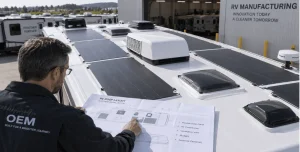
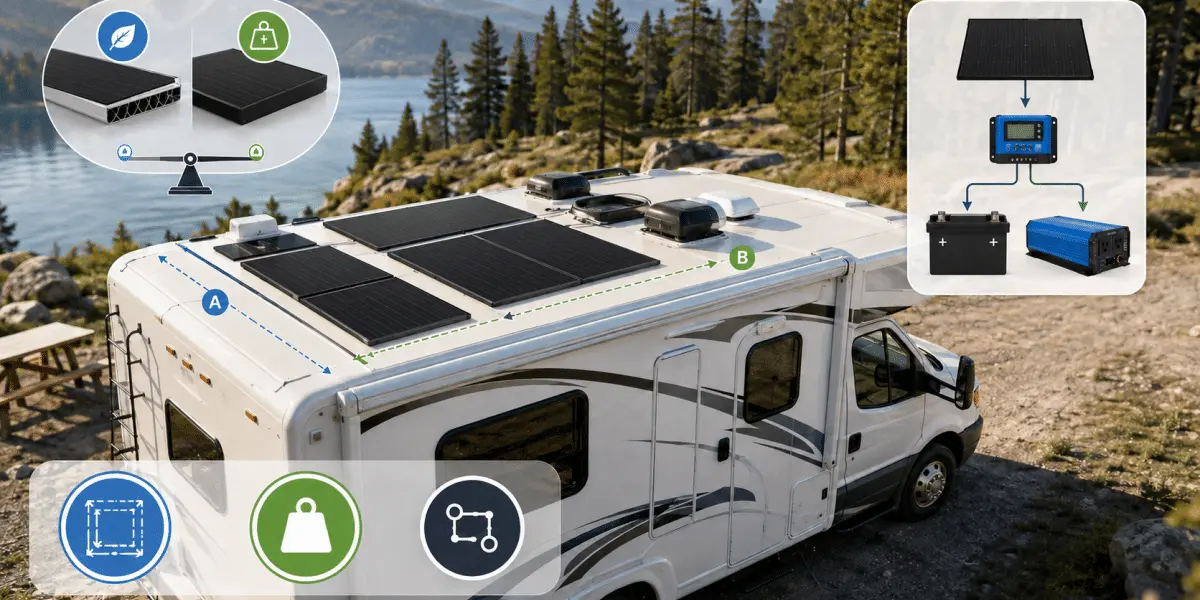
An RV roof is a constrained engineering surface. Vents, air conditioners, skylights, antennas, roof boxes, and service paths compete for the same area. The panel must also work with the battery, controller, cables, and expected loads.
This guide focuses on RV solar panel selection for RV owners, dealers, system brands, and custom project buyers. The goal is to decide which panel format and electrical specification fit the vehicle before ordering a kit or starting an installation.
What Should RV Buyers Decide First?
Start with the vehicle and the power system, not the product catalogue. A useful first review answers five questions:
| First question | Why it matters | Information to confirm |
|---|---|---|
| How much roof area is usable? | Nominal roof size can be misleading when equipment blocks the surface. | Clear length, clear width, obstructions, service gaps, cable route |
| What battery architecture is already installed? | Panel voltage and controller selection must fit the battery charging design. | Battery voltage, chemistry, series or parallel arrangement, charge profile |
| What loads need support? | Daily energy use and short high-power loads lead to different system decisions. | Load list, operating hours, startup current, desired autonomy |
| Will the panel stay on the roof? | Fixed panels and portable panels have different mounting, storage, and cable needs. | Travel frequency, parking pattern, security, maintenance access |
| What conditions will the roof see? | Heat, vibration, partial shade, water, and cable movement affect long-term use. | Roof material, climate, shade pattern, airflow, exposure, maintenance plan |
If these inputs are unknown, a precise panel recommendation is premature. A supplier can still review a project, but the open items should be listed before sampling or quotation.
Why Roof Space and Panel Weight Matter
Use clear roof area, not advertised roof area
The available roof is the area left after fixed equipment and installation clearances are considered. A practical estimate is:
This is why a panel with a lower nominal wattage can sometimes be easier to use than a larger panel. It may fit a narrow section beside a vent or use an area that would otherwise remain unused.
Measure the roof in a simple drawing. Mark the air conditioner, vents, skylights, rails, roof box, antenna, and areas that cannot be drilled, bonded, or walked on. This drawing is more useful to a panel supplier than a general statement such as “the roof is large enough.”
Weight affects more than fuel use
Panel weight affects roof loading, handling, installation time, and the total vehicle design. It can also affect whether one person can position the panel safely during installation.
A lightweight panel may be helpful when the roof has a limited load allowance or when a dealer needs a repeatable installation across several vehicle models. It does not remove the need to check the mounting surface, adhesive system, fasteners, vibration, wind exposure, and maintenance access.
For weight-sensitive RV roof projects, buyers can review the PA621 lightweight solar panel option as a starting point. Final suitability still depends on the confirmed model specification and installation method.
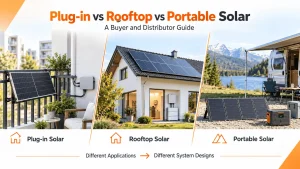
Flexible, Lightweight, Rigid or Portable?
These formats should not be treated as interchangeable. Each one trades roof fit, mechanical support, serviceability, and handling in a different way.
| Panel format | Where it can fit | Main design question | Common trade-off |
|---|---|---|---|
| Flexible | Curved or weight-sensitive surfaces | Can the laminate, roof, adhesive, and cable exit work together? | Serviceability and heat management need careful review |
| Lightweight framed or semi-flexible | Flat or gently shaped roof areas where low mass is important | How will the panel be supported and protected during travel? | Mounting details may be more application-specific |
| Rigid framed | Open, accessible roof areas with a suitable mounting structure | Is there enough area and roof structure for the frame and hardware? | More weight, height, and visible hardware |
| Portable or folding | Campground stops, temporary parking, and vehicles with blocked roofs | Can the panel be placed in sun and stored securely? | Manual setup, cable handling, and theft or damage risk |
Flexible does not mean “bend without limits.” The bend radius, surface pressure, cable exit, connector position, and repeated movement must be checked against the product documentation. A PA219 flexible solar panel configuration may be relevant for a curved or weight-sensitive RV project, but the application drawing should be reviewed before final selection.
Match Panel Voltage With the RV System
Panel voltage is one of the most common sources of a poor kit match. A panel label that says “12V” or “24V” is not a complete electrical design.
Buyers should review at least four values from the panel datasheet:
- Vmp: voltage at the panel’s maximum power point.
- Voc: open-circuit voltage, which can rise in cold conditions.
- Imp: current at the maximum power point.
- Isc: short-circuit current used in system and protection checks.
These values must be checked against the controller input range and the RV battery charging requirements. The controller may be PWM or MPPT, and the two architectures do not make the same use of panel voltage.
| RV system question | What to check | Why a simple label is not enough |
|---|---|---|
| 12V battery system | Panel Vmp and Voc, controller range, battery charge profile | “12V panel” does not confirm the actual operating voltage or controller compatibility |
| 24V battery system | Series battery architecture, controller range, panel string arrangement | The panel, controller, and battery must be designed as one charging path |
| Mixed or expandable system | Future panel voltage, parallel or series limits, fuse and cable plan | Adding a panel later can exceed controller or wiring limits |
The basic relationship is Power (W) = Voltage (V) x Current (A). It is useful for checking a datasheet, but it does not predict daily energy production. For a clearer explanation of the electrical relationship, see this solar panel amps-to-watts guide.
Do not connect a panel directly to an RV battery unless the charging architecture is explicitly designed for that connection. The controller, protection devices, cable size, connectors, and battery management requirements remain part of the system design.
Battery and Inverter Design: Energy Is Not the Same as Power
Panel selection should follow the intended load profile. A refrigerator, lights, fans, communications equipment, and small electronics may have modest daily energy needs. An air conditioner, microwave, kettle, or induction appliance can introduce a much higher short-term demand.
Two separate questions should be asked:
- How much energy is needed each day? This is usually expressed in watt-hours or kilowatt-hours.
- What is the highest simultaneous load? This affects the inverter, battery discharge capability, and wiring.
A larger panel does not automatically solve an inverter or battery limitation. The panel replenishes energy when conditions allow. The battery and inverter must still support the load at the time it occurs.
For an RV system operating in hot storage bays or under a hot roof, thermal planning also matters. Review the inverter heat and performance guide when the system includes an inverter, battery, and continuous or high-starting loads.
Heat, Shade and Outdoor Conditions
Heat changes the real operating condition
Solar panels are rated under defined test conditions. An RV roof can be hotter, more enclosed, and less uniform than the test environment. The panel laminate, roof surface, installation gap, cable insulation, controller location, and battery compartment all influence the real operating condition.
For a roof-mounted design, check where heat can leave the system. A bonded panel may have a different thermal path from a framed panel. That difference does not make one format universally better; it changes what the installer must review.
Shade is a pattern, not only a percentage
RV roof shade often comes from air conditioners, vents, roof racks, antennas, trees, and nearby structures. The position and movement of the shade matter. A narrow shadow across a cell string can affect output differently from a broad reduction in irradiance.
Before choosing an anti-shading design, map the shade during the expected parking periods and review the module layout, bypass behavior, string configuration, and controller response. The anti-shading versus standard panel guide explains why the choice should follow the shade pattern rather than a generic performance promise.
Fixed Roof or Portable Panel?
A fixed roof system is convenient during travel and can support a consistent charging path. It is less convenient when roof space is blocked or the RV is parked under trees.
A portable panel can be placed away from the vehicle to find better sun. It also needs a storage location, a secure cable route, weather-aware handling, and a plan for setup and removal.
| Use case | Fixed roof may fit when | Portable may fit when |
|---|---|---|
| Frequent travel | The buyer wants charging while driving or during short stops, subject to the vehicle system design | Manual setup is acceptable at each stop |
| Tree-covered campsites | The roof still receives useful light or the system includes an intentional shade strategy | The panel can be moved into a clear area |
| Limited roof space | A compact or custom panel can use otherwise wasted space | The owner prefers more area without permanent roof changes |
| Dealer package | Repeatable installation and a clean user experience are priorities | The product is positioned as an optional add-on for different vehicle layouts |
When Do Custom RV Solar Panels Make Sense?
Custom panels are worth reviewing when the standard catalogue leaves a clear design gap. Typical signals include an unusual roof shape, a narrow unused strip, a fixed cable exit, a special connector position, a weight limit, or a distributor package that must fit several vehicle models.
A custom request should include a roof drawing, target dimensions, electrical requirements, surface material, mounting method, cable position, connector type, expected environment, and target quantity. A supplier can then assess whether the request needs a custom size, layout, voltage, laminate, or wiring design.
Custom does not mean every combination is automatically available. Prototype timing, minimum order quantity, production documentation, testing scope, and final model approval must be confirmed case by case. The custom solar panel solution page provides the appropriate starting point for an OEM or system-brand review.
What Dealers and System Brands Should Check
For a dealer or RV system brand, a panel is only one part of a sellable package. The product must be easy to specify, install, explain, and support.
| Package area | Buyer or dealer check | Evidence to request |
|---|---|---|
| Panel specification | Dimensions, weight, Vmp, Voc, Imp, Isc, surface material | Current model datasheet and drawing |
| Electrical matching | Controller input range, battery architecture, fusing, connector polarity | System wiring review and installation notes |
| Mechanical fit | Roof material, bend limit, mounting method, cable exit, vibration exposure | Application drawing and mounting guidance |
| User support | What the kit can support, what it cannot support, and when review is required | Installation guide, FAQ, troubleshooting flow |
| Supply planning | Sample process, MOQ, packaging, lead time, labelling, replacement path | Project-specific commercial and documentation confirmation |
How Sungold Can Support RV Solar Projects
RV projects can be reviewed around the actual vehicle constraints: usable roof area, weight, electrical architecture, shade pattern, mounting surface, and target sales package.
Sungold can discuss panel options for RV applications, including lightweight and flexible formats, as well as custom dimensions or cable layouts when the project justifies further engineering review. The final recommendation depends on confirmed drawings, electrical requirements, environmental conditions, and the applicable model documentation.
For a broader application path, review the Sungold RV solar kit solution. It should be treated as a project starting point, not a substitute for checking the battery, controller, inverter, wiring, mounting, and vehicle-specific installation requirements.
FAQ
Do flexible solar panels overheat on an RV roof?
They can operate in hot roof conditions, but the actual thermal behavior depends on the panel construction, roof surface, mounting method, airflow, ambient temperature, and electrical load. A bonded flexible panel and a raised framed panel do not have the same heat path. Review the manufacturer’s installation guidance and consider controller, cable, and battery location as part of the same thermal design.
How long do flexible solar panels last on an RV?
There is no single lifespan that applies to every flexible panel. Service life is affected by the laminate, UV exposure, thermal cycling, vibration, water ingress, roof movement, cable protection, and installation stress. Buyers should ask for the model-specific warranty and test documentation, then confirm whether the roof and mounting method match the intended use.
Why is my 100W solar panel producing much less than 100W?
A 100W label refers to the rated test condition, not a guaranteed field output at every moment. Irradiance, sun angle, roof temperature, shade, panel orientation, cable loss, controller behavior, battery state, and the measurement point can all change the observed value. Compare the panel and controller readings under similar conditions before deciding that the panel is defective.
Can I glue a flexible solar panel directly to an RV roof?
Direct bonding may be suitable for some panel and roof combinations, but it should not be treated as a universal installation method. The adhesive, roof material, surface preparation, heat exposure, water path, cable exit, bend limit, and future replacement plan all need to be checked. Follow the panel and adhesive manufacturer’s instructions and confirm the method before installation.
Can a 24V solar panel charge a 12V RV battery?
Not by direct connection. The panel’s operating voltage must be compatible with the charge controller, and the controller must support the 12V battery charging profile. The complete path also includes cable sizing, protection, connector design, and the battery’s own limits. Check Vmp and Voc rather than relying only on the product’s “12V” or “24V” marketing label.
Final Thoughts
A good RV solar panel choice starts with the vehicle, not the highest wattage on a product page. Measure the clear roof area. Identify the battery and controller architecture. Separate daily energy needs from peak loads. Then review weight, heat, shade, cable routing, mounting, and service access.
For an individual RV, this process reduces the chance of buying a panel that does not fit the roof or charging system. For a dealer or system brand, it creates a repeatable product package that is easier to specify, install, and support.
Source Notes: The FAQ topics were selected from recurring user questions in RV and van-conversion discussions, including conversations about flexible-panel heat, field output, direct roof bonding, limited roof space, and 24V panels with 12V batteries. These discussions are anecdotal user research, not laboratory evidence or product specifications.
Renogy RV Solar Kit Guide was reviewed as a competitor structure reference. Reddit discussion examples include flexible panels for extended use, real-world flexible-panel output, limited RV roof space, and 24V solar with a 12V RV battery.