




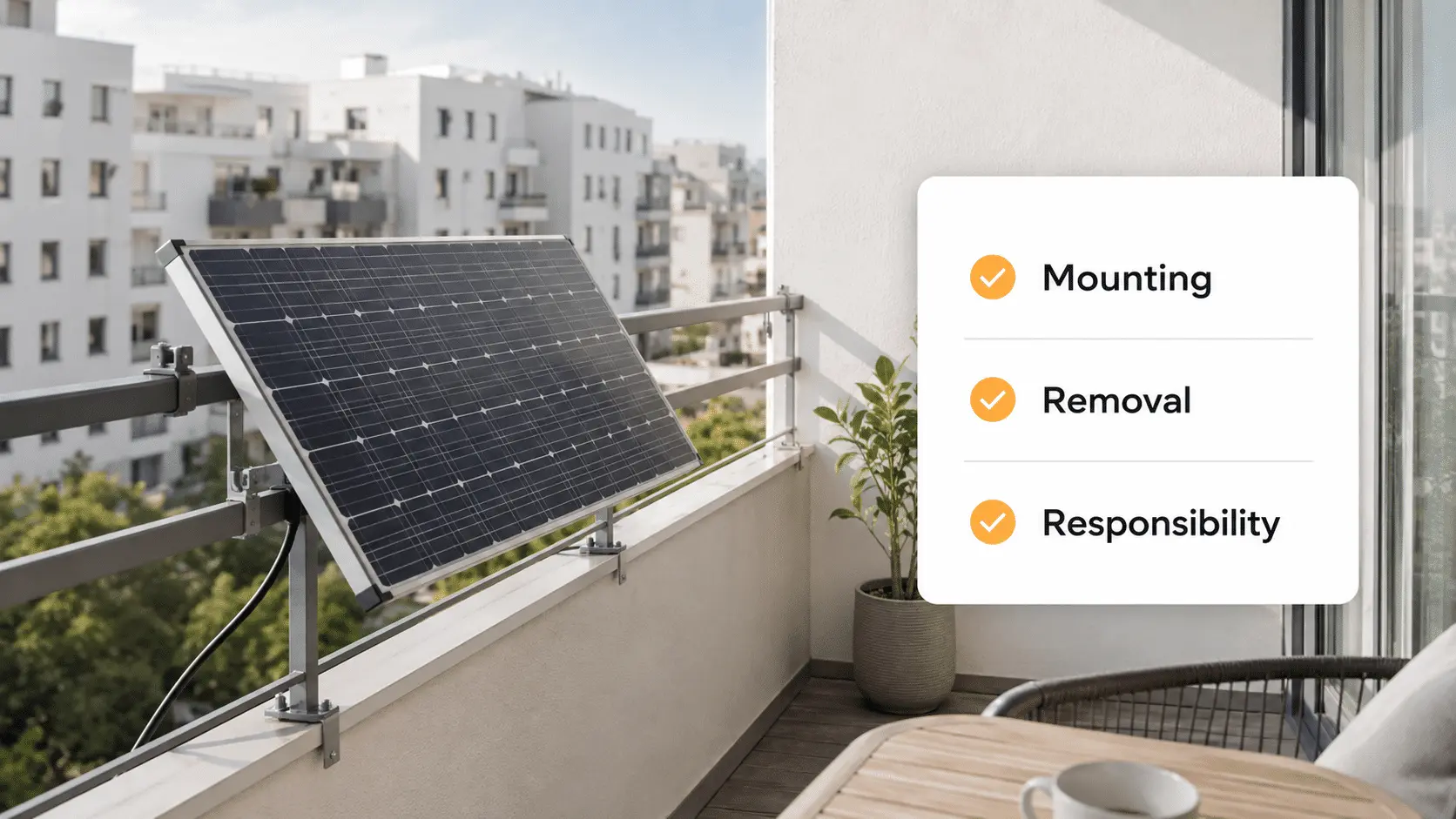
Plug-in solar panels can look simple on a product page, but installation and removal are where many sales problems start. Before taking orders, sellers should be clear about where the kit can be mounted, how it can be removed, what the user must check locally, and where the seller’s responsibility ends.
- “Easy to install” should not mean “suitable for every balcony, railing, outlet, or rental property.”
- “Removable” should mean removable under defined conditions, not a guarantee that no surface will ever be affected.
- The strongest product page is not the one that promises the least friction. It is the one that helps buyers avoid the wrong setup.
- Sellers should prepare mounting notes, removal guidance, unsuitable-surface warnings, and after-sales answers before pushing volume.
- For renters, the real question is rarely only “Can it generate power?” It is also “Can I use it without creating a property, safety, or responsibility problem?”
The Short Answer on Plug-in Solar Kit Installation
A plug-in solar kit is easier to sell when the installation and removal path is clear before the customer places an order.
For sellers, plug-in solar kit installation is not only a setup step. It is a pre-order clarification process covering mounting, removal, property rules, connection assumptions, and support responsibility.
That sounds obvious, but it is often the part that gets compressed into one phrase: “easy installation.” In practice, the seller needs to know more. Where will the panel sit? Is the railing suitable? Is drilling allowed? Can the system be taken down when the user moves? What outlet or connection path is being assumed? Who handles the installation if the buyer is not comfortable doing it?
Those questions are not obstacles to sales. They are what make the sale repeatable.
Why Installation and Removal Should Be Discussed Before the Order
Plug-in solar has a strong appeal because it feels approachable. A small solar kit, a balcony or patio, a microinverter or battery setup, and a user who wants lower bills without owning a roof. The idea is simple enough that buyers may assume the rest is simple too.
That is where sellers need to be careful.
Most after-sales problems do not come from the sentence “the panel produces electricity.” They come from everything around it: the balcony shape, the mounting hardware, the cable route, the local rule, the landlord’s view, the outlet assumption, the user’s confidence, and sometimes the gap between a lifestyle photo and a real installation site.
For distributors and solar kit brands, this is a product-readiness issue. If the installation path is vague, the same kit can create different expectations in every market. One buyer thinks it is a no-drill renter product. Another expects a permanent wall-mounted system. A third assumes it can be plugged into any outlet. The product may be the same, but the risk is not.
This is also why installation wording should sit next to certification wording. A product team may already be checking UL 1741 vs UL 3700, but certification language does not answer every real-site installation question.
Plug-in Solar Kit Installation Is Not One Scenario
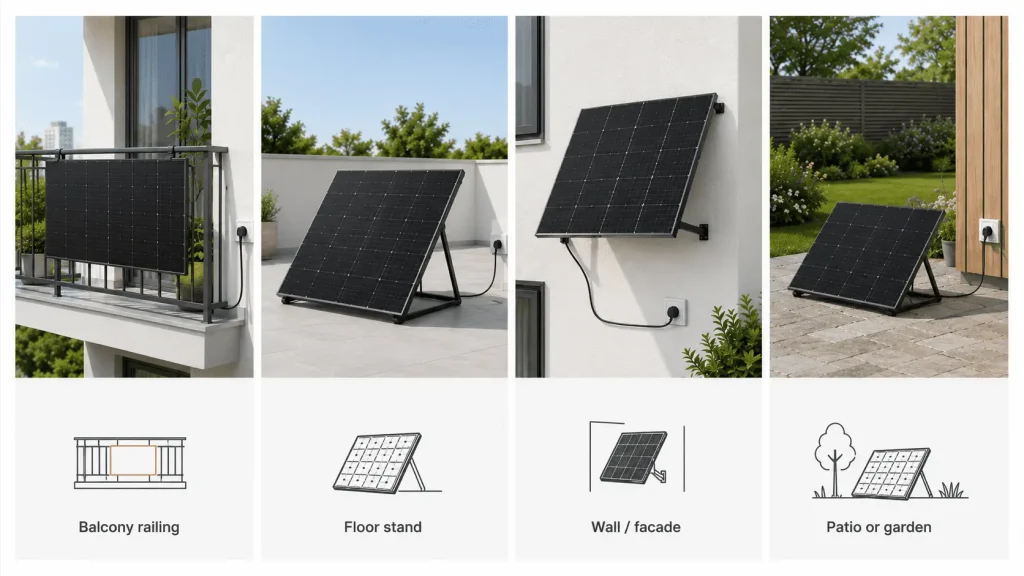
There is no single “plug-in solar installation.” The phrase covers several different use cases, and each one needs a different level of caution.
| Installation Scenario | What Sellers Should Clarify | Risk If Ignored |
|---|---|---|
| Balcony railing | Railing type, panel size, bracket fit, wind exposure, weight | Poor fit, movement, falling-object risk |
| Floor stand | Available space, tilt angle, shading, trip hazard | Low output or unsafe placement |
| Wall or facade | Whether drilling is allowed, building approval, cable route | Property dispute or permanent damage |
| Patio or garden | Weather exposure, cable protection, theft risk, stable placement | Damage, instability, poor user experience |
| Portable battery setup | PV input range, connector, storage location, user handling | System mismatch or weak performance |
A seller does not need to turn every product page into an engineering manual. But the page should make one thing clear: the buyer must match the kit to the installation condition before ordering.
A clean product photo is not enough. A kit that looks simple on a balcony may still be unsuitable for a weak railing, a high-wind exterior wall, a shaded corner, or a lease that restricts visible equipment. For a broader renter and apartment context, the apartment solar installation guide is a useful supporting resource.
What “Removable” Should Mean for Plug-in Solar Kits
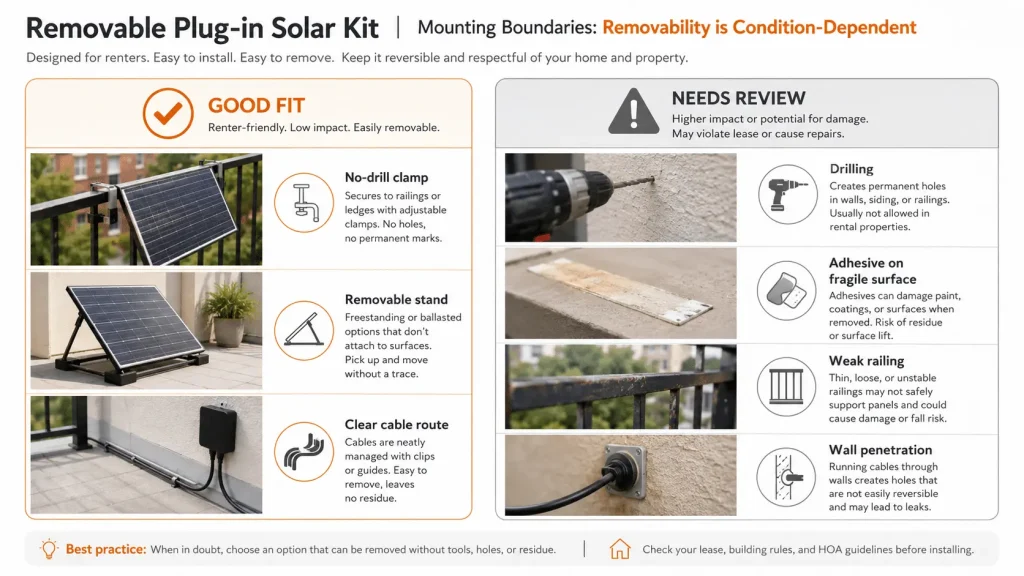
“Removable” is one of the most useful words in plug-in solar marketing. It is also one of the easiest to overuse.
For a renter, removable sounds reassuring. It suggests the system can move with them, does not require a roof, and does not permanently change the property. That is a real advantage. But sellers should define it carefully.
A safer way to explain it is this: a removable plug-in solar setup can be taken down under suitable mounting conditions without intended permanent modification to the building.
That sentence leaves room for reality. It does not promise that every surface, railing, coating, wall, or cable route will remain untouched in every case. It also avoids turning “removable” into “no approval needed.”
There are situations where sellers should be careful with removable claims:
- the setup requires drilling into a wall, facade, or balcony structure;
- adhesive is applied to painted, aged, textured, or fragile surfaces;
- the cable route requires a window modification or wall penetration;
- the railing is rusted, weak, unusually shaped, or not designed for load;
- the installation is exposed to strong wind without verified mounting guidance;
- the user expects to install the kit without reading instructions or checking local requirements.
In other words, removable is not just a product feature. It is a condition-dependent promise.
Seller Questions Before Plug-in Solar Kit Orders
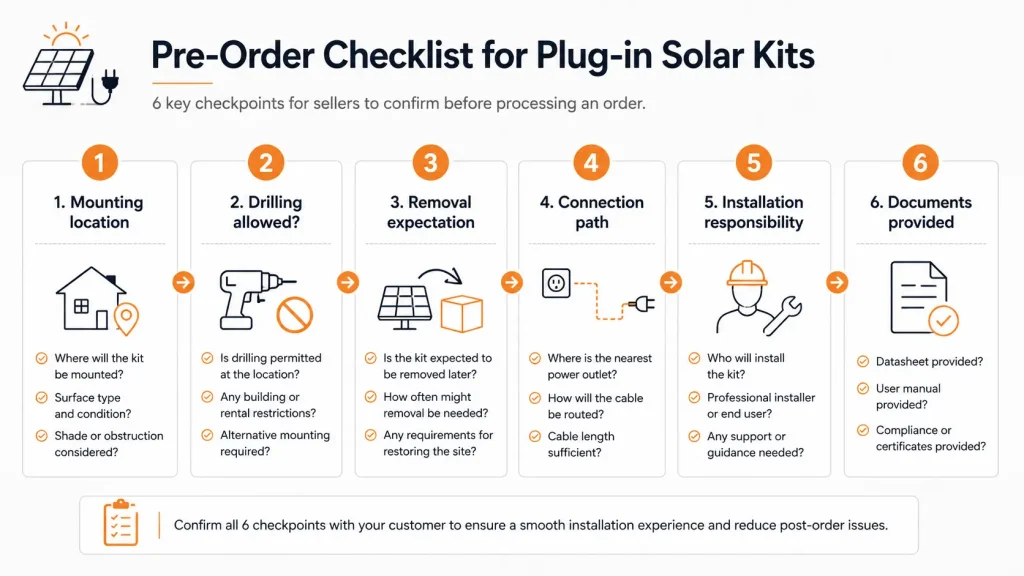
A practical seller does not need to solve every installation detail for the buyer. But they should ask enough questions to avoid the wrong sale.
| Question | Why It Matters |
|---|---|
| Where will the panel be mounted? | Determines panel size, weight, bracket type, and wind exposure. |
| Is drilling allowed? | Separates renter-friendly setups from semi-permanent installations. |
| Can the kit be removed before moving out? | Reduces landlord and property-damage disputes. |
| What outlet or connection path will be used? | Prevents unsafe plug assumptions and mismatched inverter claims. |
| Who is responsible for installation? | Clarifies seller, installer, and end-user boundaries. |
| What documents will the buyer receive? | Supports safe setup, local review, and after-sales handling. |
These questions are especially useful for B2B orders. A distributor may not be installing the kit personally, but they will still receive the customer questions. If the sales team does not have a standard answer, support quality will vary by salesperson, market, and customer mood.
That is not a stable way to scale a product category.
Safer Sales Wording for Installation and Removal Claims
Good plug-in solar copy should reduce friction without removing necessary caution. The goal is not to scare buyers. The goal is to make the product easier to understand.
| Avoid Saying | Safer Alternative |
|---|---|
| No approval needed | Check local rules, building requirements, and utility guidance before installation. |
| Works on any balcony | Suitability depends on railing type, panel size, wind exposure, and mounting hardware. |
| Easy DIY for everyone | Some setups may require qualified installation or local electrical review. |
| Removable with no damage | Designed for removable setups when used with compatible mounting surfaces and instructions. |
| Plug into any outlet | Outlet suitability depends on local electrical conditions, inverter requirements, and applicable rules. |
This type of wording may look less aggressive, but it is often stronger for serious buyers. It shows that the seller understands the real situation after the product leaves the warehouse.
Installation and Removal Documents Sellers Should Prepare
If a plug-in solar kit is going to be sold through distributors, retailers, or regional partners, documentation matters almost as much as the product image.
At minimum, sellers should prepare:
- model number and panel dimensions;
- panel weight;
- mounting option diagrams;
- suitable and unsuitable mounting surfaces;
- wind and outdoor-use cautions where applicable;
- cable route guidance;
- inverter compatibility boundaries;
- removal steps;
- user maintenance notes;
- warranty and misuse exclusions;
- local-rule disclaimer;
- after-sales FAQ for renters, landlords, and installers.
The documentation does not need to answer every local legal question. It should help the buyer understand what still needs to be checked.
That distinction is important. A seller can provide product guidance. They should not imply that a product document replaces local electrical review, building approval, utility requirements, or installation responsibility.
Where Sungold Fits
For solar kit brands, distributors, and OEM/ODM buyers, Sungold can support the panel-side review before sampling or bulk ordering.
That may include panel format, wattage range, dimensions, weight, cable position, connector needs, lightweight panel selection, flexible panel selection, packaging discussion, and documentation support for project review. Buyers can start from balcony solar panel solutions, review a custom solar panel solution, or compare model directions such as the PA219 flexible solar panel and PA621 lightweight solar panel.
The final kit still depends on the full system: inverter, mounting hardware, cable route, user manual, labels, local rules, installation responsibility, and after-sales process. A good plug-in solar offer should make those boundaries clear instead of hiding them behind a simple product photo.
If you are building a renter-facing or balcony-focused solar kit, start with the installation condition first. The panel choice becomes much easier after that.
FAQ
Can plug-in solar kits be removed when a renter moves out?
Yes, when the kit uses a suitable mounting method and the surface condition supports removal. Sellers should avoid promising damage-free removal in every case because drilling, adhesive mounting, fragile surfaces, or poor railing conditions can change the answer.
Does removable mean no landlord approval is needed?
No. Removable design and property approval are different issues. A kit may be physically removable, but renters may still need to check lease terms, landlord rules, HOA rules, building appearance requirements, or local guidance.
Can sellers describe a plug-in solar kit as DIY?
Only with care. Some users may be able to assemble simple mounting parts and connect compatible components, but sellers should not imply that every buyer, outlet, balcony, or market is suitable for DIY installation.
What should be included in an installation document?
A useful document should include the model, dimensions, weight, mounting options, suitable surfaces, unsuitable surfaces, cable routing notes, removal steps, safety warnings, maintenance guidance, and support contact path.
Who is responsible if the customer installs the kit incorrectly?
That depends on the sales terms, warranty policy, installation method, and local rules. Sellers should define the boundary before selling: what is covered by product support, what requires installer responsibility, and what counts as misuse or unsupported installation.