




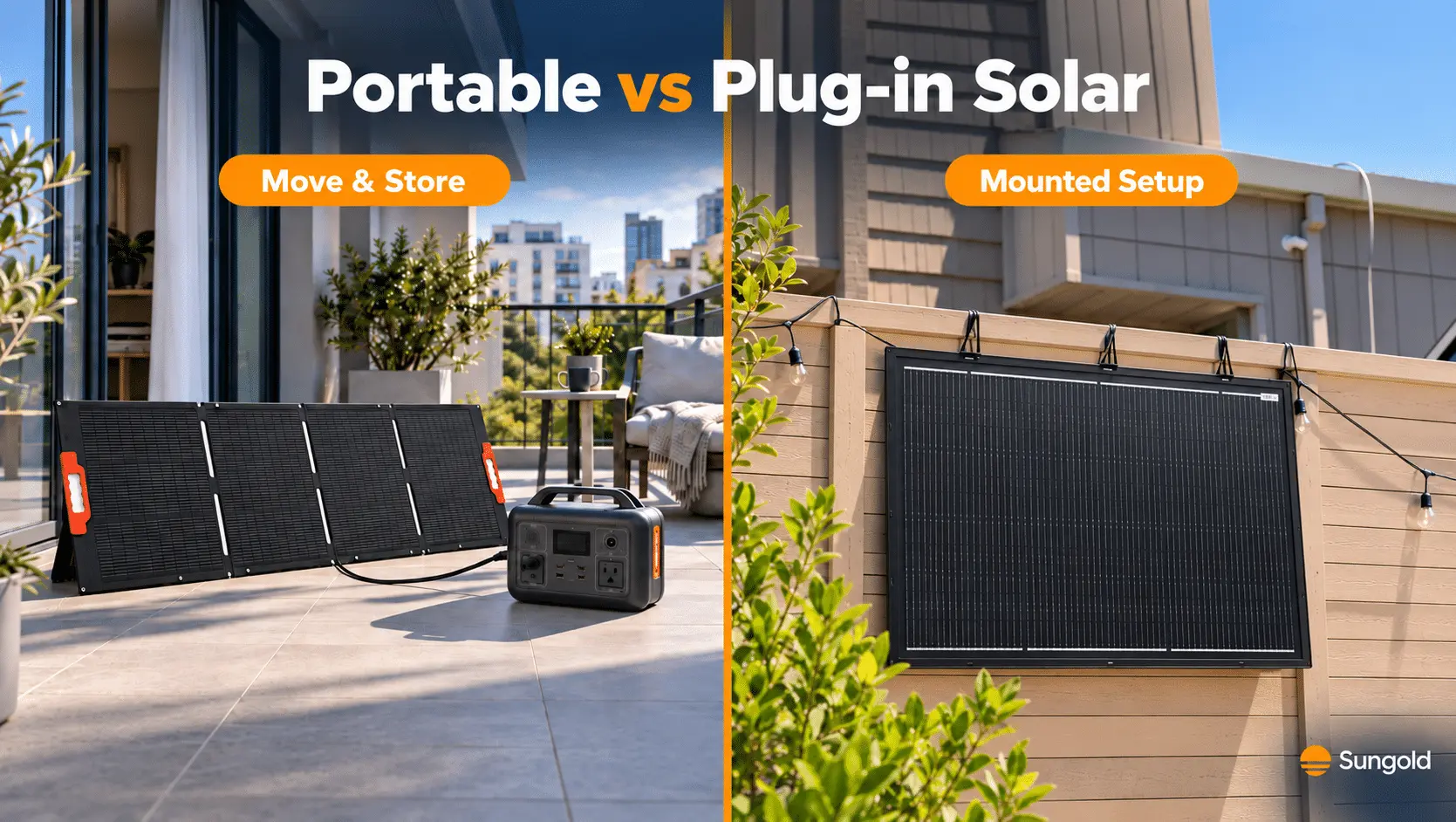
The choice between portable vs plug-in solar panels depends on the apartment’s permissions, available mounting space, battery path, and local electrical requirements.
Start with what you want to power. A portable panel paired with a compatible power station can support selected devices through that station. A plug-in solar system supplies a household circuit through an appropriate inverter and a permitted connection. These are different electricity paths, even when the panels look similar.
Key Takeaways
Choose around the intended electricity path and usable space before comparing panel formats.
- Portable solar: consider it when moving, packing away, or charging a compatible power station matters most.
- Plug-in solar: consider it for regular household daytime use when mounting permission and the local connection route are confirmed.
- System matching: a matching connector or panel wattage does not establish compatibility.
- Channel purchasing: compare complete packages, instructions, and market-specific documentation.
What Is the Difference Between Portable and Plug-in Solar Panels?
“Portable” describes how a panel is handled; “plug-in” describes a system’s connection route.
Portable panels are commonly paired with a compatible power station or battery charging system. Some fold for storage; others use a movable rigid construction. Their suitability depends on the receiving equipment and intended installation.
Plug-in solar usually refers to modules combined with an inverter and a connection to a household circuit. The inverter converts panel DC electricity to AC, as explained in the US Department of Energy’s inverter guide. A panel alone is not a complete plug-in system.
The categories can overlap, but moving a panel does not make it suitable for every system. A portable power station’s AC outlet must not be treated as a household grid connection.
Portable vs Plug-in Solar Panels: A Practical Comparison
Portable setups prioritize flexible use, while permitted plug-in systems can suit a more regular household installation.
| Decision factor | Portable panel with compatible power station | Plug-in solar system |
|---|---|---|
| Main use | Charge a station and supply selected devices from its supported outputs. | Supply a household circuit through the specified inverter and connection. |
| Placement | Requires sunlit space, stable placement, and a workable cable route. | Requires suitable mounting, cable routing, and electrical connection checks. |
| Moving home | Can be easier to pack, depending on panel and battery size. | Removal and installation at the next property require another suitability check. |
| Battery path | The station determines PV input limits, storage, and appliance output limits. | Storage is system-specific; do not assume a battery is included or freely interchangeable. |
| Daily handling | Deployment, repositioning, and packing away may become routine tasks. | A suitable fixed installation can reduce daily handling but still needs inspection. |
| Purchase comparison | Panel, station, adapters, cables, weight, and intended outdoor use. | Modules, inverter, mounting, connection equipment, installation, and documentation. |
Which Option Fits Renters and Apartments?
Portable solar panels for apartments are worth considering when frequent moves or restrictions on permanent alterations make a removable setup more practical.
Portable panels may involve fewer permanent installation changes, but they still require checks for placement, wind exposure, cable routing, and storage. A panel that fits on a balcony floor may still block access or sit in shade.
Confirm permission to use the proposed space, restrictions on exterior mounting, and a cable route that avoids trapped cables and trip hazards. The Apartment Solar Installation Guide covers these property-level checks.
Plug-in solar panels for apartments may suit residents with an approved mounting location and a verified connection route. The phrase “plug and play solar panels” does not mean every system can be inserted into any household socket.
Which Option Fits Small Homes and Everyday Use?
Choose according to whether you want electricity for selected devices or a system intended to contribute to household daytime demand.
Portable solar panels for small homes can suit users who want to move equipment between a patio, another property, and outdoor activities. Check deployed dimensions, packed size, and handling weight. A large panel that rarely gets deployed may be a poor practical choice.
A plug-in arrangement may fit a household with a consistent sunlit position and permission for the intended installation. Compare expected generation with when electricity is used; rated panel power alone does not establish household savings.
For the system explanation behind this choice, see how plug-in solar panels work and what buyers should check.
How Should You Compare Batteries and System Matching?
Select the receiving equipment before assuming that panel wattage or connector shape establishes compatibility.
For a portable setup, compare the station’s permitted PV voltage range, maximum input current and power, connector specification, and polarity with the proposed panel arrangement. Follow manufacturer limits, including any required allowance for cold-weather voltage.
The Solar Panel Compatibility with Power Stations guide explains the detailed matching process. Also compare usable battery capacity and station output limits with the devices you intend to operate.
For a plug-in system or balcony solar kit, ask whether storage is supported, which components control charging and discharge, and what operates during an outage. Do not infer backup capability from the presence of a battery; request the documented system arrangement.
What Permissions and Connection Checks Still Matter?
Neither format removes the need to check the intended location and electrical connection.
Some markets or system designs may require specific backfeed, anti-islanding, or connection protections. These requirements should be verified locally. Export control and anti-islanding serve different purposes; one should not be presented as a substitute for the other.
For example, VDE’s plug-in solar FAQ describes connection and product requirements in the German context. These are not universal permission for other markets. Have a qualified local professional confirm the connection method when necessary.
Compare documented installation and operating conditions rather than assuming portable solar is inherently safer or plug-in solar inherently more dangerous.
What Should Retailers and Distributors Compare Before Ordering?
Compare the complete package against the intended customer use and target market before comparing panel prices.
For distributors, the decision is not only about panel format. The product package should also be reviewed as a complete system, including the panel type, battery or power station path, inverter architecture, mounting method, cable set, user manual, labels, and market-specific documentation.
| Request from the supplier | What to establish |
|---|---|
| Itemized bill of materials | Which parts are included, optional, or supplied by the customer. |
| System diagram and compatibility list | The supported panel, station, battery, inverter, and cable combinations. |
| Mounting and handling instructions | Permitted placement, attachment, removal, and storage conditions. |
| Manuals and labels | Clear setup instructions and limits for the actual configuration and sales language. |
| Market-specific documents | Which models each document covers and whether complete-system evidence is needed. |
| Support and replacement terms | Who resolves compatibility questions, missing parts, and faults after delivery. |
Compare delivered system cost, including required accessories and installation work. For a panel sourcing enquiry, give Sungold the target market, application, dimensions, receiving equipment’s electrical input limits, mounting approach, and cable requirements. Keep panel selection and complete-system approval as distinct checks.
Frequently Asked Questions
The deciding factors are intended use, usable space, and the electrical system the panel must match.
Are portable panels always better for renters?
No. They may be easier to remove, but renters still need suitable space, permission where applicable, and a practical storage routine. A permitted plug-in installation may suit a longer stay better.
Can a portable panel become part of a plug-in system?
Only when its electrical specifications, intended use, and installation method match the specified system. Adding an adapter does not establish suitability or local permission.
Do plug-in solar panels need a battery?
Not every system includes or requires storage. Confirm whether the proposed architecture serves daytime consumption, supports a specified battery, or provides a documented backup function.
Which option produces more useful electricity?
The labels alone cannot answer that. Compare capacity, actual sunlight and shading, placement, time deployed, system losses, and when electricity can be used or stored.
Final Thoughts
Choose portable solar when flexible placement and a compatible power station fit the intended use; consider plug-in solar when regular household use, installation permission, and the connection route are confirmed.
Before buying, record the location, devices or household demand you want to support, storage needs, and restrictions. For channel buyers, turn those inputs into a complete package specification and documentation checklist.