 EN
EN
 Deutsch
 Italiano
 Español
 Français
 日本語
日本語

Plug-in solar can be worth it for renters, apartment users, small homes, balconies, and buyers who have suitable sunlight, safe mounting space, daytime electricity demand, and a kit that matches local rules.
It may not be suitable for heavily shaded locations, unsafe railings or walls, homes with little daytime electricity use, or buyers who expect a small kit to replace a whole-home rooftop system. For retailers and kit brands, the product must be evaluated as a complete package: panel, microinverter, plug, mounting, cables, instructions, labels, and market-specific documentation.
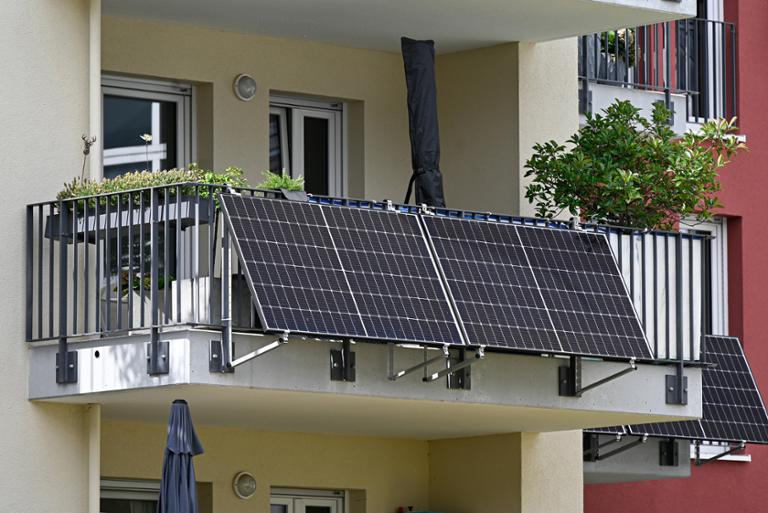
How Much Can Plug-in Solar Panels Save?
There is no single savings figure that applies to every plug-in solar installation. The result depends on the solar energy generated, how much of that energy is used on site, the local electricity rate, shading, panel angle, system size, and total project cost.
Estimated payback = total system cost ÷ annual electricity savings
| Input | Why It Changes the Result |
|---|---|
| Annual solar energy generated | Depends on location, season, panel direction, tilt, shading, weather, and system size. |
| Solar energy used on site | Energy used during the day can create direct bill value. Unused energy may not have the same value in every market. |
| Local electricity rate | The value of each kilowatt-hour depends on the customer’s electricity tariff and how that tariff changes over time. |
| Total system cost | Include panels, microinverter, mounting, cables, delivery, installation, registration, and any required electrical work. |
What Do Plug-in Solar Panels Cost?
The purchase price is only one part of the cost. A buyer should compare the complete installed or ready-to-use kit, including the equipment and the work required to use it safely.
| Cost Item | What to Include in the Estimate |
|---|---|
| Solar modules | Panel wattage, dimensions, weight, surface material, cable position, and quantity. |
| Microinverter or power electronics | Input range, output rating, grid compatibility, certification scope, monitoring, and export limits where applicable. |
| Mounting and hardware | Balcony, railing, wall, patio, or ground mounting parts, plus wind and structural considerations. |
| Cables, connectors, and plug | Length, weather exposure, connector type, polarity, plug standard, and replacement requirements. |
| Installation and compliance | Professional review, registration, inspection, utility notification, or electrical work required by the target market. |
| After-sales support | Manuals, labels, troubleshooting, warranty process, spare parts, and customer-service capacity. |
A lower panel price does not automatically mean a lower project cost. For a kit brand or retailer, unclear compatibility or weak documentation can increase returns, installation questions, and compliance risk.
When Are Plug-in Solar Panels Worth It?
Plug-in solar is more likely to make sense when the installation and the user’s electricity pattern match the product’s limits.
| User or Buyer Type | When It May Fit | Main Check |
|---|---|---|
| Renters | When roof access is unavailable and a removable balcony, patio, or ground setup is allowed. | Confirm landlord, property, mounting, and local requirements. |
| Apartment users | When there is usable sunlight, safe balcony space, and meaningful daytime electricity demand. | Check railing strength, wind exposure, shading, and connection rules. |
| Small-home owners | When they want a smaller entry point before considering a larger PV system. | Do not position a small kit as a whole-home solar replacement. |
| Retailers and kit brands | When the complete package has clear instructions, labels, product boundaries, and market-specific documentation. | Review the panel, microinverter, mounting, cable, plug, and battery configuration together. |
Plug-in solar can be a practical entry point where the buyer values simpler installation, removable equipment, or a smaller project scope. It is most useful when daytime solar production can be consumed on site and the user understands the system’s limits.
When Is It Not Worth It?
Plug-in solar may be a poor fit when the installation is heavily shaded, the mounting position cannot safely carry the equipment, daytime electricity use is very low, or the local rules do not permit the proposed setup.
It may also be a weak investment when the complete kit cost is high compared with the expected bill savings, when the user needs whole-home backup, or when a suitable rooftop system would provide better long-term value. Buyers should compare the full system scope instead of comparing panel wattage alone.
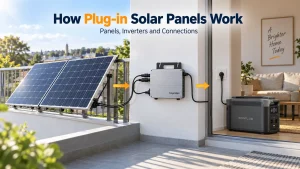
How Do Plug-in Solar Panels Work?
Plug-in solar panels generate DC electricity from sunlight. A compatible microinverter converts that DC electricity into AC electricity, which can then be connected through the approved product and installation method for the target market.
Optional battery storage can shift some solar energy to later use, but may create additional product and compliance requirements.
The exact setup depends on the country, grid rules, inverter approval, socket or plug type, export limits, installation location, and whether the system is grid-connected or connected to a portable power station. A plug-in solar kit should therefore be reviewed as a small system, not just as a panel with a cable.
Plug-in solar rules are market-specific and can change. A product that is accepted in one country, state, utility area, or building type may require a different configuration or approval elsewhere.
`n`nFor general photovoltaic system design context, the U.S. Department of Energy solar PV guide explains the main elements that affect a rooftop solar system.
Before use or sale, check the current requirements for the target market, including inverter and interconnection standards, plug and socket requirements, mounting safety, wind exposure, labeling, user instructions, registration, and utility notification where applicable.
For US projects, requirements may vary by state, utility, and installation type. Inverters and interconnection equipment may need to meet applicable standards such as UL 1741 and related grid requirements. The relevant authority, utility, or qualified installer should confirm the current requirements for the specific project.
For European projects, balcony and plug-in solar requirements also differ by country. Registration, product limits, building rules, and connection methods should be checked against current official guidance rather than copied from a general online article.
Do not claim that plug-in solar can be used anywhere. A responsible kit must match the target market’s panel, inverter, plug, mounting, labeling, user-instruction, and electrical requirements.
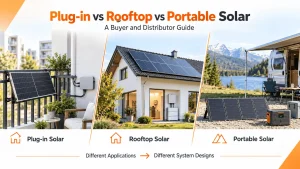
Plug-in Solar vs Rooftop vs Portable Solar
Plug-in solar is not the same as rooftop solar or a portable power station. The best option depends on installation rights, energy demand, portability, system size, safety requirements, and the expected use period.
| Option | Best Fit | Main Limitation |
|---|---|---|
| Plug-in solar | Flats, renters, balconies, small homes, and smaller solar projects. | Limited output and market-specific connection and safety rules. |
| Rooftop solar | Homeowners with roof access and a long-term installation plan. | Higher installation cost, permits, installer work, and roof suitability checks. |
| Portable solar | Camping, outdoor use, mobile power, and charging a compatible power station. | Usually not designed to offset household grid use directly. |
| Balcony solar with battery | Users who want to store some daytime solar for later use. | More equipment, higher cost, and potentially different safety requirements. |
For portable power station use, check Voc, Vmp, current, connector type, and polarity before ordering a panel. The solar panel compatibility with power stations guide explains the matching process for EcoFlow, Jackery, Bluetti, and similar portable power inputs.
For Retailers and Kit Brands
A plug-in solar product is easier to sell when the buyer can understand its application, limits, and documentation before purchase. Retailers, distributors, and kit brands should review:
- target market rules and product safety expectations;
- panel wattage, dimensions, weight, and mounting method;
- microinverter input and output compatibility;
- plug type, cable length, connector, and polarity;
- balcony, railing, wall, patio, or ground mounting options;
- wind load and installation stability;
- user manual quality, warnings, and after-sales FAQ;
- battery boundary if storage is included;
- packaging, labels, spare parts, and replacement process;
- market-specific certification and technical documentation.
One universal claim about legality, plug type, or installation method should not be used across multiple countries. Different markets may require different kit versions, manuals, labels, and product documentation.
For buyers developing a balcony or compact solar kit, Sungold can support the solar panel side of the review. This is mainly a panel selection and customization role, not a claim that one panel configuration replaces the microinverter, household wiring, grid approval, or local compliance process.
Buyers can review Sungold’s balcony solar panel solution. If weight, appearance, or curved-surface fit matters, PA219 flexible solar panels and PA621 lightweight solar panels may be reviewed during product planning. For a specific size, cable position, connector, label, or packaging requirement, use Sungold’s custom solar panel solutions.
FAQ
Are plug-in solar panels worth it?
They can be worth it when the user has suitable sunlight, safe mounting space, daytime electricity demand, and a product that matches local rules. They are not ideal for heavily shaded locations, unsafe mounting positions, or users expecting whole-home solar coverage.
How much can plug-in solar save?
There is no universal savings number. Estimate annual savings by multiplying the annual solar energy used on site by the local electricity rate. The result depends on solar output, self-consumption, electricity price, shading, system size, and total cost.
What does a plug-in solar kit cost?
The total cost depends on panels, microinverter, mounting, cables, plug, delivery, installation, registration, electrical work, and after-sales support. Buyers should compare the complete kit rather than the panel price alone.
Can plug-in solar panels power a whole house?
Usually no. Most plug-in solar systems are smaller systems designed to offset part of household electricity use. A full-home system normally requires a larger PV system with proper installation and grid connection.
Do plug-in solar panels need a battery?
Not always. A simple plug-in solar system may work without storage. A battery can improve self-consumption, but it adds cost and may change the safety and regulatory requirements.
Are plug-in solar panels safe?
They can be safe when the product is properly designed, certified, installed, and used within the intended market rules. Buyers should check the inverter, plug type, mounting method, user manual, and local requirements before use.
What should retailers check before selling plug-in solar kits?
Retailers should check product documentation, plug and inverter compatibility, market-specific rules, mounting instructions, warranty terms, after-sales FAQ, packaging, and clear warnings about where the system can and cannot be used.