 EN
EN
 Deutsch
 Italiano
 Español
 Français
 日本語
日本語
- Do not request only “FOB price for 550W laminates”; that is usually too vague for a serious quote.
- The supplier needs to know whether the laminate is glass-backsheet, glass-glass, monofacial, bifacial, framed later, or integrated into another product.
- Electrical sorting, EL images, flash data, lead position, and packaging matter more here than they do in a normal finished-module inquiry.
- Certification scope should be checked carefully, because the final framed module or locally assembled product may need its own verification.
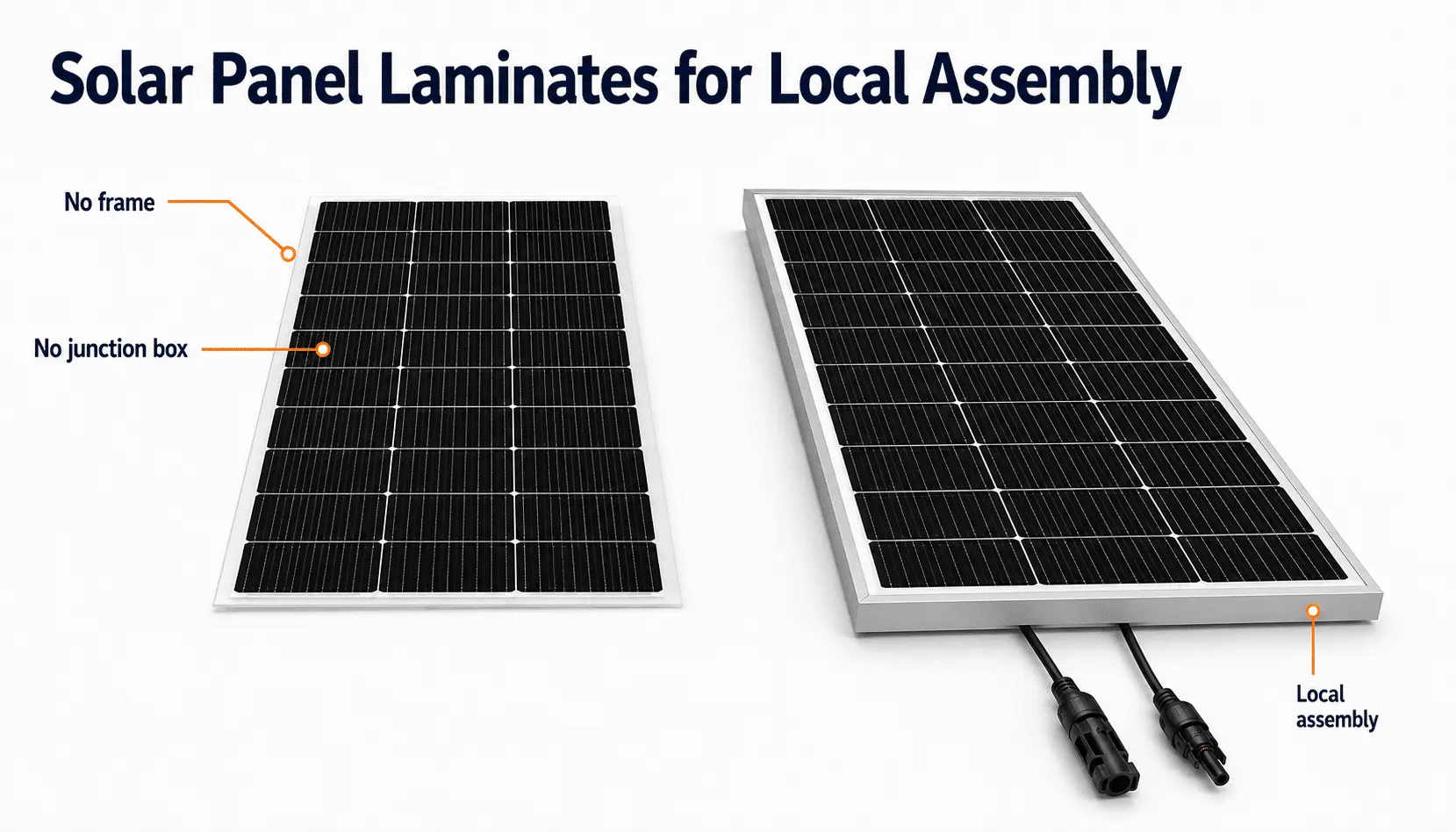
Semi-finished solar panel laminates can make sense when a buyer already has local framing, junction box installation, labeling, or final assembly capacity. The idea is simple on paper: import the laminated PV sheet, then complete the module closer to the market. In practice, the quote can go wrong quickly if the buyer treats the laminate like a standard finished panel.
A recent procurement request in our inquiry records followed this pattern: the buyer was planning local solar panel assembly and asked for laminated glass solar panels without aluminum frames and without junction boxes. That is a real buying scenario, but it is also a technical RFQ. The supplier cannot price it accurately from wattage alone.
If your project involves a private-label panel, a special-size module, or a local assembly line, it may be useful to review Sungold’s custom solar panel capability as a reference point before preparing the RFQ.
What Are Semi-Finished Solar Panel Laminates?
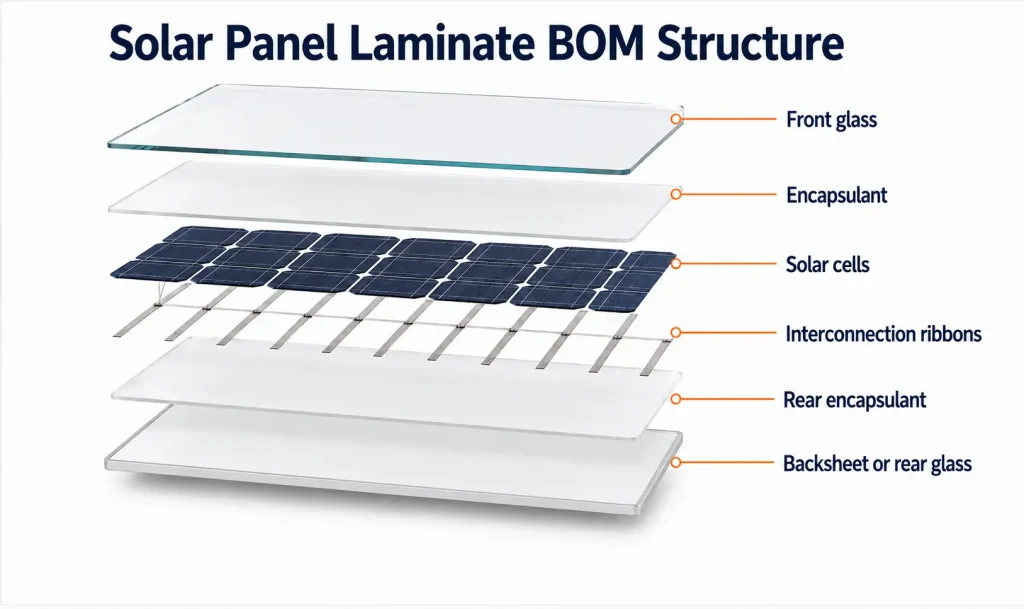
Semi-finished solar panel laminates are laminated PV structures that usually include front glass, encapsulant, solar cells, interconnection ribbons, rear encapsulant, and either a backsheet or rear glass. They are not yet complete modules if the frame, junction box, output cables, labels, or final packaging are still missing.
That distinction matters because the missing parts are not cosmetic. The frame affects handling and edge protection. The junction box affects output connection and safety. Labels and final documentation affect market entry. Packaging affects whether the laminate arrives usable or cracked.
| Item | Semi-Finished Solar Panel Laminate | Finished Solar Module |
|---|---|---|
| Frame | Usually not installed | Installed before shipment |
| Junction box | Often not installed; ribbon leads may be exposed | Installed and connected |
| Testing | Needs EL, flash data, and sorting before shipment | Usually tested as a complete module |
| Packaging risk | Higher edge and micro-crack risk | Lower handling risk because the frame protects the laminate |
| Certification boundary | Must confirm whether the laminate alone is covered | May be certified as a complete product, depending on model and scope |
Why Semi-Finished Solar Panel Laminates Need a More Detailed RFQ
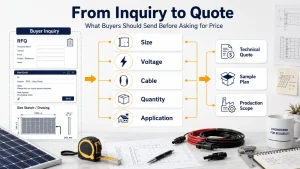
A finished panel RFQ can sometimes start with power, size, voltage, and quantity. A laminate RFQ needs more. The supplier has to understand what has already been completed at the factory, what will be completed locally, and what tolerances your local process can accept.
For example, two buyers may both ask for “550W laminate,” but one may need a glass-backsheet PERC laminate for low-cost local framing, while another may need a bifacial glass-glass TOPCon laminate with a different cell layout and lead exit position. Those are not the same BOM, not the same handling requirement, and not the same quotation basis.
If your project is moving toward n-type products, the TOPCon solar panel page can help frame the technology discussion before you lock the cell architecture in your laminate RFQ.
What Buyers Should Specify Before Requesting FOB Pricing
The most useful RFQ is not the longest one. It is the one that removes the biggest quote assumptions. For semi-finished solar panel laminates, the following fields should be clear before the supplier starts pricing.
| RFQ Field | What To Specify | Why It Matters |
|---|---|---|
| Cell technology | PERC, TOPCon, HJT, or other confirmed cell type | Drives cost, efficiency range, availability, and product positioning |
| Cell format and layout | Cell size, half-cut or other cutting method, cell matrix, target power range | Determines laminate size, voltage/current window, and production process |
| BOM structure | Glass thickness, encapsulant type, backsheet or rear glass, color, and any special material requirement | Affects durability, weight, appearance, cost, and application fit |
| Electrical target | Power bin, Vmp, Voc, Imp, Isc, tolerance, and sorting requirement | Prevents mismatch and avoids surprises during local final assembly |
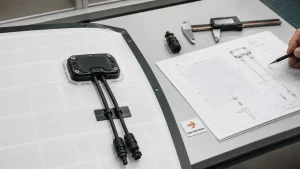
| Lead exit design | Ribbon position, exposed length, exit point, and local welding or junction box process | Ensures the laminate can actually be completed by your local team |
| Testing package | EL image, flash test data, barcode traceability, and inspection standard | Creates a quality baseline before the fragile laminate leaves the factory |
| Packaging | Vertical or crate packing, separators, corner protection, moisture protection, and container loading plan | Reduces breakage, edge chips, scratches, and hidden freight damage |
Where Local Assembly Responsibility Begins
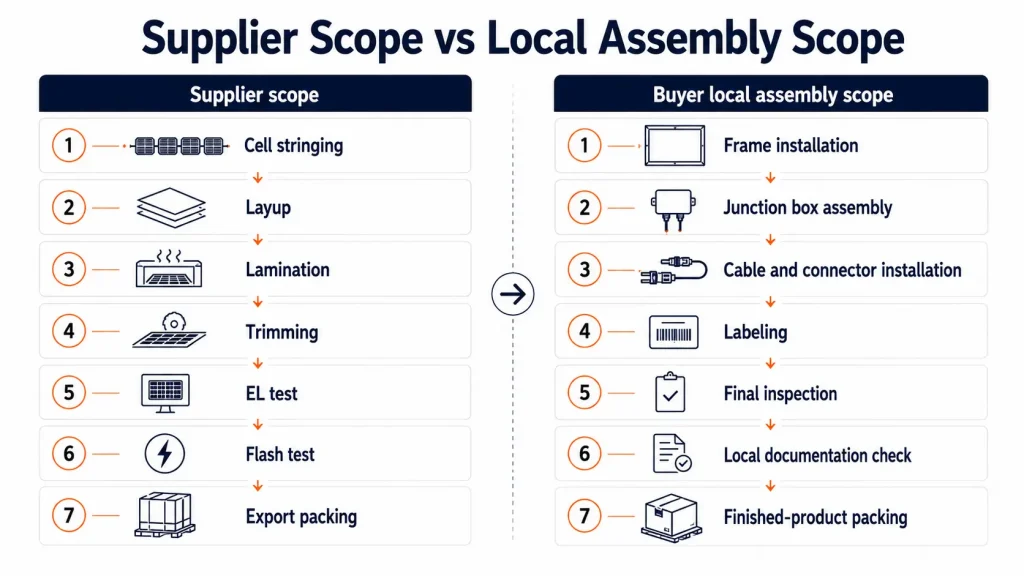
The cleanest way to avoid confusion is to draw a boundary line between supplier scope and buyer scope. This is especially important when the buyer will install the frame and junction box locally.
The supplier side may include cell stringing, layup, lamination, trimming, pre-shipment EL testing, flash testing, sorting, and export packaging. The buyer side may include framing, junction box soldering or potting, cable and connector installation, label application, final inspection, local certification review, and finished-product packaging.
This does not mean one side is always responsible for every item. It means the RFQ should say who is responsible. A good quote makes the boundary visible; a weak quote hides it until production starts.
Certification and Documentation Checks for Semi-Finished Solar Panel Laminates
Certification wording needs care. A supplier may have certificates for a finished module series, for selected materials, or for a specific tested construction. That does not automatically mean every semi-finished laminate, every local assembly process, or every new finished product is covered.
Before placing an order, ask which exact model, BOM, construction, and test scope the documents cover. If the final module is assembled locally, your team may need to confirm whether local retesting, labeling, or market-specific documentation is required.
For buyers who are still building their documentation process, Sungold’s solar panel certification guide is a useful related reference, although laminate certification must still be checked by exact product scope.
Packaging Is Part of the Product, Not an Afterthought
Frameless laminates are more vulnerable than framed modules during handling and ocean freight. A small edge chip, glass scratch, or hidden micro-crack can become a local assembly problem after the container arrives.
The RFQ should therefore describe packaging before price is finalized. Ask for the packing orientation, crate design, separator material, corner protection, moisture control, pallet strength, loading quantity, and photo confirmation before shipment. If you need 40HQ loading estimates, make clear whether the estimate is based on your final laminate size and packing method.
Checklist: Semi-Finished Solar Panel Laminates RFQ
Before sending your RFQ, check whether these items are already included. If they are not, the supplier will either ask follow-up questions or quote with assumptions.
- Target product type: glass-backsheet or glass-glass laminate
- Cell technology, cell format, busbar design, and cutting method
- Cell matrix, laminate dimensions, thickness, and weight limit
- Target power range and electrical parameter window
- Encapsulant, front glass, rear layer, and color requirement
- Ribbon lead location, length, and local junction box assembly method
- EL image, flash test data, barcode traceability, and sorting method
- Defect acceptance criteria for cracks, bubbles, misalignment, scratches, and edge chips
- Certification and documentation scope to be verified by exact model and construction
- Packaging, container loading, MOQ, sample need, and expected order volume
If you are preparing a broader procurement request, the custom solar RFQ checklist can be used together with this laminate-specific checklist.
FAQ About Semi-Finished Solar Panel Laminates
Are semi-finished solar panel laminates cheaper than finished modules?
They may reduce some factory-side assembly cost, but the final cost depends on local labor, frame and junction box sourcing, testing, packaging loss, certification work, and rework risk. Buyers should compare landed cost, not only FOB price.
Can I request laminates only by wattage, such as 550W or 700W?
Wattage alone is not enough. The supplier still needs the cell technology, layout, laminate dimensions, BOM, electrical tolerance, lead design, test requirements, and packing method before the quote can be reliable.
Do semi-finished laminates include junction boxes?
Not always. Many local assembly projects request laminates without junction boxes, with ribbon leads left accessible for local soldering or connection. The exact lead location and exposed length should be specified in the RFQ.
Who is responsible for final certification after local assembly?
That depends on the product scope, market, and certification pathway. Buyers should confirm whether the supplier’s documents cover the laminate, the finished module, or only certain tested constructions, and then check local requirements before selling the final product.
Final Thoughts
Semi-finished solar panel laminates are a good fit for buyers who already understand local module assembly. They are not a shortcut around engineering details. The more unfinished the product is, the more specific the RFQ needs to be.
A practical RFQ should answer three questions before price: what exactly is being laminated, what exactly is left for local assembly, and what proof will show that the laminates left the factory in acceptable condition. Once those points are clear, the conversation moves from a vague FOB request to a workable manufacturing quote.
Preparing a laminate RFQ? Share your target power range, cell technology, laminate dimensions, junction box plan, and expected order volume so the engineering and sales team can check whether the specification is ready for quotation.