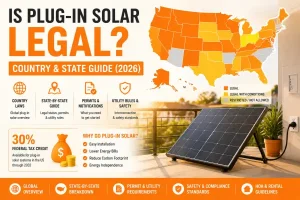





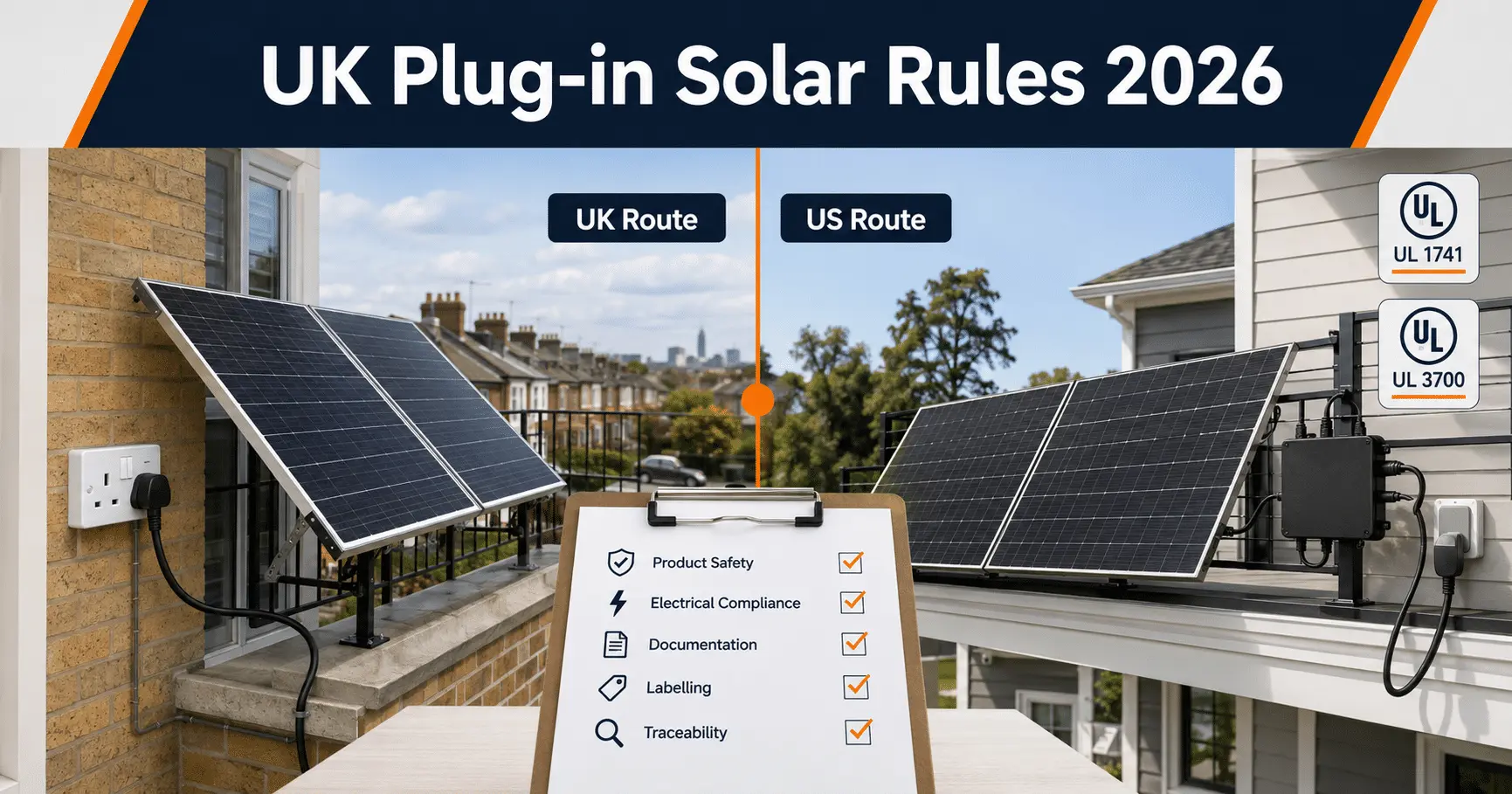
UK plug-in solar rules 2026 changed the market from August 27, 2026, but they did not make every solar kit with a plug automatically ready for sale. For retailers, distributors, and solar kit brands, the real work is verifying the exact product configuration, output limit, plug/socket pathway, battery boundary, documentation, and user guidance before listing a kit for the Great Britain market.
The UK route is not the same as the US balcony solar route. Great Britain now has a more defined framework for compliant plug-in solar products, while the US market still depends heavily on state laws, utility rules, local code interpretation, and standards discussions around UL 1741 and UL 3700.
For B2B buyers, the safer question is not only “Is plug-in solar legal now?” It is “Which exact kit can we document, label, install, remove, and support without overstating the compliance claim?”
Quick Answer: What Do UK Plug-in Solar Rules 2026 Mean for Retailers?
UK plug-in solar rules 2026 mean retailers can prepare compliant plug-in solar kits for the Great Britain market, but they still need to verify the exact product scope before listing a product. A generic balcony solar kit, portable solar bundle, battery-integrated product, or microinverter package should not be described as UK-ready unless the exact configuration has been checked against the relevant requirements.
A retailer should confirm the model number, AC output, plug and socket pathway, product specification scope, ENA/G98 status where applicable, labels, user manual, installation limits, removal instructions, and permission wording. The goal is not just to sell quickly. It is to avoid product-page claims that are broader than the actual evidence.
What Changed Under UK Plug-in Solar Rules 2026?
From August 27, 2026, compliant plug-in solar products can be bought and used across Great Britain. GOV.UK also describes plug-in solar as a lower-cost way for more households to generate some of their own electricity, especially where traditional rooftop solar may not be practical.
That change matters for retailers, but the details matter more. The UK consultation outcome ties the route to defined product requirements and makes clear that only products meeting the plug-in solar framework should be treated as eligible for this simplified consumer pathway.
There are three practical boundaries for product teams:
- The product should be reviewed as an exact kit, not only as a panel, inverter, cable, or plug.
- The UK route should be treated as Great Britain-specific unless Northern Ireland requirements are separately verified.
- Plug-in batteries and solar-plus-storage kits should not be folded into the initial plug-in solar claim without separate evidence.
This is why Sungold’s existing guide to plug-in solar panels in the UK remains useful for home suitability, system limits, and buyer checks. This article focuses more tightly on the retailer and distributor launch decision.
What Retailers and Distributors Should Verify Before Listing a UK Plug-in Solar Kit
A UK plug-in solar product page should do more than show panel wattage and a lifestyle image. It should give enough information for a buyer, installer, support team, or AI search engine to understand what the product is, what it is not, and what still needs to be checked before use.
| What to verify | Why it matters | Safer B2B action |
|---|---|---|
| Exact model number | Compliance usually applies to a specific configuration, not a broad product family. | Match the listed SKU, inverter, panels, cable, plug, manual, and label set to the documented model. |
| AC output | The output limit is not the same as total PV panel wattage. | State microinverter AC output separately from PV module DC wattage. |
| Plug and socket pathway | UK product wording needs to match the BS 1363 plug and fixed socket route where applicable. | Verify plug type, socket assumptions, and user warnings before making UK-ready claims. |
| Product specification scope | A compliant component does not automatically qualify the complete kit. | Ask whether the complete package is covered, including panels, inverter, cable, plug, labels, and manual. |
| ENA/G98 status | Register status can affect whether the product is ready for the market route being claimed. | Check the current record or ask for supplier evidence tied to the exact model. |
| Battery inclusion | The initial UK route should not be treated as a blanket approval for plug-in batteries. | Separate PV-only kits from solar-plus-storage products in copy, documentation, and sales training. |
| Installation and removal instructions | Retailers need support-ready guidance, not only a sales page. | Review mounting, socket use, cable routing, user warnings, maintenance, and removal steps. |
| Property permissions | Product legality does not remove every site-level permission issue. | Mention landlord, freeholder, building owner, planning, or listed-building checks where relevant. |
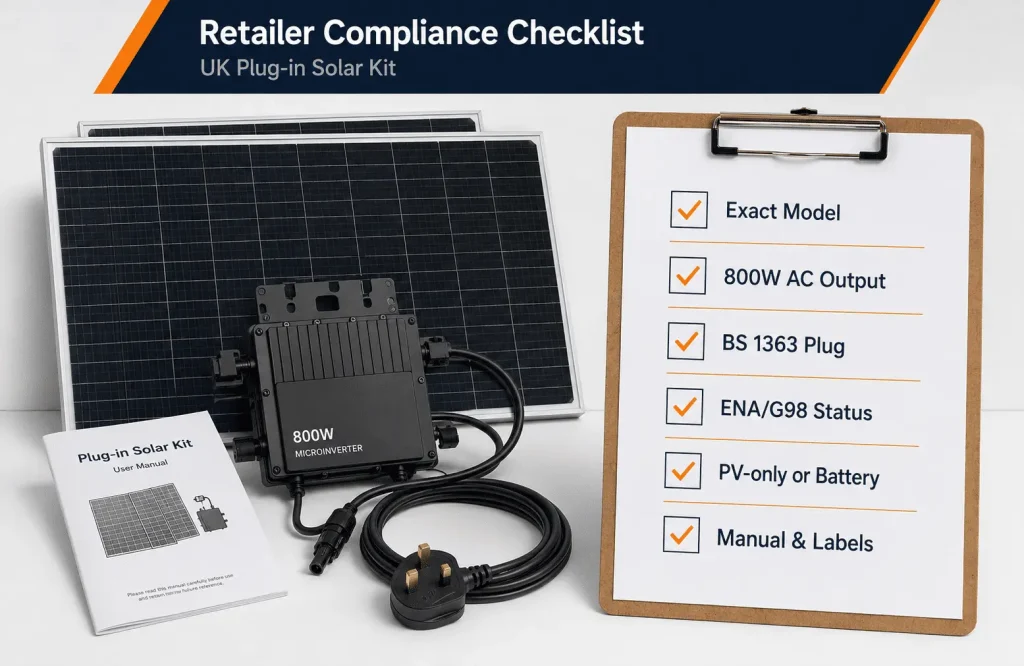
UK Plug-in Solar Rules 2026: 800W AC Output vs Solar Panel Wattage
One of the easiest mistakes in UK plug-in solar listings is mixing up panel wattage and microinverter output. A kit may include PV modules with a higher combined DC rating, while the microinverter has a lower AC output limit for connection into the home circuit.
Retailers should make that distinction visible. Otherwise a buyer may assume that a panel number, inverter number, and legal output limit all describe the same thing.
| Term | What it means | Why it matters for UK listings |
|---|---|---|
| PV panel wattage | The DC rating of the solar modules under test conditions. | Useful for understanding panel capacity, but not the same as plug-in AC output. |
| Microinverter AC output | The AC power the inverter can feed into the household circuit. | This is the number retailers should separate clearly when discussing the UK output limit. |
| Daily energy yield | The amount of energy produced over time in real conditions. | Depends on sunlight, orientation, shading, season, installation position, and self-consumption. |
A safer explanation is simple: “This kit includes PV modules and a microinverter. The PV module wattage and AC output rating are different values. Check the exact product specification before installation.”
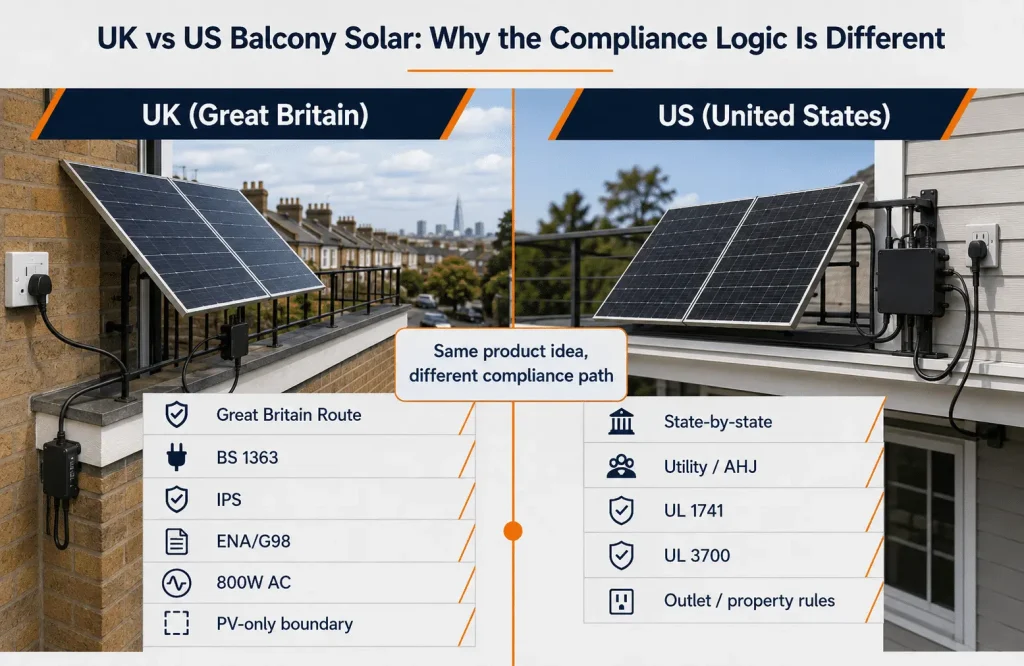
UK vs US Balcony Solar: Why the Compliance Logic Is Different
UK and US balcony solar are moving toward the same broad idea: smaller solar products that more households can access. But the compliance logic is different enough that retailers should not copy US product-page language directly into a UK listing.
| Factor | Great Britain plug-in solar | US plug-in / balcony solar |
|---|---|---|
| Regulatory structure | A more defined Great Britain route for compliant products from August 27, 2026. | More fragmented; requirements can vary by state, utility, AHJ, property type, and product design. |
| Product standard focus | UK interim product specification, BS 1363 plug/socket pathway, and ENA/G98-style verification. | UL 1741 for inverter/interconnection equipment and UL 3700 discussion for complete plug-in PV systems. |
| Output framing | Retailers should separate PV module DC wattage from microinverter AC output. | Output limits and acceptance conditions depend on state, utility, and product pathway. |
| Battery treatment | The initial route is PV-only and should not be treated as covering plug-in batteries. | Some market discussions include storage, but rules and acceptance still vary. |
| Socket logic | Product language should match UK plug and fixed socket assumptions. | Products often involve NEMA-style outlet assumptions, but local electrical rules still matter. |
| Retail copy risk | “UK legal” must match the exact compliant product and installation boundary. | “UL certified” must clarify whether only the inverter is listed or the complete kit has been evaluated. |
| Buyer action | Check exact model, product specification, register status, plug, manual, and permission wording. | Check state law, utility rules, UL 1741/UL 3700 scope, AHJ requirements, and property rules. |
A US kit with a UL 1741-listed microinverter is not automatically compliant in the UK. A UK kit designed around the Great Britain route is not automatically approved for every US state. The same product idea may travel across markets, but compliance evidence does not travel automatically.
For the US standard conversation, Sungold’s guide to UL 1741 vs UL 3700 for plug-in solar kits explains why inverter-level certification and complete-kit evaluation should not be treated as the same claim.
Why Battery Kits Need Careful Wording Under UK Plug-in Solar Rules 2026
Battery storage is commercially attractive because it makes a plug-in solar offer feel more complete. Users want to store daytime solar generation for evening loads, and retailers want a higher-value kit. But under UK plug-in solar rules 2026, battery wording needs careful handling.
The GOV.UK consultation outcome states that the interim product specification applies specifically to plug-in solar products and does not extend to other plug-in technologies such as plug-in batteries. That does not mean battery products have no market. It means they should not be folded into the initial plug-in solar route without separate verification.
| Risky wording | Safer wording |
|---|---|
| UK legal plug-in solar battery kit. | Solar-plus-storage configurations require separate review and are not automatically covered by the initial UK plug-in solar route. |
| Plug this battery solar kit into any home socket. | Check the product specification, socket condition, installation instructions, and property permissions before use. |
| Compliant with UK plug-in solar rules. | Compliance should be verified for the exact model and configuration. |
| Works like German balcony solar. | UK requirements differ from other European plug-in solar markets. |
What Product Documents Should Distributors Ask Suppliers For?
Distributors should not rely on a catalog title, marketplace listing, or product photo. Before launching a UK plug-in solar SKU, ask the supplier for a complete document pack that matches the exact configuration.
- Exact model number and SKU configuration.
- PV module datasheet.
- Microinverter datasheet.
- Plug and cable specification.
- Product specification or compliance evidence for the target market.
- ENA/G98 or relevant register reference where applicable.
- Labels and warning text.
- User manual.
- Installation and removal instructions.
- Packaging artwork and claim language.
- After-sales troubleshooting guide.
- Statement on whether the kit includes battery storage.
- Statement on what remains the user’s responsibility, including property permissions.
This document pack also helps compare suppliers. Two kits can look similar online, but the stronger supplier is usually the one that can explain the exact product scope, certification boundary, labels, and installation limits.
How to Write Safer Product Page Copy for UK Plug-in Solar Kits
Product-page copy should be clear enough for consumers, but specific enough for compliance review. The safest retail copy does not hide the limits. It explains them in plain English.
A good UK plug-in solar product page should state what the kit includes, the microinverter AC output, whether the product is PV-only or includes storage, which socket and installation assumptions apply, what evidence supports the compliance claim, and what permissions the customer may still need.
Safer example: Designed for compliant plug-in solar applications in Great Britain. Final use depends on the exact product configuration, socket condition, installation location, user instructions, and any property permissions required by the homeowner, landlord, freeholder, or local authority.
That sentence is less aggressive than “UK legal plug-in solar kit,” but it is more defensible for retailers, distributors, and support teams.
Retailer Checklist Before Launching UK Plug-in Solar Kits
Before a retailer or distributor lists a UK plug-in solar kit, check:
- Is the product intended for Great Britain plug-in solar use?
- Is the exact model documented, not just the product family?
- Is the microinverter AC output clearly stated?
- Is PV panel wattage separated from AC output?
- Is the plug/socket pathway suitable for UK expectations?
- Is the product PV-only, or does it include battery storage?
- Is the relevant compliance evidence available for the exact configuration?
- Is the ENA/G98 or register status checked where applicable?
- Does the manual explain where and how the kit can be installed?
- Does the page avoid overclaiming “legal anywhere” or “no permission needed”?
- Are landlord, freeholder, planning, and listed-building checks mentioned where relevant?
- Does the after-sales team know how to answer certification, installation, and removal questions?
If any of these points are unclear, the product can still be discussed with suppliers. But it should not be rushed into a retail listing with broad legal claims.
FAQ About UK Plug-in Solar Rules 2026
Are plug-in solar panels legal in the UK now?
From August 27, 2026, compliant plug-in solar products can be bought and used in Great Britain. Retailers should still verify the exact product configuration, compliance evidence, plug/socket pathway, installation instructions, and property-permission wording before claiming a kit is ready for the UK market.
Do UK plug-in solar rules 2026 include batteries?
The initial UK plug-in solar route should not be treated as a blanket approval for plug-in batteries or solar-plus-storage kits. GOV.UK’s consultation outcome says the interim product specification applies to plug-in solar products and does not extend to other plug-in technologies such as plug-in batteries. Battery-integrated products need separate review.
Can a US balcony solar kit be sold in the UK if it has UL 1741 or UL 3700?
Not automatically. UL 1741 and UL 3700 are relevant to the US standards conversation, but they do not replace UK requirements. A product intended for Great Britain should be reviewed against the UK product specification, plug/socket pathway, ENA/G98 status where applicable, labels, manuals, and installation boundaries.
Final Thoughts
UK plug-in solar rules 2026 create a real market opening. They give retailers, distributors, and solar kit brands a clearer way to talk about small plug-in solar products for households that may not be able to use traditional rooftop solar.
But the opportunity is not only speed. It is accuracy.
The retailers that move well will not be the ones that write the loudest “UK legal” headline. They will be the ones that verify the exact kit, separate panel wattage from inverter output, treat batteries carefully, write installation limits clearly, and explain what the customer still needs to check.
The US balcony solar market is useful as a comparison, but not as a copy-and-paste template. UK and US plug-in solar are moving in the same direction, but the compliance logic is different. For B2B buyers, that difference is where product risk and market opportunity both sit.
Need to prepare a UK-ready plug-in solar kit?
Send your target market, panel configuration, microinverter model, plug type, cable design, documentation scope, and battery boundary. Sungold can help review whether a standard or customized plug-in solar package is better suited to your retail or distributor plan.