




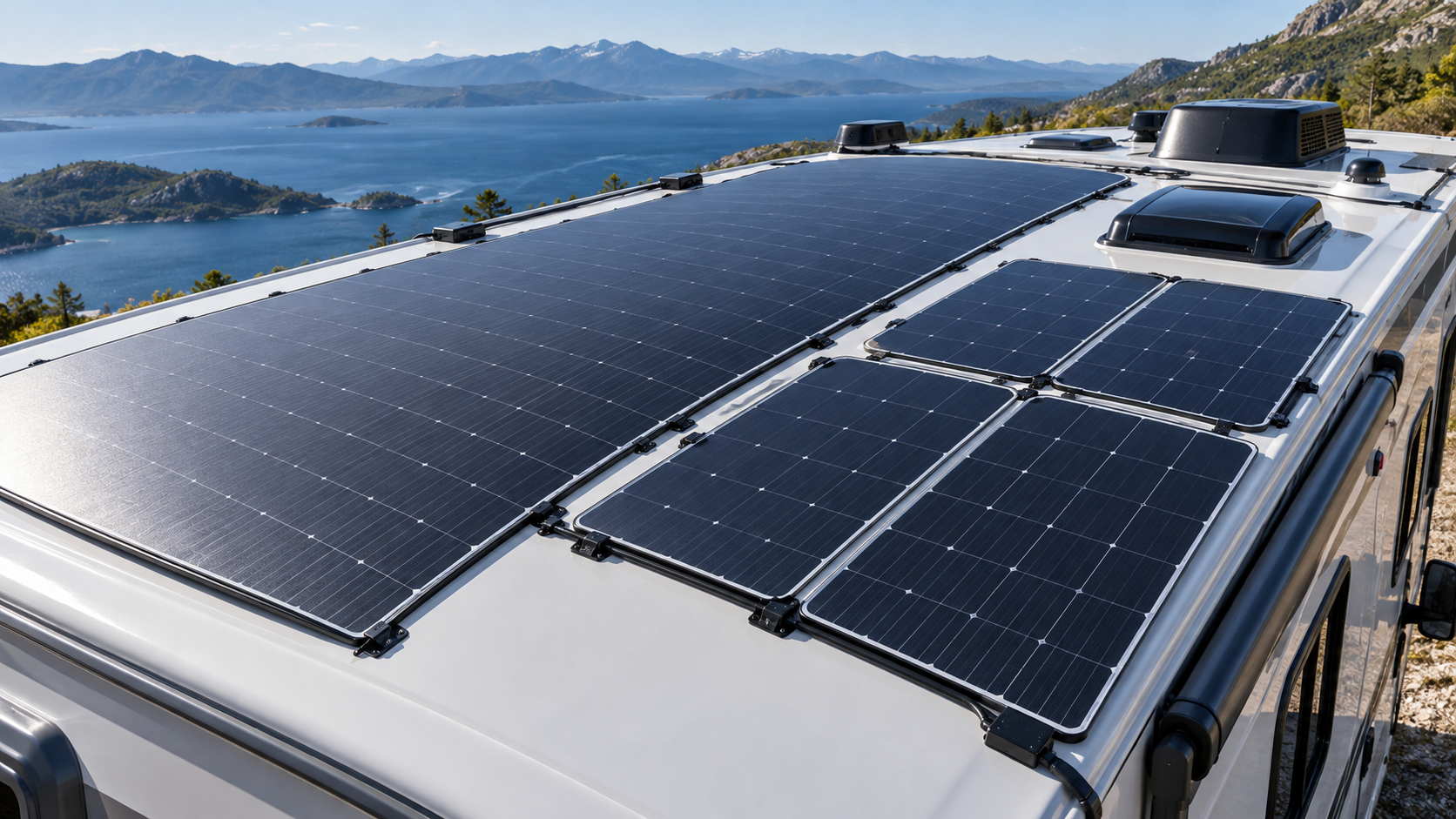
High-power flexible solar panels for 400W+ projects should be selected by installation area, weight, electrical matching and maintenance requirements, not wattage alone. One large panel, several smaller panels and a custom-size design can all be practical choices in different applications.
Key Takeaways
- There is no universal maximum wattage for every flexible solar panel project.
- One large panel is not always better than several smaller panels.
- Higher wattage usually affects panel size, weight, cable routing and handling.
- Custom sizing may be useful when standard panels leave unusable space.
- Panel wattage must be checked with voltage, current, controller and battery limits.
What Does High-Power Mean for Flexible Solar Panels?
For flexible solar panels, high power does not describe one fixed panel size or one universal output limit. The practical wattage depends on active area, cell layout, electrical design, panel construction and the installation surface.
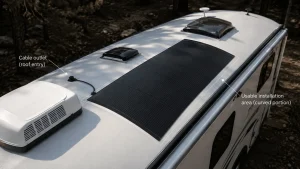
A 400W or higher panel may suit a large RV roof, marine deck, commercial vehicle or low-profile roof. The same panel may be difficult to use on a narrow curved roof or a surface divided by vents, rails or service equipment.
Before choosing a high-wattage flexible solar panel, check:
- Panel length and width;
- Panel weight;
- Operating voltage and current;
- Open-circuit voltage;
- Cable exit position;
- Connector type;
- Mounting method;
- Heat, airflow and maintenance access.
A panel can have the required wattage and still be the wrong choice if it cannot be installed, connected or maintained properly.
One Large Panel or Several Smaller Panels?
| Configuration | More suitable when | Main tradeoff |
|---|---|---|
| One large panel | The installation area is continuous and mostly clear | More difficult to move, position and replace |
| Several smaller panels | The surface has vents, rails, curves or separate sections | More cables, connectors and installation coordination |
| Custom-size panel | Standard sizes leave unusable gaps | Requires drawings, review and sample confirmation |
| Standard panel combination | Fast purchasing and simple replacement are priorities | May not use the available surface efficiently |
For buyers comparing high-power flexible solar panels, one large panel can create a cleaner layout and reduce panel-to-panel connections. Several smaller panels may be easier to install when the available area is divided or affected by partial shade.
The better choice depends on the actual surface, handling conditions, cable route and electrical design.
When Does One Large Flexible Panel Make Sense?
One large flexible panel may be practical when the surface is continuous, there are few obstacles and the installation team can handle the panel safely.
It is also important to confirm that:
- The panel can be delivered to the installation area;
- The panel can be positioned without excessive bending or edge pressure;
- The cable route is short and protected;
- The controller accepts the panel voltage and current;
- There is enough space for inspection and future replacement.
A large panel may reduce the number of connections, but it can be harder to align on a curved surface. It may also be more difficult to remove if the roof or vehicle needs repair later.
When Are Several Smaller Panels Better?
Several smaller flexible panels may be a better solution when the installation area is interrupted by fixed equipment or has different curves.
Common obstacles include:
- Roof vents;
- Air-conditioning units;
- Roof rails;
- Hatches and antennas;
- Handrails and storage boxes;
- Changing curves or separate roof sections.
A smaller panel can fit around these obstacles without forcing one large panel into an unsuitable position. It can also make future replacement more manageable.
The tradeoff is that the system has more cables, connectors and installation points. Panels installed in different areas may also receive different levels of sunlight, so the series and parallel connection plan should be checked carefully.
When Are Custom High-Power Solar Panels Worth Considering?
Custom sizing is useful when the main problem is not a lack of wattage, but a poor fit between standard panels and the actual installation area.
A custom high-power panel may be worth reviewing when:
- A standard panel leaves a long unused strip;
- The roof has a narrow or irregular section;
- A fixed cable exit is required;
- The panel must fit around an opening;
- The project has a strict weight limit;
- A specific voltage or connector is required;
- The panel must follow a simple curve;
- The same format must fit several product models.
Custom design does not mean that every outline or wattage is automatically feasible. The installation area, electrical target, bend direction, cable route and mounting method must still be reviewed together.
For more detail on size, voltage, cable position and rear-exit design, see our guide to custom flexible solar panel size, voltage and cable design.
How Wattage, Size and Weight Affect Each Other
Higher wattage normally requires more active solar area, a different cell arrangement or a more concentrated electrical design. This creates several practical tradeoffs.
Higher Wattage and Larger Surface Area
If the available area is limited, increasing wattage may require a more space-efficient layout. However, the panel still needs practical clearance for edges, cables, drainage and maintenance.
Larger Size and Handling
A flexible panel can be lighter than a glass panel but still be difficult to handle when it is long or wide. Wind, narrow access routes and roof height can all affect installation.
Before selecting a large panel, consider how it will be transported, carried, positioned, fixed and removed later.
Lower Weight and Installation Limits
A lightweight panel can help when roof load or manual handling is a concern. It does not remove the need to review wind exposure, fixing, adhesive compatibility, cable protection and service access.
Weight should always be considered together with panel surface area and the actual installation method.
Electrical Matching for 400W+ Flexible Solar Panels
A 400W+ project should not be specified by wattage alone. Before ordering, confirm:
- Battery system voltage;
- Controller maximum input voltage;
- Controller maximum input current;
- Panel Voc and Vmp;
- Series or parallel connection plan;
- Cable length and wire size;
- Connector type;
- Fuse and protection requirements;
- Portable power station input limits, if applicable.
Two panels with similar wattage may behave differently because their voltage and current are different. A controller that accepts one configuration may not accept another.
The U.S. Department of Energy also treats the panel, mounting structure and power-conversion equipment as parts of a complete photovoltaic system. That is why a high-power flexible solar panel should be checked as part of the full system, not evaluated by its wattage label alone. See the Department of Energy overview of photovoltaic technology basics for the system-level context.
For broader application planning, see the RV solar panel selection guide and the solar panel compatibility guide for power stations.
Heat and Installation Conditions
High-power flexible solar panels also need a realistic heat and mounting review. A large panel placed close to a hot surface may have less opportunity to release heat.
Before choosing a mounting method, check:
- Whether the panel will be fully bonded;
- Whether an air path is possible;
- Whether the surface is curved or flat;
- Whether water can drain around the panel;
- Whether the cable route remains protected;
- Whether the panel can be inspected or replaced.
For EPDM or other roof membrane applications, the roof material and adhesive must be reviewed separately. A lightweight panel should not be treated as automatically suitable for every roof.
See our guide to flexible solar panels on EPDM roofs for membrane, adhesive, spacing and drainage checks.
400W+ Project Review Checklist
Before requesting a quotation or sample, prepare:
- Available installation length and width;
- Photos or drawings of the mounting surface;
- Obstructions and no-go areas;
- Target wattage range;
- Maximum acceptable panel weight;
- Maximum acceptable panel size;
- Battery voltage and capacity;
- Controller or power station model;
- Cable length and connector requirements;
- Mounting surface and fixing method;
- Heat, moisture, salt air, vibration or wind conditions;
- Whether a sample is required before production.
These details help determine whether the project should use one large panel, several smaller panels or a custom-size design.
FAQ About High-Power Flexible Solar Panels
Can flexible solar panels exceed 400W?
They may be suitable for projects requiring more than 400W, but there is no single wattage limit for every flexible panel design. The practical range depends on panel dimensions, active area, electrical layout, heat management and installation conditions.
Is one large flexible solar panel better than several smaller panels?
Not always. One large panel may reduce connections on a continuous surface. Several smaller panels may be easier to install around vents, rails, curves, shaded areas or separate roof sections.
How do I choose the right size and weight for a high-power flexible panel?
Start with the usable installation area, then check panel weight, handling, cable routing, controller input, battery voltage, mounting conditions and maintenance access. The right panel meets the power requirement without creating an installation problem.
Final Thoughts
The highest rated wattage is not automatically the best choice for a 400W+ project.
A large single panel may work well on a clear, continuous surface. Several smaller panels may be easier when the roof is divided or affected by shade. A custom-size panel may make sense when standard products leave too much unused space.
The final decision for high-power flexible solar panels should balance wattage, size, weight, voltage, current, heat, mounting and maintenance. When these details are confirmed before sampling or ordering, the panel format becomes easier to choose and the risk of an unsuitable installation is reduced.