




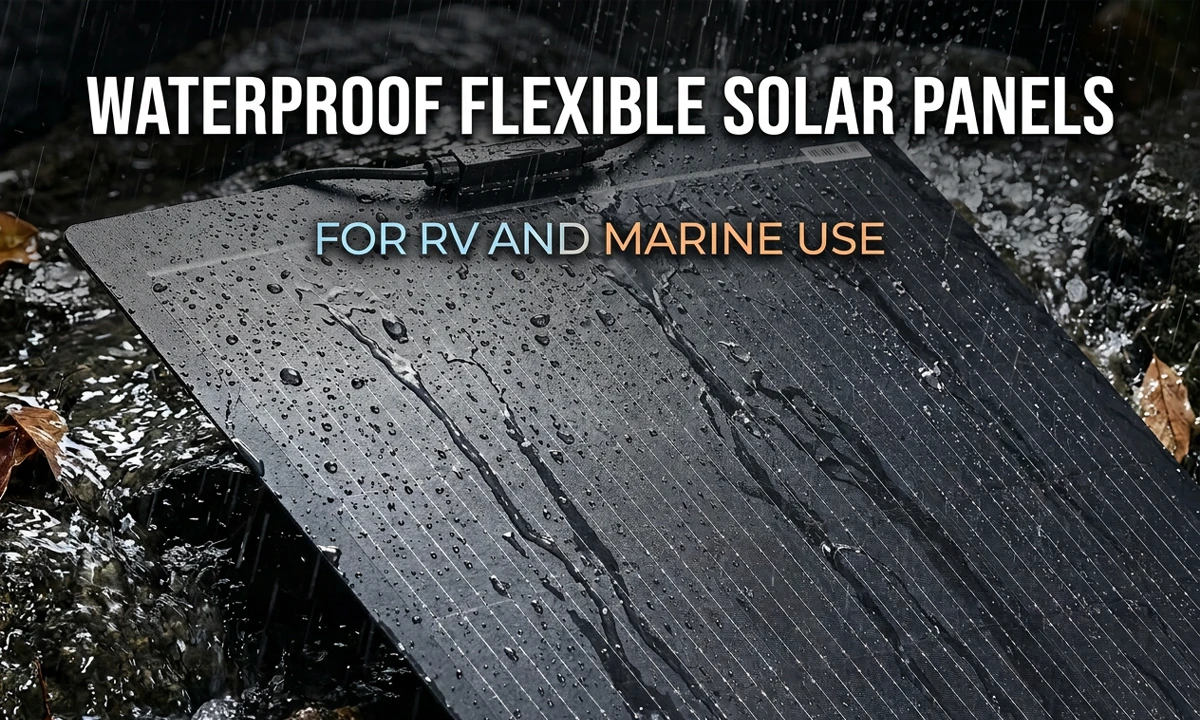
When people search for waterproof flexible solar panels, they are usually asking more than whether the panel can get wet. They want to know whether it will remain reliable after rain, washing, road vibration, salt spray and repeated outdoor exposure.
A flexible solar panel may be suitable for some RV and marine applications, but the panel surface is only one part of the installation. The junction box, cable exit, connectors, mounting surface, drainage path and heat management all affect the result.
Key Takeaways
- Waterproofing depends on the complete installation, not only the panel surface.
- Cable exits, junction boxes and connectors need the same attention as the laminate.
- RV roofs and marine decks have different vibration, spray, salt and maintenance conditions.
- Adhesive selection, drainage and heat management should be reviewed before installation.
- The exact model and its documentation matter more than the word “waterproof” in a product description.
Will Waterproof Flexible Solar Panels Stay Dry on an RV or Boat?
A flexible solar panel installed on an RV roof may be exposed to rain, road spray, washing water and large temperature changes. On a boat, the environment can be more demanding because of humidity, saltwater spray, deck movement and limited maintenance access.
This does not mean that flexible panels cannot be used in these applications. It means the installation should be evaluated as a complete system. Water may still reach vulnerable areas through the panel edge, junction box, cable exit, connector, roof penetration or a low point where water collects.
A product description that only says “waterproof solar panel” is not enough to confirm whether the panel is suitable for a particular RV roof or boat deck. The more useful question is: How is the complete panel and cable system protected in the actual installation environment?
Where Can Water Enter the Installation?
Most users first look at the surface of the panel. In practice, the connection areas often deserve more attention.
| Area | What can go wrong |
|---|---|
| Panel surface | Scratches, cracks or damaged layers may reduce protection. |
| Panel edge | Exposed layers or edge damage may allow moisture to enter. |
| Junction box | Poor protection or mechanical stress may affect the connection. |
| Cable exit | Movement can place stress on the sealing point. |
| Connectors | Loose, mismatched or exposed connectors may collect moisture. |
| Mounting surface | Uneven bonding can leave water paths underneath. |
| Cable routing | Low points may hold water or allow cables to rub against the surface. |
The panel edge is especially important on curved or frequently moving surfaces. If an edge lifts, bends sharply or rubs against another object, the issue is not only cosmetic. It may also increase the chance of moisture reaching the internal structure.
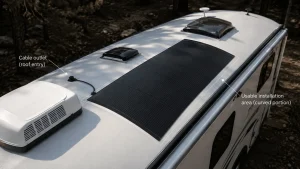
Cable routing should be planned at the same time as panel placement. A cable that looks acceptable during installation may later rub against an air conditioner housing, roof edge or deck fitting. On an RV, repeated road movement can make this problem worse. On a boat, cable movement can combine with salt and moisture exposure.
Can You Glue a Flexible Solar Panel Directly to the Surface?
Direct bonding can be practical in some installations, but it should not be treated as the default solution for every roof or deck.
RV and marine surfaces may include coated metal, fiberglass, FRP, painted substrates, composite materials or membrane roofing. These surfaces do not all behave in the same way, and an adhesive that bonds well to one material may not be suitable for another.
Before bonding, confirm whether the surface is clean, dry and sound; whether the adhesive is compatible with the surface and panel backing; whether the bonding method leaves a practical route for water to drain; whether the panel can be removed later; and whether the cable exit and junction box can be protected.
Adhesive compatibility is not the same as waterproofing. A strong bond does not automatically protect a cable exit, and a sealed edge does not solve a poor drainage layout.
Full bonding can also reduce airflow behind the panel. This may simplify the appearance of the installation, but it can make heat management more difficult on dark roofs or decks exposed to strong sunlight.
For EPDM or other membrane surfaces, review the membrane, adhesive and panel backing together. See also: Flexible Solar Panels on EPDM Roofs.
How Should Cables and Junction Boxes Be Protected?
A well-positioned cable can prevent several problems later. A poorly positioned cable can create a maintenance issue even when the panel itself is working normally.
Cable exit position
Before ordering or installing the panel, check which side the cable should exit from, whether it crosses a curved area, whether the exit point is exposed to standing water, whether it passes through the roof or deck, whether it can be secured without sharp bends, and whether it remains accessible for inspection.
A cable exit should not be placed where water naturally collects. Keep it away from areas that are stepped on, rubbed by equipment or exposed to repeated movement.
Junction box location
The junction box should be protected but still accessible. Hiding it under another component may make the installation look cleaner, but it can make future inspection difficult. On an RV, avoid contact with roof equipment, luggage and cleaning tools. On a boat, consider spray exposure, deck traffic and salt residue.
Connector protection
Check the connector type, polarity, mating method, outdoor installation conditions, cable support and compatibility with the charge controller, inverter or power station. Do not leave the connector loosely resting where water can collect.
Does a Waterproof Panel Still Need Airflow?
Yes. Waterproofing and heat management solve different problems.
Waterproof flexible solar panels still need a mounting approach that allows the installation to manage heat and water in a predictable way. A sealed surface does not remove the need to review airflow, drainage and service access.
A waterproof panel may resist moisture, but it can still operate at a higher temperature if its back surface has little airflow. Heat can be affected by the distance from the mounting surface, roof or deck material, local airflow, surrounding equipment, bonding method and installation orientation.
An air gap may improve ventilation, but it also introduces wind loading, additional fixing points, cable-support requirements, greater installation height and water-management considerations. There is no universal rule that every flexible panel needs an air gap or that every panel should be fully bonded.
A higher-wattage panel also needs to be matched with the rest of the system. The charge controller, power station or battery system must accept the panel’s operating voltage and current.
For a general explanation of how PV modules form part of a complete electrical system, see the U.S. Department of Energy’s Solar Photovoltaic Technology Basics.
See also: 400W Flexible Solar Panels: Size, Weight and System Matching.
What Changes Between RV and Marine Installation?
| Factor | RV installation | Marine installation |
|---|---|---|
| Main water exposure | Rain, washing and road spray | Spray, humidity and saltwater |
| Mechanical conditions | Road vibration and roof movement | Deck movement, vibration and impact |
| Surface concerns | Roof coating, vents and curved areas | Deck material, walkways and drainage |
| Maintenance | Vehicle cleaning and roof access | Salt cleaning and limited access |
| Cable risks | Roof penetrations and moving parts | Spray exposure and corrosion concerns |
| Layout priority | Avoid vents and maximize usable roof area | Avoid walkways and preserve drainage |
For an RV, the main concern may be whether the panel remains attached and the cable stays protected during driving and cleaning. For a boat, the installation may need to cope with salt residue, limited access, frequent moisture and a surface used for walking or equipment handling.
A panel that works well on an RV roof should not automatically be described as suitable for marine use without reviewing the actual environment and installation method.
When Is a Flexible Panel Not the Right Choice?
- The installation area is regularly walked on.
- Water remains on the surface for long periods.
- The surface material has not been identified.
- Adhesive compatibility cannot be confirmed.
- The junction box cannot be protected.
- The panel must be removed frequently.
- The available area cannot provide enough power.
- The panel would block a hatch, vent or drainage route.
- Evidence for the exact model and marine environment is not available.
- The installation requires structural support that the flexible panel cannot provide.
In these situations, changing the layout or considering a different panel construction may be more appropriate than forcing a flexible panel into an unsuitable location.
What Should You Confirm Before Ordering?
Application
- RV roof, boat deck or another surface;
- Freshwater or saltwater environment;
- Stationary or frequently moving installation;
- Expected exposure to rain, spray and washing.
Available space
- Usable length and width;
- Curved or irregular areas;
- Roof vents, hatches and equipment;
- Drainage paths;
- Required cable exit direction.
Mounting conditions
- Surface material;
- Adhesive or mechanical fixing;
- Need for an air gap;
- Available maintenance access;
- Areas exposed to walking, rubbing or impact.
Electrical requirements
- Target power;
- Charge controller, battery or power station model;
- Required voltage and current;
- Connector type;
- Cable length and routing direction.
Technical documents
Ask for documents that apply to the exact model, such as the product datasheet, installation instructions, junction box information, cable and connector details, recommended mounting conditions, cleaning guidance and applicable environmental or test documentation.
The more clearly these conditions are defined, the easier it is to decide whether a standard panel will work or whether the dimensions, cable position or mounting method should be adjusted.
Final Thoughts
Waterproof flexible solar panels can be a practical option for some RV roofs and marine installations, but the decision should not be based on the word “waterproof” alone.
The more important question is whether the panel, edge sealing, junction box, cable routing, connectors, mounting surface, drainage and heat management work together in the intended environment.
For an RV, that may mean checking road vibration, washing and roof equipment. For a boat, it may mean reviewing saltwater exposure, deck movement, maintenance access and drainage.
If you are evaluating a flexible solar panel for an RV or marine project, provide the available surface dimensions, mounting material, target power and cable exit requirements. These details are more useful than choosing a panel based only on its advertised waterproofing.
Frequently Asked Questions
Are all flexible solar panels waterproof?
Not necessarily. Verify the complete panel construction, edge sealing, junction box, cable exits, connectors and installation instructions for the exact model. A waterproof surface alone does not confirm that the full installation will remain protected.
Can waterproof flexible solar panels be installed on an RV roof?
They may be suitable for some RV roofs, depending on the roof material, curvature, mounting method, cable routing, drainage and heat conditions. The layout should also avoid vents, air conditioners and areas that may damage the panel or cables.
Are waterproof flexible solar panels suitable for boats?
Some flexible panels may be considered for marine applications, but saltwater spray, humidity, vibration, deck movement and maintenance access should be reviewed first. Marine suitability should not be assumed only because a panel is described as waterproof.
Does a waterproof flexible solar panel still need heat management?
Yes. Water protection and heat management are separate design issues. A panel can resist moisture while still operating in a hot, poorly ventilated installation. The mounting method should be selected according to the surface, airflow, drainage, wind exposure and maintenance requirements.