




Battery, inverter, microinverter, or complete kit shipments may need additional checks beyond a standalone solar panel shipment.
For a distributor, an import problem is not always caused by a missing document. It can also start with documents that describe the same shipment differently.
The invoice may show one model name, the packing list another description, and the product label a third reference. A certificate may cover a related model but not the configuration being shipped.
This guide focuses on the document chain that should be checked before solar panels leave the factory. It is not a substitute for destination-country customs advice. The importer, customs broker, and local authority should confirm the final entry requirements.
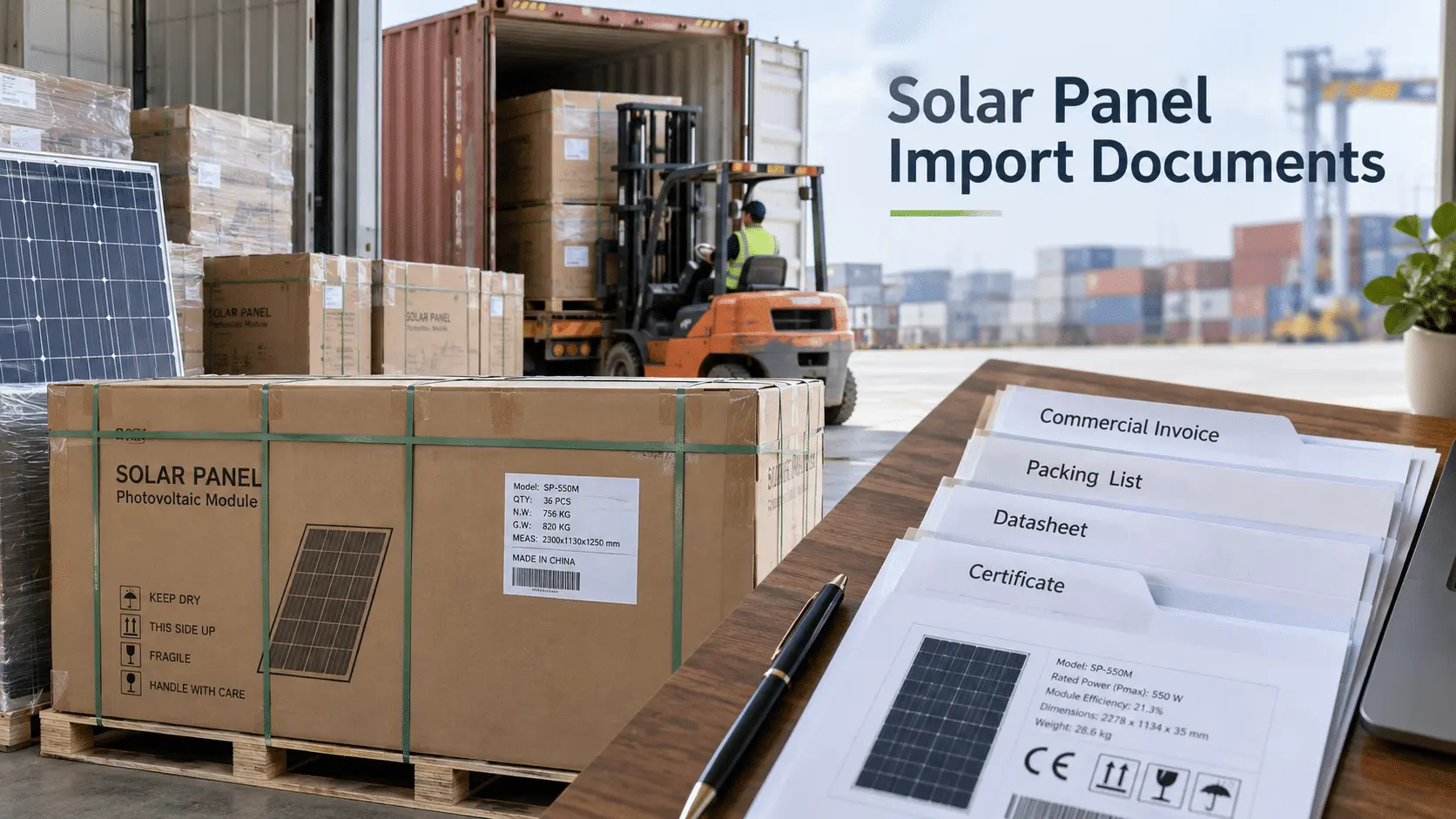
Solar Panel Import Documents at a Glance
| Document or Record | Main Purpose | Buyer Should Check |
|---|---|---|
| Commercial invoice | Declares seller, buyer, value, terms, and goods | Description, quantity, value, currency, Incoterm, and origin |
| Packing list | Identifies the physical shipment | Carton count, model by carton, weights, and dimensions |
| Product datasheet | Explains technical characteristics | Exact model, electrical data, dimensions, cables, and connectors |
| Product and carton labels | Supports product identification and receiving | Model number, rating information, barcode, and serial format |
| Certificate or test report | Supports market or project requirements | Model scope, issuing body, date, standard, and market relevance |
| Origin document | Supports origin and tariff review | Country of origin and destination-specific wording |
| Manual and packaging files | Supports sales and customer use | Language, warnings, installation limits, and model consistency |
The final document list depends on the destination country, product category, shipment value, transport method, and whether the order includes batteries or power electronics.
1. Commercial Invoice for Solar Panel Imports
The commercial invoice is one of the first documents reviewed during customs clearance. It should identify the transaction clearly enough for the buyer, broker, carrier, and customs authority to understand what is being shipped.
Check that it includes:
- Exporter and importer information
- Invoice number and date
- Product description and model or part number
- Quantity, unit price, total value, and currency
- Incoterm and payment information where required
- Country of origin
- Shipment or purchase-order reference
Avoid vague descriptions such as “solar goods” or “PV items” when the product can be described more precisely. The invoice description should not conflict with the product label, packing list, datasheet, or purchase order.
For HS classification, the supplier may provide a reference, but the importer or customs broker should confirm the code for the destination market and exact product configuration.
2. Packing List and Carton-Level Information
The packing list explains how the shipment is physically arranged. This becomes especially important when one container includes several panel models, private-label products, or mixed accessories.
Before shipment, check:
- Total cartons, pallets, and carton number sequence
- Model and quantity inside each carton
- Net weight, gross weight, and carton dimensions
- Pallet details and shipping marks where applicable
- Whether the carton labels match the packing list
A packing list is not a replacement for the commercial invoice. The invoice explains the commercial transaction, while the packing list explains the physical load.
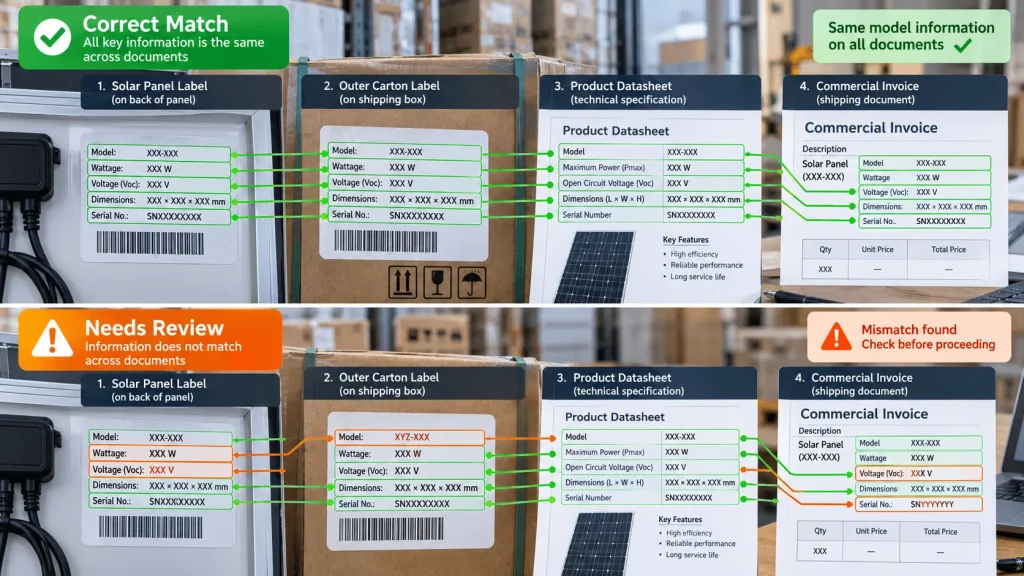
3. Model, Label, and Datasheet Consistency
Model consistency is one of the most useful pre-shipment checks because it connects the commercial file to the physical product.
Compare the model information across:
- Purchase order and approved quotation
- Commercial invoice and packing list
- Product datasheet and drawing
- Product label and carton label
- Certificate or test report
- User manual and sample approval record
Review the model number, rated power, voltage, dimensions, connector, cable length, junction box position, and serial-number format. If a custom panel has been revised after sampling, ask the supplier to identify the new revision and confirm which documents still apply.
This check should be completed after the technical quotation is agreed. For a broader method of comparing technical scope, packaging, delivery terms, and documentation between suppliers, see Sungold’s solar panel quote comparison guide.
4. Certificates and Test Reports
A certificate or test report should be treated as model-specific evidence, not as a general label for an entire product category.
Before using a document for import, resale, or project submission, verify:
- Exact model or covered model family
- Product construction and relevant revision
- Issuing organization
- Applicable standard or test method
- Report date and stated scope
- Target-market relevance
Do not assume that a document for one panel series covers every wattage, custom size, cable arrangement, or complete kit. For a deeper review of model scope, test reports, and certification boundaries, use the flexible solar panel certification guide.
5. Country of Origin and Destination-Market Checks
Country of origin is not always the same as the country from which the goods are shipped. The importer should confirm the declared origin and whether an origin certificate or origin statement is required for the destination market.
Check:
- Origin shown on the commercial invoice
- Origin information on any origin document
- Whether preferential tariff treatment is being claimed
- Whether the wording matches the relevant trade arrangement
- Whether the importer has supporting records
Origin and tariff treatment should be confirmed with the importer or customs broker. The supplier should not be asked to use wording simply because it appears more convenient for the buyer.
Official guidance in different markets shows that commercial invoices, packing lists, origin statements, and other supporting documents can have different roles. Requirements must therefore be checked by destination rather than copied from another shipment.
6. Packaging, Manuals, and Private-Label Files
For distributors, the document pack also supports warehouse receiving, sales, installation, and after-sales work.
Request the final versions of:
- Product label and carton artwork
- Barcode or SKU information
- User manual and installation instructions
- Warning labels and application limits
- Private-label files where applicable
- Warranty or service documents where applicable
The model shown on the carton should match the model on the datasheet and invoice. The manual should not show a different cable arrangement, connector, or installation method from the delivered product.
If the shipment is private label, confirm which information must remain on the product and which information can be customized.
7. Additional Documents for Solar Kits and Power Electronics
A standalone solar panel may have a simpler document package than a complete solar kit.
Ask for a separate review when the shipment includes:
- Batteries or battery-containing products
- Portable power stations
- Inverters or microinverters
- Charge controllers
- Pre-wired cables, adapters, or complete kits
These components may involve different transport, labeling, safety, market-entry, or installation requirements. Do not treat a complete kit as a single product simply because it is packed in one box.
The importer should identify the main components and ask the customs broker or local authority whether additional documents are needed for each one.
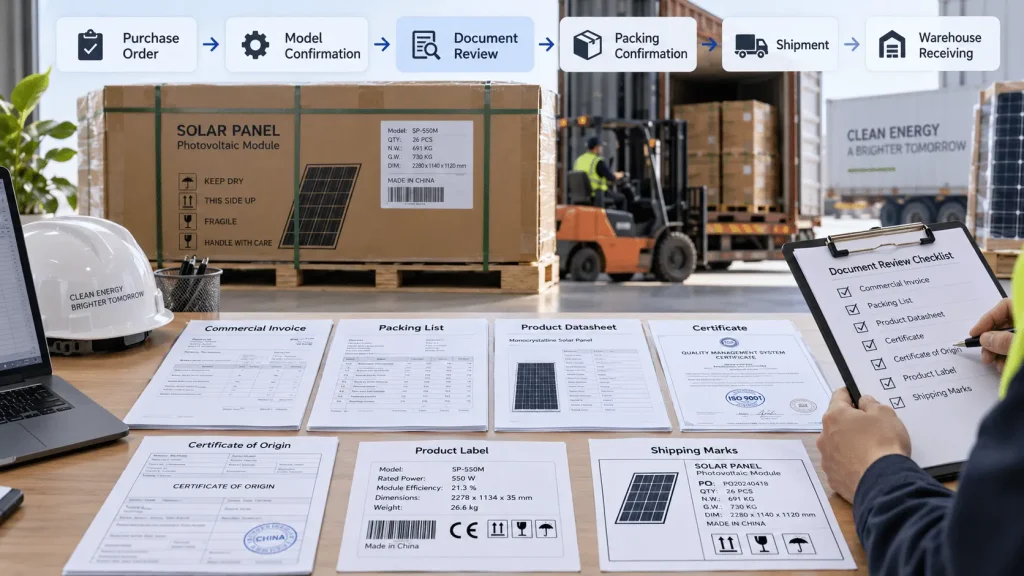
8. Pre-Shipment Document Checklist for Distributors
Before approving shipment, request one folder containing:
- Final commercial invoice
- Final packing list
- Final datasheet and approved model list
- Product and carton label files
- Certificate and test-report list
- Origin document where applicable
- Shipping marks and carton photos
- Manual and target-market language files
- Sample approval record
- Serial number or batch information where applicable
| Buyer Check | Pass Condition | Follow-Up If Not Confirmed |
|---|---|---|
| Model matches purchase order | Same model and revision | Request written model-change confirmation |
| Invoice and packing list match | Same description and quantity basis | Correct the document set before shipment |
| Certificate covers the product | Scope matches model and construction | Request a scope or applicability statement |
| Labels match technical files | Same model and rating information | Update artwork or product records |
| Destination requirements confirmed | Broker or local authority has reviewed them | Hold shipment-specific assumptions for review |
This review is different from a full supplier evaluation. For questions about sample approval, production control, packaging, and repeat orders, use the flexible solar panel supplier bulk-order guide.
9. FAQ About Solar Panel Import Documents
What documents should a solar panel distributor request before shipment?
Start with the commercial invoice, packing list, product datasheet, approved model list, product labels, and any certificates or origin documents relevant to the destination market. Confirm the final list with the importer’s customs broker.
Does every solar panel shipment need the same import documents?
No. Requirements vary by country, product type, shipment value, transport method, and whether the shipment includes batteries, inverters, microinverters, or a complete kit.
Can a supplier confirm all import requirements?
A supplier can prepare product and shipment documents, but the importer, customs broker, and local authority must confirm destination-specific customs, tax, market-entry, and installation requirements.
Final Thoughts
Import documentation is part of product quality for a distributor.
A panel can arrive physically intact and still create problems if the model, label, invoice, certificate, or packing list does not match. The earlier these differences are found, the easier they are to correct.
Before shipment, review the document pack against the purchase order and approved sample. Check product identity, commercial information, origin, certificates, packaging, and any additional requirements for batteries or power electronics.
The goal is not to collect the largest possible number of files. The goal is to create a consistent, traceable document pack for the exact shipment.
Source boundary: Import and origin requirements vary by destination market. Buyers should confirm the final requirements with the relevant customs authority or licensed customs broker. See GOV.UK origin guidance, EU Access2Markets customs guidance, and U.S. CBP commercial invoice guidance.