




For a custom project, confirm panel dimensions, junction box position, cable exit, connector type, and mounting method before ordering.
When someone asks for solar panels for a van, the useful question is not simply how many watts will fit on the roof. The real question is whether the panel layout, battery system, cable route, and daily loads work together.
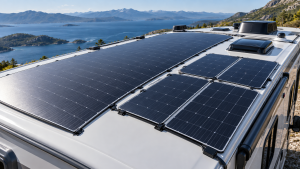
A van roof often has vents, air-conditioning equipment, roof racks, skylights, and service areas. These details can make a standard panel difficult to place. They also affect shading and cable routing.
Solar Panels for Van Conversions Start With the Roof Layout
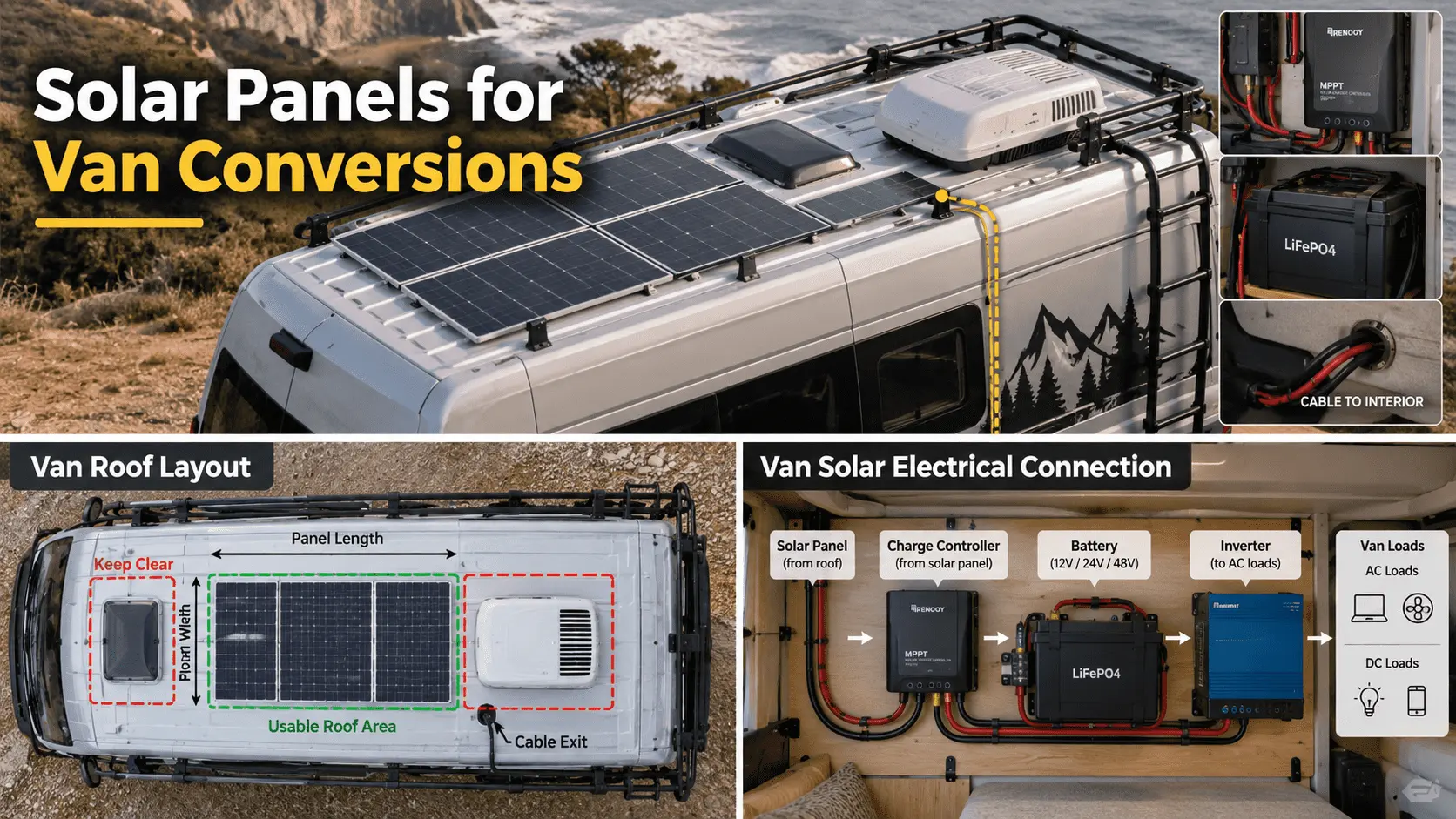
Measure the usable roof area rather than the total roof area. Mark every obstruction and leave enough clearance for installation and future service.
Before selecting a panel, record:
- Usable roof length and width
- Curved or uneven roof sections
- Vents, air conditioners, skylights, and roof racks
- Likely cable-entry location
- Areas that may be shaded during the day
- Space needed to clean or remove the panel
A longer, narrower panel may use a difficult roof section better than a standard square panel. This is one reason custom dimensions can be useful for van conversion projects.
Flexible or Rigid Solar Panels for a Van
Flexible panels can be considered when the roof is curved, added weight must be controlled, or a low-profile layout is important. Rigid panels may be a better fit when the roof is flat and the buyer wants a raised mounting structure with easier access below the panel.
| Project Condition | Flexible Panel Direction | Rigid Panel Direction |
|---|---|---|
| Curved or interrupted roof | Can fit selected roof contours and narrow spaces | May need a rack or additional structure |
| Low-profile requirement | Usually supports a closer-to-roof layout | Mounting hardware adds height |
| Heat and service access | Requires careful fixing and heat review | Raised mounting can make inspection easier |
| Replacement planning | Removal can be more involved if bonded | Rack-mounted replacement may be more straightforward |
Flexible does not automatically mean easier to install or suitable for walking on. Confirm the fixing method, roof material, heat exposure, drainage, and service plan for the specific project.
For a more detailed comparison, see flexible solar panels vs rigid solar panels for RV and marine applications.
Match Van Solar Panels With the Battery and Controller
The electrical system should be checked before the final panel configuration is selected.
- Battery system voltage
- Charge controller input voltage and current limits
- Series or parallel connection plan
- Cable length and cable size
- Connector type and polarity
- Inverter input and output requirements
- Portable power station limits, if used
A 12V battery system does not make every 12V-labelled panel configuration compatible. The panel voltage, controller range, wiring arrangement, and battery charging profile must work together.
A connector that fits physically also does not prove electrical compatibility. Before combining panels or connecting to a power station, check the accepted PV voltage range and current limit. Sungold’s solar panel compatibility guide explains this check in more detail.
How Many Solar Panels Does a Van Need?
There is no single panel count for every van conversion. The answer depends on the appliances, daily runtime, battery reserve, available sunlight, and backup charging options.
Typical loads may include:
- LED lighting and device charging
- Fans and communication equipment
- Water pumps
- A 12V refrigerator
- Laptops, cameras, and small tools
- Kitchen appliances connected through an inverter
Separate four questions when sizing the system:
- How much energy do the loads use each day?
- How much battery storage is available?
- How much solar input can the roof accept?
- Can the inverter support the continuous and startup loads?
The solar panel charges the battery when sunlight is available. The battery and inverter support loads when sunlight is weak or unavailable.
Van Solar Panel Cable Routing and Installation Details
Cable routing is easy to overlook in an early design and difficult to change after the panel has been installed.
Confirm the cable length, exit direction, junction box position, roof-entry point, connector, polarity, sealing method, and distance from roof hardware.
A marked-up roof drawing should show the panel outline, vents, racks, cable route, controller location, and service clearance. For cable sizing on longer runs, see the RV and marine wire sizing guide.
Custom Solar Panels for Van Conversion Projects
Custom flexible solar panels may be useful when standard dimensions leave unused roof space or conflict with roof equipment.
Project customization may involve panel length and width, electrical configuration, cable length, cable exit position, junction box location, connector selection, labels, and packaging.
For a custom RFQ, send the supplier the roof drawing, target wattage, battery voltage, controller information, cable requirements, and expected order quantity. Sungold’s custom solar panel solution can be used as a starting point for this type of project review.
Van Solar Panel RFQ Checklist
Include the following information when requesting a quotation:
- Van model or roof layout
- Usable panel area and roof shape
- Required wattage and battery voltage
- Charge controller or power station model
- Cable length, exit position, and connector type
- Mounting method and roof material
- Shade and service-access conditions
- Sample quantity and target order volume
- Packaging, labeling, and private-label requirements
FAQ About Solar Panels for Van Conversions
Are flexible solar panels suitable for a van roof?
They can be suitable when the roof is curved, weight is limited, or a low-profile layout is preferred. The fixing method, heat conditions, cable route, and service plan still need to be confirmed.
Can solar panels run every appliance in a van?
Not automatically. The result depends on solar input, battery capacity, inverter limits, daily energy use, sunlight, and any backup charging source.
Can I order custom solar panels for a van roof?
Custom dimensions, cable positions, junction box locations, connectors, labels, and packaging can be reviewed for project-specific orders. A roof drawing is recommended before quotation.
Final Thoughts
The right solar panels for a van are not selected by wattage alone. The roof layout, battery system, controller, cable route, installation method, and maintenance plan all affect the final choice.
For a conversion project, confirm these details before ordering. A clear drawing and complete RFQ give the supplier enough information to recommend a workable configuration rather than a panel based only on its nameplate rating.