 EN
EN
 Deutsch
 Italiano
 Español
 Français
 日本語
日本語
Plug-in solar panels 800W are now a serious small-solar category, but the meaning of “800W” depends on the market. In Great Britain, compliant plug-in solar products can be bought and used from August 27, 2026. In Germany, the common boundary is 800 VA inverter output with up to 2,000 W module capacity under the special plug-in device rules. In the United States, there is no single national 800W plug-in solar rule, so retailers and kit brands need to check state, utility, AHJ, and certification requirements before selling.
Last updated: August 28, 2026. This guide updates the older 2025 plug-in solar article with current market boundaries, buyer checks, and B2B product language for distributors, retailers, OEM/ODM kit brands, and small-system buyers.
An 800W plug-in solar panel system usually means a compact PV kit with solar modules, a microinverter, mounting hardware, cable, plug pathway, labels, and user instructions. It is designed to reduce household daytime grid consumption, not to replace a full rooftop PV system. For B2B buyers, the main question is not only whether 800W plug-in solar is “worth it.” The more important question is whether the exact kit is legal to sell, safe to connect, clear to install, and supportable after delivery.
Quick Answer: Are 800W Plug-In Solar Panels Worth It in 2026?
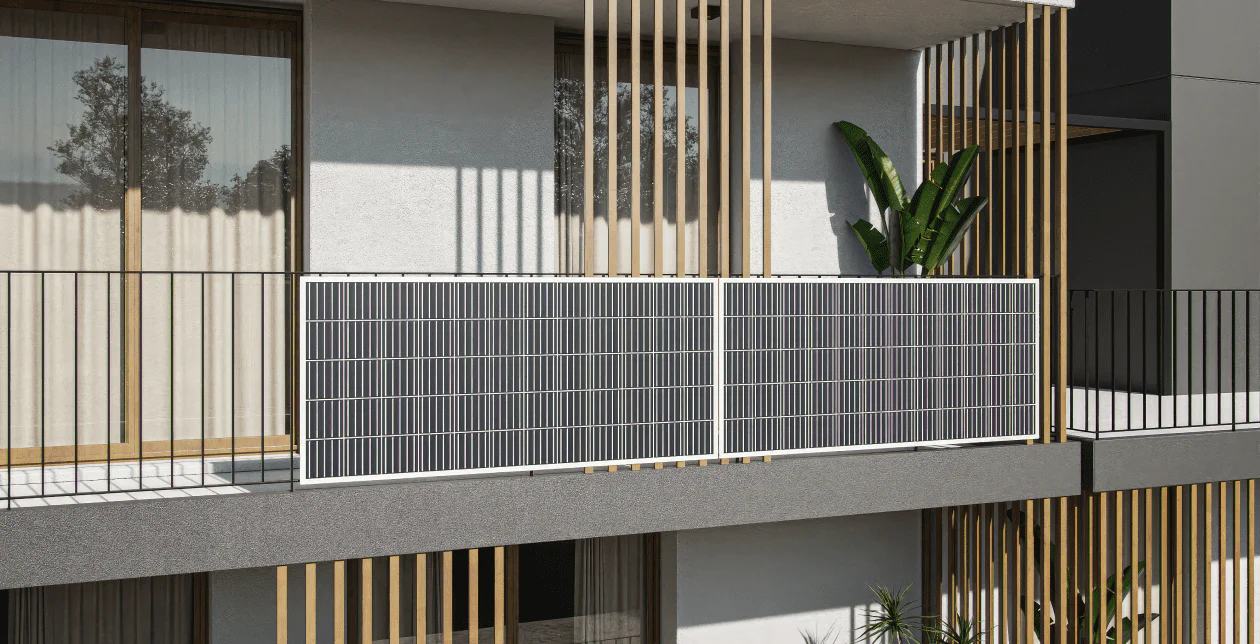
Yes, 800W plug-in solar panels can be worth it when the product matches the local rules, the user has daytime loads, and the installation position receives useful sunlight. The strongest fit is usually apartments, balconies, terraces, rental properties, and small homes where a full rooftop system is impractical. The weakest fit is a shaded balcony, an unclear socket route, or a product listing that treats every 800W kit as compliant in every country.
For a retailer or distributor, the commercial value comes from a complete, documented kit rather than a loose bundle of panels and inverter. The product page should separate PV module wattage from microinverter AC output, state the intended market, clarify battery boundaries, and give users realistic permission and installation checks.
What Is an 800W Plug-In Solar Panel System?
An 800W plug-in solar system is a small grid-connected PV device designed to feed power into a household circuit through a defined plug and socket route where local rules allow it. A typical kit includes one or two solar panels, a microinverter, mounting hardware, AC cable, plug, user manual, safety labels, and registration or compliance documents.
The system is different from a portable solar panel that charges a power station, and it is also different from a conventional rooftop solar installation. Plug-in solar is meant to offset daytime household consumption. It normally shuts down when grid power is lost because certified grid-connected inverters require anti-islanding protection.
| System Type | Typical Scope | Buyer Risk |
|---|---|---|
| 800W plug-in solar kit | PV modules, microinverter, mounting, plug/cable path, labels, manual, registration guidance | Rules depend on country, socket route, inverter output, product specification, and property permissions |
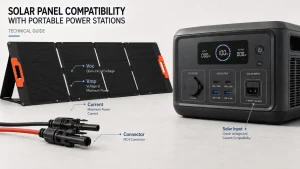
| Portable solar plus power station | DC solar panel charging a battery or portable power station | Not the same as grid-connected plug-in solar; should not be described as a plug-in grid product |
| Traditional rooftop PV | Multi-kW array, inverter, fixed electrical work, permits, installer commissioning | Higher output and more formal installation, but not the same consumer route as plug-in solar |
Why 800W Does Not Mean the Same Thing in Every Market
The phrase “800W plug-in solar” is easy to search but easy to misread. In product design and compliance review, 800W can refer to PV module capacity, inverter AC output, or a market-specific limit. These are not interchangeable values.
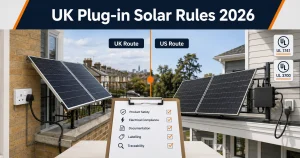
| Market | Current 2026 Position | What B2B Buyers Should Check |
|---|---|---|
| Great Britain | Compliant plug-in solar products can be bought and used from August 27, 2026. Government materials describe kits producing up to 800W, while product eligibility depends on the defined safety and product framework. | Check the exact device scope, plug pathway, interim product specification, G98-related status, user guidance, and whether the product is PV-only or includes storage. |
| Germany | Special plug-in device rules use an 800 VA inverter output boundary and up to 2,000 W installed module capacity, with simplified grid-operator notification but continued registration in Marktstammdatenregister. | Separate PV module wattage from inverter VA, confirm VDE/FNN connection guidance, registration instructions, and whether multiple devices are counted behind the same connection point. |
| United States | The US does not have one nationwide 800W plug-in solar rule. The market discussion is developing around state-level legislation, utility acceptance, AHJ interpretation, and standards such as UL 1741 and UL 3700. | Do not copy European claims. Check local electrical code, utility interconnection path, outlet assumptions, complete-kit certification scope, labels, and property rules. |
For a deeper market-specific review, see Sungold’s UK plug-in solar rules 2026 retailer checklist and the separate guide on UL 1741 vs UL 3700 for plug-in solar kits.
Great Britain 2026: What Changed for Plug-In Solar Panels?
From August 27, 2026, compliant plug-in solar panels became legal to buy and use across Great Britain. GOV.UK states that each plug-in solar kit can produce up to 800W and that households may save up to GBP110 per year, depending on use and conditions. That makes Great Britain one of the clearest new retail opportunities for this product category.
The important B2B boundary is that the route is not a blanket approval for any product with a plug. The UK consultation outcome links the route to amendments around plugs and sockets and an interim product specification. It also states that the interim product specification applies to plug-in solar products only and does not extend to other plug-in technologies such as plug-in batteries.
Germany and the 800 VA Rule: PV Watts vs Inverter Output
Germany remains an important reference market for balcony solar. The German regulator describes special rules for plug-in solar devices with up to 2,000 W installed module capacity and 800 VA inverter output. It also states that plug-in solar devices still need to be registered in the Marktstammdatenregister, while grid-operator notification is simplified within the defined conditions.
For kit brands, this distinction should be visible in every quotation and product listing. A two-panel package may have more DC panel wattage than its AC inverter output. If a listing says “800W system” without explaining whether that means DC modules or AC output, buyers can misunderstand the compliance position.
United States: Why an 800W Plug-In Solar Claim Needs More Caution
In the United States, an 800W plug-in solar system should not be marketed as automatically legal nationwide. The product may need to satisfy local utility interconnection rules, AHJ expectations, property rules, and safety certification requirements. UL Solutions launched a plug-in solar certification program in 2026 based on UL 3700, while UL 1741 remains central to grid-interactive inverter and interconnection discussions.
For US-facing product pages, the safer claim is specific: describe the inverter listing, complete-kit evaluation status if available, intended outlet assumptions, installation requirements, and state or utility verification needs. Avoid writing “no permit” or “no electrician” unless the exact jurisdiction and product pathway support that statement.
How Much Power Can an 800W Plug-In Solar System Produce?
An 800W rating is a peak output reference, not a promise that the system will produce 800W all day. Real output depends on sunlight, tilt angle, orientation, shading, season, panel temperature, inverter clipping, cable routing, and how much power the home can use during solar production hours.
| Factor | Why It Matters | Practical Check |
|---|---|---|
| Panel direction and tilt | A balcony or wall mount may receive less sun than a south-facing roof. | Check target market latitude, balcony direction, railing height, and seasonal shading. |
| Self-consumption | Plug-in solar is most valuable when the home uses power while the system is producing. | Match the kit to daytime loads such as refrigerator cycling, router, laptop, small appliances, or standby loads. |
| Output limit | The inverter AC output may be capped below the combined DC panel wattage. | State PV DC wattage and inverter AC output separately in product sheets. |
| Socket and circuit condition | Local safety depends on a suitable fixed socket, protection devices, and installation conditions. | Provide clear user guidance and avoid extension cords, damaged outlets, or unsupported DIY changes. |
If buyers ask what the system can run, answer with boundaries. An 800W plug-in solar system can offset part of daytime consumption when the sun is available. It should not be sold as backup power during outages unless it is part of a separately designed and compliant backup system.
How Do You Install 800W Plug-In Solar Panels?
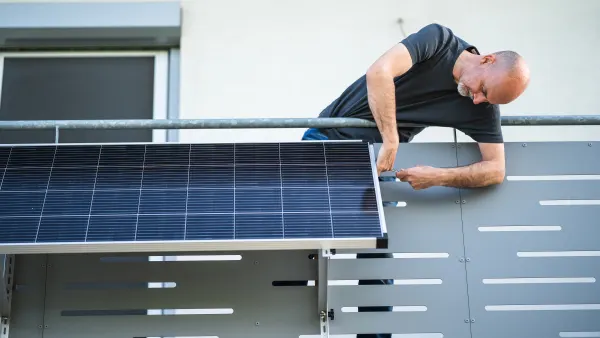
Installation depends on the local product pathway and property type, but the safe workflow is similar: confirm the product is intended for the market, inspect the mounting location, secure the panels, route cables without strain or water ingress, connect only through the approved plug/socket route, complete any required registration, and keep the manual available for the end user.
- Confirm the exact kit model, inverter output, plug type, cable length, and documentation.
- Check the property: balcony, terrace, wall, garden, railing, landlord/freeholder permission, and local planning limits.
- Check the socket route: fixed socket condition, weather protection, RCD/GFCI where required, and no unsupported extension cable use.
- Install mounting hardware according to the product manual and local wind-load assumptions.
- Connect the system only as described in the approved instructions.
- Complete registration or notification steps where required.
- Record the model, serial number, installation date, user manual version, and support contact.
For user-side process details, see the plug-in solar kit installation and removal guide.
What Should Retailers and Distributors Ask Before Ordering?
A useful 800W plug-in solar quotation should include more than panel wattage and carton quantity. For B2B procurement, ask the supplier to document the complete kit and the target market rather than only sending a low price.
- Target country and sales channel: Great Britain, Germany, wider EU, US state, online retail, installer channel, or private-label kit brand.
- PV module specification: wattage, size, cell technology, frame or lightweight format, connector, and mounting compatibility.
- Microinverter specification: AC output, voltage/frequency, anti-islanding protection, listing or certification evidence, and model-specific documents.
- Plug and cable design: plug type, cable length, outdoor rating, strain relief, labels, and user warnings.
- Battery boundary: whether storage is excluded, optional, or part of a separate product path.
- Documentation: user manual, installation guide, removal guide, registration instructions, conformity documents, carton labels, and after-sales support materials.
- Packaging: drop protection, accessory packing, label language, barcode, retail shelf needs, and spare-part plan.
For the UK path, the older home-suitability article on plug-in solar panels in the UK is a useful support page. For product selection, Sungold’s balcony solar panel solutions can be reviewed when buyers need kit-level customization.
When Is an 800W Plug-In Solar System a Good Fit?
An 800W plug-in solar system is a good fit when the buyer needs a compact, low-barrier solar product for daytime load offset and the local market has a clear route for compliant use. It is especially relevant for renters, apartments, small homes, balconies, terraces, garden installations, and retail channels that can support product education.
It is not the right fit when the buyer needs whole-home backup, high night-time consumption coverage, unclear socket wiring, heavy shading, or a product that will be sold across many countries with one generic compliance claim. In those cases, a rooftop PV system, portable solar-plus-storage kit, or market-specific product version may be more appropriate.
FAQ
Compliant plug-in solar products can be bought and used across Great Britain from August 27, 2026. However, this does not mean every 800W kit is automatically eligible. The exact product, plug route, documentation, and property permissions should still be checked before sale or installation.
It depends on the market and product listing. For compliance and quotation work, separate PV module DC wattage from microinverter AC output. Germany, for example, uses an 800 VA inverter output boundary for its plug-in device special rules, while the connected PV module capacity can be higher within the stated limit.
Battery wording needs caution. The Great Britain 2026 plug-in solar route is described for plug-in solar products and does not extend to plug-in batteries. If storage is included, treat it as a separate product configuration and verify the applicable local rules, standards, labeling, and user instructions.
There is no single national US rule that makes all 800W plug-in solar kits allowed. US buyers should check state law, utility interconnection rules, AHJ expectations, outlet assumptions, and certification scope. A UL 1741-listed inverter and a complete plug-in PV system evaluation are not the same claim.
Final Thoughts
800W plug-in solar panels are becoming easier to explain to consumers, but the B2B procurement work is becoming more detailed. The winning product is not just the cheapest 800W kit. It is the kit with a clear market position, documented inverter output, verified plug/socket route, installation and removal instructions, battery boundary, and compliance wording that matches the exact product being sold.
Source Notes: Regulatory and safety context should be checked against the latest official materials, including GOV.UK’s August 2026 plug-in solar announcement, the GOV.UK plug-in solar consultation outcome and interim product specification, the GOV.UK electrical safety study, Ofgem’s DCRP/MP/26/02 decision, the Bundesnetzagentur balcony solar guidance, and UL Solutions’ 2026 plug-in solar certification framework announcement. Local electrical rules, product listings, and property permissions should be confirmed before installation or resale.