 EN
EN
 Deutsch
 Italiano
 Español
 Français
 日本語
日本語
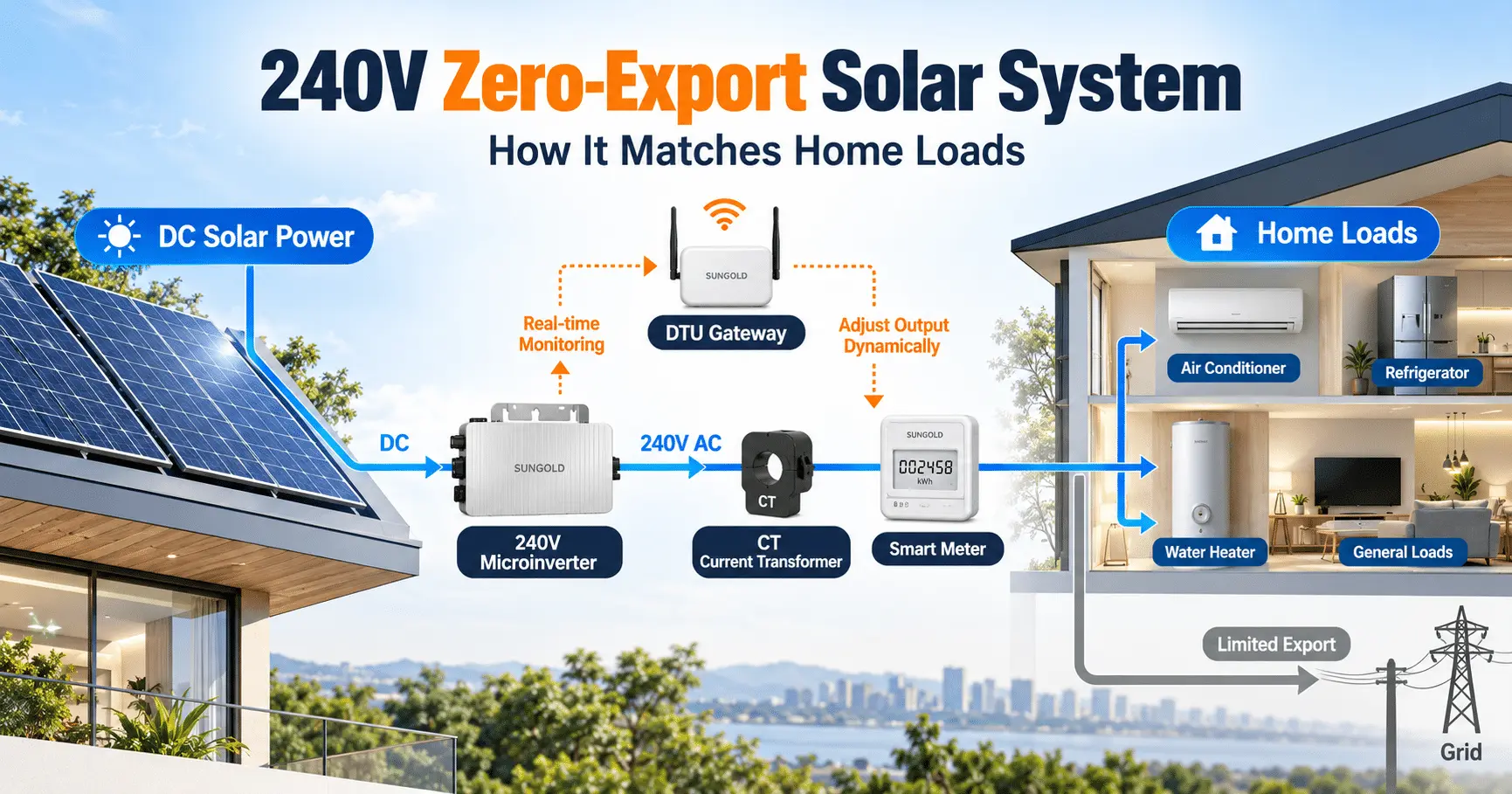
KEY TAKEAWAYSA 240V zero-export solar system uses a microinverter, CT sensors, a smart meter, and a DTU gateway to match solar output with household electricity demand.
The system can reduce unwanted grid export by measuring power flow and adjusting microinverter output. However, zero-export control does not automatically provide backup power or eliminate local electrical and interconnection requirements.
For homeowners, installers, and distributors, the key evaluation points are system compatibility, CT placement, communication performance, load-response behavior, curtailment, and complete installation cost.
Quick Answer: How Does a 240V Zero-Export Solar System Match Household Loads?
A 240V zero-export solar system matches household loads by measuring the power flowing between the property and the grid, then adjusting the connected microinverter output.
When household demand is higher than solar production, the system can use more available solar power. When solar production is higher than the current household demand, the control system can reduce output to limit unnecessary export.
The result depends on the microinverter, CT sensors, smart meter, DTU communication, electrical configuration, and local operating requirements. It should be evaluated as a complete energy-control system rather than as a simple 240V plug-in solar kit.
What Is a 240V Zero-Export Solar System?
A 240V zero-export solar system is a grid-connected solar arrangement designed to match solar output more closely with household electricity demand.
In a typical North American split-phase electrical system, the household distribution system uses two 120V hot lines. The voltage between the two lines is approximately 240V. A 240V microinverter can connect across these two lines instead of connecting to only one 120V branch.
This may allow the solar system to interact with both sides of the household distribution system. However, it should not be interpreted as meaning that the system can power every appliance in the house at all times.
| Term | More accurate meaning |
|---|---|
| Covering both sides of the panel | The connection reaches both sides of the split-phase system. |
| Powering the whole house | The solar output is sufficient for the household’s actual demand. |
| Backup power | The system continues operating when grid power is unavailable. |
A 240V connection may help the system serve loads across the distribution system, but actual performance still depends on solar capacity, household demand, system design, and grid conditions.
How Does a 240V Zero-Export Solar System Work?
A 240V zero-export solar system generally follows a continuous measurement and adjustment cycle:
- The solar panels generate DC electricity.
- The microinverter converts DC electricity into grid-connected AC power.
- CT sensors and a smart meter measure power flowing between the home and the grid.
- The control system compares solar output with household demand.
- The microinverter output is adjusted when necessary.
- The system continues measuring and adjusting as household loads change.
In simplified form: Measure power flow → compare generation with demand → adjust output → measure again.
This is the central difference between a basic grid-connected solar setup and a system designed for active export control. The system is not simply producing as much power as possible at all times. It is trying to coordinate generation with the load that exists at that moment.
What Components Are Needed for Zero-Export Solar?
The exact equipment depends on the manufacturer and system architecture, but the main components usually have separate responsibilities. A 240V zero-export solar system is only as dependable as the compatibility between its generation, measurement, communication, and control devices.
| Component | Main function |
|---|---|
| Solar panels | Generate DC electricity from sunlight. |
| Microinverter | Convert DC electricity into grid-connected AC power. |
| CT sensors | Measure the direction and level of current flow. |
| Smart meter | Monitor household import and export conditions. |
| DTU gateway | Communicate between monitoring equipment and microinverters. |
| Dedicated AC circuit | Provide the system’s electrical connection path. |
| Protection equipment | Support the electrical integration of the system. |
These devices cannot necessarily be combined at random. The microinverter, smart meter, CT sensors, and DTU may need to be compatible with one another. The manufacturer’s documentation should define which models can work together and how the equipment should be configured.
Hoymiles explains that its export-control solution relies on coordinated microinverter, smart meter, and DTU equipment. Review the official Hoymiles documentation before evaluating a specific configuration.
What Does the CT Meter Do?
The CT, or current transformer, measures the flow of electricity in a circuit without directly carrying the full load current through the measuring device.
In a zero-export system, the CT measurement helps the controller understand whether the home is drawing electricity from the grid, using solar energy locally, sending surplus electricity to the grid, or experiencing a change in demand.
The CT’s location, direction, and phase relationship matter. If the sensor is installed in the wrong position or facing the wrong direction, the system may misread import and export conditions.
This is why a zero-export system should not be evaluated only by looking at solar panel wattage. The measurement system is part of the control architecture.
What Is the Role of the DTU Gateway?
The DTU is a communication device that exchanges information between the microinverters, monitoring equipment, and control system.
Depending on the product design, the DTU may help with communication between microinverters and the monitoring platform, output-limit configuration, data collection, system-status monitoring, and control instructions to compatible devices.
The DTU does not replace the microinverter, CT sensor, or smart meter. It is part of the communication and control layer that allows these components to work together.
If communication is interrupted, the system’s response may depend on the specific equipment and configuration. Buyers should confirm how the system behaves during communication loss, sensor errors, or abnormal readings.
How Does Automatic Solar Output Limiting Work?
Consider two simplified operating situations.
When household demand is higher than solar production
If the home is using more electricity than the solar system is producing, the system may allow the microinverter to operate at a higher output, subject to its configured limits. The remaining electricity may still come from the grid.
When solar production is higher than household demand
If solar generation is higher than the household’s current demand and the system is configured to limit export, the controller may reduce the microinverter’s output.
This avoids treating the solar system as a device that must always operate at full output. In a zero-export configuration, some available solar energy may be curtailed when there is not enough local demand or storage capacity.
Limiting export can reduce unwanted grid export, but it may also reduce the amount of solar energy used at a particular moment.
What Does “Zero Export” Actually Mean?
“Zero export” should be treated as a control target, not as a guarantee that the grid will never detect any brief power flow.
Household loads can change suddenly, measurements take time to update, communication can introduce delays, and CT installation can affect measurement accuracy. Buyers should ask how the manufacturer defines zero export and how the system responds to fast load changes.
Hoymiles also emphasizes the importance of correct CT installation, phase relationships, communication, and real-time data for export-control functions. Review the official zero-export guidance before making installation assumptions.
Does Zero Export Mean the System Works During a Blackout?
No. Zero-export control and backup power are different functions.
A 240V zero-export solar system normally depends on the electrical grid and its inverter configuration. If the grid is unavailable, the system may need to shut down or change operating mode for safety.
Backup operation usually requires additional equipment and a system architecture designed for islanded operation. This may include a suitable battery, a backup-capable inverter, a transfer or isolation function, critical-load wiring, and a control system designed for backup operation.
Therefore, a zero-export solar system should not be understood as a backup system unless the manufacturer’s documentation specifically confirms that capability.
Can a 240V Solar System Power the Whole House?
The phrase “whole house” needs to be used carefully.
A 240V system may connect across both sides of a split-phase panel, but that does not mean the solar system can meet every household load at the same time.
Actual coverage depends on solar capacity, current sunlight, household demand, appliance starting loads, inverter output limits, the electrical connection, whether storage is included, and whether the grid is available.
A more accurate description is: The system may help offset household electricity demand across the distribution system, subject to its output and operating conditions.
Can This System Expand an Existing Solar Installation?
A zero-export microinverter system may be considered for expanding an existing solar installation, but compatibility must be checked carefully. For a 240V zero-export solar system expansion, the new equipment must be assessed alongside the existing inverter, monitoring, and protection arrangement.
- Does the monitoring system measure whole-house net power or only one branch circuit?
- Can it distinguish existing solar generation from the new system’s output?
- Can the DTU control only compatible new microinverters?
- Will the existing inverter affect the measurement?
- Does the system support the proposed connection architecture?
- Are the protection and interconnection requirements still satisfied?
Seeing whole-house power does not necessarily mean the controller can control every solar device connected to the property. A system may measure total import and export while controlling only the microinverters in its own compatible ecosystem.
What Should Be Checked Before Choosing This Setup?
Electrical configuration
- Is the property using a compatible 120/240V split-phase system?
- Is a dedicated circuit required?
- What protection equipment is specified?
- Which electrical work must be completed by a qualified professional?
Equipment compatibility
- Which microinverter models are supported?
- Which smart meter and CT sensors are compatible?
- Is the DTU required?
- Can the system be expanded later?
- How does the system behave if communication is interrupted?
Measurement and control
- Where should the CT sensors be installed?
- How should CT direction be verified?
- Does the system measure whole-house or branch-circuit power?
- How quickly does the output respond to load changes?
- How is export limiting documented?
Financial evaluation
- Are panels, microinverters, meters, DTU, wiring, protection, and labor included?
- How much solar output may be curtailed?
- What household loads are normally active during daylight hours?
- Is a battery included or excluded?
- Are ROI assumptions based on measured data or estimates?
Does Zero-Export Solar Improve ROI?
Zero-export control may improve the practical value of solar where exporting electricity is restricted, limited, or financially unattractive. However, it does not automatically improve the return on investment.
The financial result depends on equipment cost, installation cost, household load profile, solar production, export rules, curtailment losses, electricity prices, maintenance, and the expected operating period.
A system that limits export may avoid unwanted operating conditions, but it may also curtail solar production when household demand is low. ROI should therefore compare the complete installed cost, energy used directly, energy limited by the control system, exported energy, displaced electricity value, and expected operating period.
Do not calculate savings from theoretical panel output alone.
Is This a DIY Solar System?
The word “DIY” can be misleading.
A homeowner may purchase components, configure software, and monitor the system independently. However, a setup involving a 240V circuit, distribution panel, CT sensors, protection equipment, and grid connection conditions should not automatically be treated as a simple plug-in project.
The video’s parts list and configuration cannot be used as a universal installation standard for every home. Before using a similar system, confirm local electrical requirements, utility interconnection rules, equipment compatibility, qualified installation requirements, manufacturer instructions, and inspection requirements. For related quotation inputs, see Sungold solar panel quotation requirements. Read the quotation requirements guide.
Final Thoughts
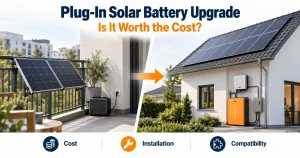
A 240V zero-export solar system is best understood as a coordinated energy-control system, not simply as a larger plug-in solar kit. If you are comparing this architecture with a smaller plug-in setup, review our plug-in solar battery upgrade guide before choosing an expansion path.
Its main value comes from combining 240V microinverter architecture, real-time power measurement, CT sensors, smart metering, DTU communication, and automatic output limiting.
The system can help match solar production with household demand, but it does not automatically provide backup power, eliminate grid requirements, or guarantee a faster payback.
For buyers evaluating this type of system, the most important questions are how accurately it measures household power, how quickly it adjusts output, which equipment it can control, what happens when demand changes suddenly, how much energy may be curtailed, and what is included in the complete installation cost.
FAQ
What is a 240V zero-export solar system?
It is a grid-connected solar system that uses a 240V microinverter architecture and power-flow monitoring to adjust solar output and limit unwanted export to the grid.
What does a CT sensor do in a solar system?
A CT sensor measures current flow so the control system can identify whether the property is importing electricity, using solar power locally, or exporting surplus energy.
Does zero export mean the system can work during a power outage?
No. Zero-export control and backup operation are separate functions. Backup requires a suitable inverter, storage, isolation, and system design.
Can a 240V solar system power the entire house?
It may offset loads across both sides of a split-phase electrical system, but actual household coverage depends on solar output, demand, inverter limits, and whether storage is included.
Can this system be added to existing solar?
It may be possible, but compatibility, measurement location, inverter control, monitoring scope, and local interconnection requirements must be checked first.
Does zero-export solar guarantee a faster payback?
No. ROI depends on complete system cost, electricity use, curtailment, electricity prices, export conditions, and operating assumptions.