 EN
EN
 Deutsch
 Italiano
 Español
 Français
 日本語
日本語

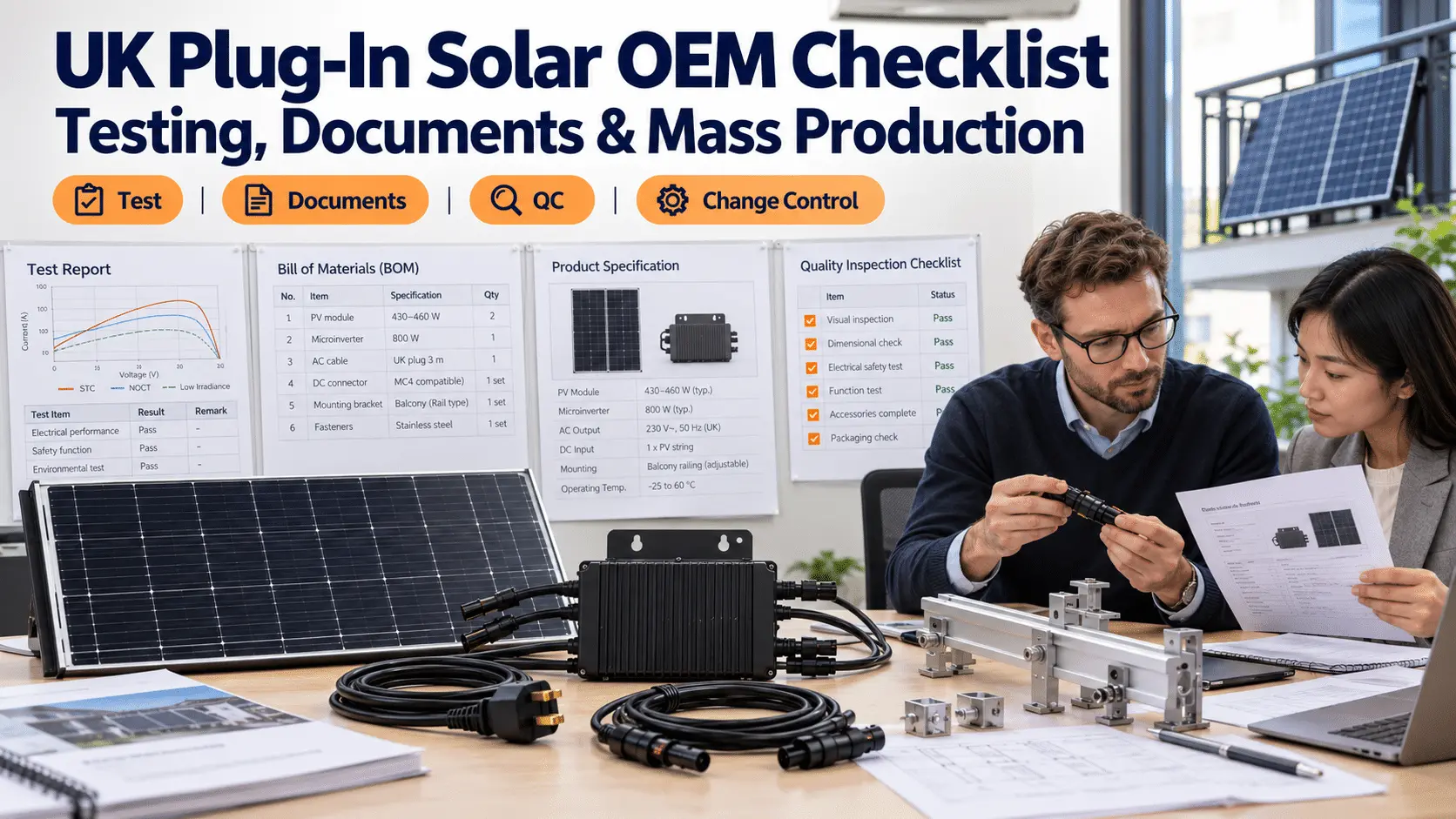
Quick answer: A successful UK plug-in solar OEM project needs more than a compliant panel or a low-cost production quote. Brands and buyers should define the intended market, system configuration, certification scope, testing responsibilities, technical file, labels, change-control process and production acceptance criteria before sampling. The manufacturer can supply product evidence, but the brand owner remains responsible for making sure the marketed kit, instructions and claims match the tested configuration.
What is a UK plug-in solar OEM checklist?
A UK plug-in solar OEM checklist is a project-control document for brands, distributors and manufacturers developing a panel, inverter, mounting set or complete plug-in solar kit for the UK. It connects commercial requirements with engineering evidence and production controls.
The checklist should answer five questions before a purchase order is released:
- What exactly is being sold: a panel, inverter, mounting kit, or complete system?
- Which country and connection route does the product target?
- Which component and system tests apply to the final configuration?
- Who owns each document, claim, label, instruction and approval?
- How will design changes be reviewed after the first sample and during mass production?
For Great Britain and Northern Ireland, do not assume that one approval route covers every market, installation type or electrical configuration. Confirm the destination, applicable rules and evidence scope with the responsible compliance professional.
1. Define the product and the intended use
Start with a controlled product definition. Record the module model, cell technology, electrical ratings, dimensions, materials, connectors, cable length, junction-box or bypass-diode arrangement, inverter model, mounting hardware and any battery or monitoring device included in the kit.
Then describe the intended installation:
- private balcony, garden, wall, roof or another location;
- portable, semi-permanent or fixed installation;
- single-phase connection and intended inverter output;
- indoor, sheltered outdoor or exposed outdoor use;
- consumer, installer, distributor or commercial fleet buyer;
- Great Britain, Northern Ireland, or another export market.
Do not use a broad phrase such as “UK certified solar kit” until the actual product scope, configuration and destination have been checked. A component certificate does not automatically certify the complete kit, the mounting method or the installation site.
2. Build a responsibility matrix before testing
OEM projects slow down when responsibility is assumed rather than written down. Create a responsibility matrix covering the brand owner, OEM factory, inverter supplier, mounting supplier, test laboratory, importer or distributor, installer and grid-connection party.
| Workstream | Questions to assign |
|---|---|
| Product design | Who controls the design drawings, bill of materials and approved variants? |
| Component evidence | Who provides certificates, declarations, reports and traceable model numbers? |
| System testing | Who confirms that panel, inverter, cables and accessories are tested as marketed? |
| Labels and manual | Who approves warnings, ratings, language, installation limits and revision numbers? |
| Connection process | Who verifies the inverter route, installer process and DNO or ENA documentation? |
| Production release | Who signs the golden sample, inspection plan and first-article approval? |
| After-sales | Who handles failures, recalls, field changes and technical questions? |
Use named roles and document owners rather than relying on an informal email chain. The matrix should be approved before the first compliance test.
3. Confirm the certification and testing scope
Ask the laboratory or compliance adviser to define the test scope against the final product configuration. This should identify the applicable standards or requirements, sample configuration, test limits, pass criteria, report owner, certificate holder and allowed production variants.
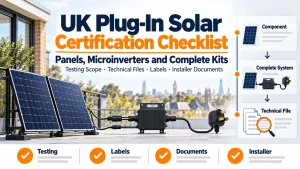
For a plug-in solar package, the evidence may need to address separate layers:
- PV module: construction, electrical safety, environmental durability and the exact model or family covered by the report;
- inverter or microinverter: electrical safety, EMC, protection functions, operating limits and the intended connection route;
- mounting and accessories: mechanical compatibility, load assumptions, materials, corrosion and installation instructions;
- cables and connectors: ratings, mating compatibility, environmental use and strain relief;
- complete system: interfaces, protection, instructions, labels and the configuration actually offered to the customer.
Do not combine separate component reports and describe them as a whole-system approval without evidence that the interfaces and final configuration were assessed. Keep a gap list showing what is confirmed, what requires testing and what depends on the installation site.
4. Control technical files and evidence
Each project should have a controlled technical file. At minimum, request:
- product specification and approved datasheet;
- drawings, dimensions, tolerances and material declarations;
- bill of materials with approved suppliers and revision status;
- electrical diagrams, connector details and protection information;
- test plans, laboratory reports and certificates;
- declarations or conformity documents applicable to the destination;
- installation, commissioning, inspection and maintenance instructions;
- labels, rating plates, warnings and packaging artwork;
- risk assessment, known limitations and misuse warnings;
- factory inspection plan, acceptance criteria and traceability method.
Check that model numbers, ratings, photographs, revision codes and certificate holders are consistent across the file. A report for an earlier prototype, a different connector, a different inverter or a different mounting bracket should not be silently reused.
5. Design labels and manuals for the real user
UK plug-in solar products are often handled by buyers who are not electrical engineers. The manual must state what the product is, what it is not, how it may be installed, which parts are compatible and when a qualified person is required.
Review the following before artwork approval:
- manufacturer, importer or responsible business details where applicable;
- model, serial or batch identification and revision date;
- electrical ratings, polarity, connector type and environmental limits;
- clear warnings for water, heat, damage, overcurrent and isolation;
- mounting limits, prohibited fixings and inspection requirements;
- connection and commissioning steps for the intended inverter;
- instructions for removal, maintenance, faults and end-of-life handling;
- language and formatting suitable for the target market.
Never let marketing language promise “no approval needed,” “safe on every balcony” or “approved everywhere” unless a competent compliance review supports the exact claim.
6. Validate the inverter and system interface
The inverter is not an interchangeable accessory. Verify the exact model, firmware or configuration where relevant, output limit, protection functions, connector arrangement, monitoring method and installation environment.
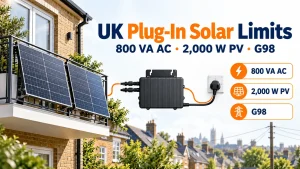
For a grid-connected product, define who checks the connection route and installer process. Our separate G98 guide for UK plug-in solar explains why the inverter and connection documentation need their own review. The OEM checklist should link that process to the exact inverter model sold in the kit.
Do not state that a panel is “G98 certified.” G98 relates to the relevant generation or connection equipment and process, not to a PV module by itself. Keep component evidence and grid-connection evidence clearly separated.
7. Approve samples and the golden configuration
Before mass production, freeze a golden configuration. It should include the approved module, inverter, cables, connectors, mounting parts, labels, manual, packaging and software or firmware version where applicable.
Sample approval should record:
- visual and dimensional inspection;
- electrical output and insulation checks;
- connector and cable verification;
- mounting fit and mechanical interface check;
- label and manual review;
- packaging and transport inspection;
- open issues, corrective actions and approval signatures.
The golden sample is a reference for production and future change review. It is not a substitute for the required laboratory tests or site assessment.
8. Manage engineering changes during production
Mass-production risk often begins after certification. A supplier may change a cell, laminate, glass, adhesive, junction box, connector, cable, inverter firmware, bracket, factory or subcontractor to improve cost or availability. Each change must be screened for technical, safety, certification, documentation and customer impact.
Use a change-control record that states:
- what changed and why;
- which models, batches and markets are affected;
- whether retesting, sample approval or a revised declaration is required;
- whether the datasheet, manual, label, packaging or installation drawing must change;
- how affected inventory and customers will be identified;
- who approved the release and when it became effective.
No material, connector, inverter or mounting substitution should be treated as “equivalent” without evidence and documented approval.
9. Set mass-production quality controls
A purchase order should refer to an inspection and test plan, not only a nominal wattage. Define incoming inspection, in-process checks, end-of-line tests, sampling level, nonconformance handling, rework rules and traceability.
For each shipment, retain the information needed to investigate a field issue: production date, factory line, bill-of-materials revision, component lots, test records, serial range, inspection results and release approval. Agree in advance how defects, repeat failures, serious safety concerns and potential recalls will be escalated.
For brands, the practical goal is not a perfect-looking sample. It is repeatable production that remains aligned with the tested and documented configuration.
10. Define the B2B handover package
A distributor or installer should receive a usable package rather than a folder of disconnected PDFs. A good handover includes the current datasheet, installation manual, wiring diagram, certificate or report index, declaration documents, labels, inspection checklist, warranty process and contact route for technical questions.
Make the evidence status visible:
- Confirmed: current document covers the exact model and configuration.
- Needs verification: evidence exists but model, market or interface needs confirmation.
- Site dependent: structural, fire, building or electrical requirements depend on the installation.
- Not applicable: outside the declared product scope, with a reason recorded.
This status system makes the package easier for procurement teams and AI search systems to understand without overstating what the evidence proves.
UK Plug-In Solar OEM Checklist
- Define the final product, market and installation use.
- Freeze the module, inverter, cables, connectors and mounting configuration.
- Assign responsibility for testing, documents, labels and claims.
- Confirm component and system-level test scope with the responsible laboratory.
- Build a controlled technical file and evidence gap list.
- Approve the golden sample and all customer-facing documents.
- Link the exact inverter to the relevant connection and installer process.
- Require written change control for design, supplier and production changes.
- Set production inspection, traceability and nonconformance rules.
- Deliver a current handover package with evidence status and support contacts.
FAQ
What should a UK plug-in solar OEM project define first?
Define the exact product configuration, intended market, installation use, inverter, mounting method, cable set and customer type before requesting final testing or production pricing. This prevents a report or quotation from being based on an incomplete configuration.
Does a solar panel certificate certify the complete plug-in solar kit?
No. A panel certificate addresses the tested panel or component scope. The inverter, cables, mounting hardware, system interfaces, instructions, labels and connection process may require separate evidence or review.
Who is responsible for compliance in an OEM solar project?
Responsibility depends on the commercial and regulatory arrangement, but it should be assigned in writing. The brand owner controls what is marketed, while the OEM and suppliers provide defined product evidence. The final responsibility matrix should identify the document owner and approver for every claim and deliverable.
What documents should a solar OEM supplier provide before mass production?
Request the current specification, drawings, bill of materials, test reports, declarations, installation instructions, labels, packaging artwork, inspection plan, traceability method and change-control procedure. Confirm that each document matches the final model and approved configuration.
What happens if a connector, glass, junction box or inverter changes after testing?
Open a formal engineering-change review. Check electrical, mechanical, environmental, safety, certification, documentation and customer impacts before release. Do not assume a substitute is acceptable simply because its headline rating is similar.
Can Sungold support private-label or custom UK plug-in solar projects?
A supplier can review the requested module, inverter, mounting and document package against the project brief. The buyer should provide the target market, system configuration, labels, expected volumes, installation use and required evidence so the gap list and testing plan can be assessed before quotation.
Final takeaway
A reliable UK plug-in solar OEM project is managed as a controlled system, not as a panel purchase. Agree the configuration, test scope, documentation, responsibility matrix, golden sample and production change process before mass production. This gives brands and buyers a clearer basis for procurement, installer handover and future technical support.